

No project to be approved until standards maintained, says finance minister
Published :
Updated :
 For all latest news, follow The Financial Express Google News channel.
Return on investment, job creation, and environmental considerations must be met for project approvals, says Finance and Planning Minister Amir Khosru Mahmud Chowdhury.
He said, “If any project does not meet these standards—we will not proceed with it. Simply, we will not do it. Because this is not the government’s money; this is the money of the people of Bangladesh, the taxpayers’ money.”
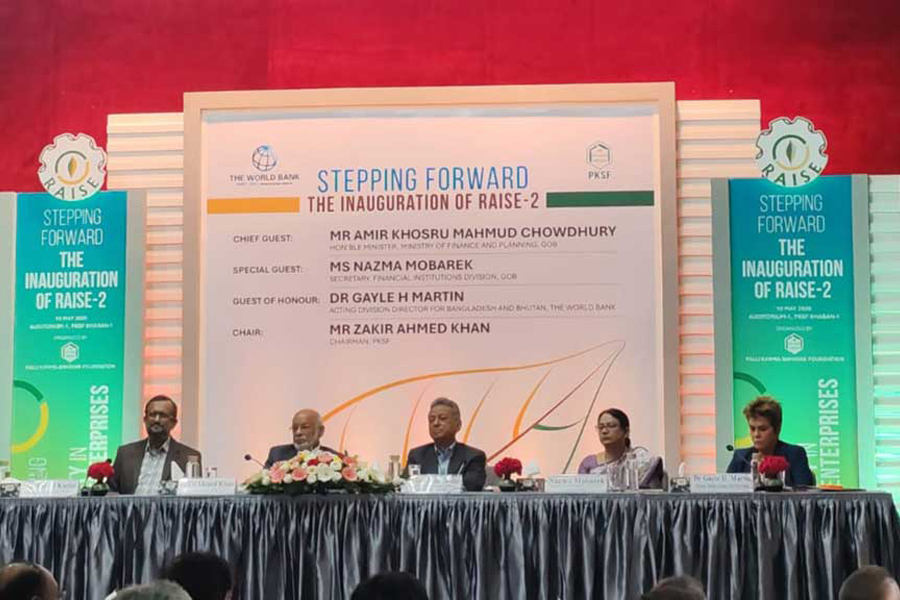
He made these remarks on Sunday while speaking as the chief guest at the inaugural event titled “Stepping Forward: The Inauguration of RAISE II” at the Palli Karma Sahayak Foundation (PKSF) building in Agargaon, Dhaka.
The RAISE project is being implemented with joint financing from the World Bank and PKSF to enhance the capabilities of entrepreneurs in the country’s informal sector and create sustainable employment.
Under the project so far, around 205,000 unemployed youths have received training and loan support. In its expanded phase, another 200,000 youths and small entrepreneurs will receive skills development and financial assistance.
To increase women’s participation in the labour force, 1,600 women will be trained as home-based childcare entrepreneurs under the expanded project.
According to project-related sources, by 2030 a total of 423,100 people will directly benefit from the project. In the second phase, priority will be given to youths from shoal areas, Haor regions, hill tracts, and coastal areas. Special importance will also be given to the inclusion of Dalits, ethnic minorities, and youths with disabilities.
Explaining the government’s position on project selection, Khosru said the government has developed new standards based on past experiences of corruption and waste.
He said projects would be assessed on whether they provide value for money and a return on investment. It would also be considered whether the project creates employment and is environmentally acceptable.
“We must have accountability so that behind every project there is a thought process, a concept, an output, and the public must know its benefits. It is not enough if only I know. Ordinary people must know what the thinking behind each project is.”
The finance minister said there are currently 1,300 projects in the Planning Commission, and many of them lack value for money, return on investment, employment generation, or proper consideration.
He said, “We are dropping many projects. We are selecting only those projects that meet these standards.”
Praising PKSF’s role, he said, “PKSF’s role is very impressive, very impressive.”
Khosru described the democratisation of the economy as part of the government’s political and economic philosophy.
He said democracy should not exist only in politics; people’s participation must also be ensured in the economy.
“That means every citizen of Bangladesh has a right to participate in the country’s economy. They should be able to take part.”
Highlighting three aspects of economic democratisation, he said the government’s goal is to ensure opportunities for every citizen to participate in the economy, to make the benefits of growth reach the people, and to include those who have long remained outside economic planning and programmes.
He said, “It is very difficult in Bangladesh. It is easy to say, but not so easy to do. We will do it, and we will move this programme forward.”
Commenting that ordinary people had remained outside the mainstream economy because of past oligarchic and patronage-based economic systems, the finance minister said poverty is still increasing. Therefore, the government is prioritising social programmes and public welfare.