

Tariff cuts, data-driven subsidies key to boosting agriculture: Study
Published :
Updated :
 For all latest news, follow The Financial Express Google News channel.
Eliminating import tariffs on key agricultural machinery and allocating subsidies based on data-driven mechanisation are vital to increasing agricultural output, according to a study presented at the Annual BIDS Conference on Development (ABCD) 2025.
The study also recommended standardising subsidy rates nationwide to reduce distortions, creating dedicated farm credit lines for machinery purchases, and investing in capacity building for farmers.
Titled "Impacts of mechanised harvesting on farm performance and rural labour in Bangladesh," the paper was presented on Monday at a session on the concluding day of ABCD 2025, held at Parjatan Bhaban in the capital's Agargaon on Monday.
Professor Emeritus Geof Wood of the Department of Social and Policy Sciences, University of Bath, UK, chaired the session, titled "Development Challenges in Bangladesh: Food Systems, Environmental Health, and Social Protection."
Moogdho Mahzab, research fellow at the International Food Policy Research Institute (IFPRI), presented the study, which highlighted the far-reaching impacts of farm mechanisation on the economies of India, China, and Myanmar, particularly in farm performance, employment, and labour allocation.
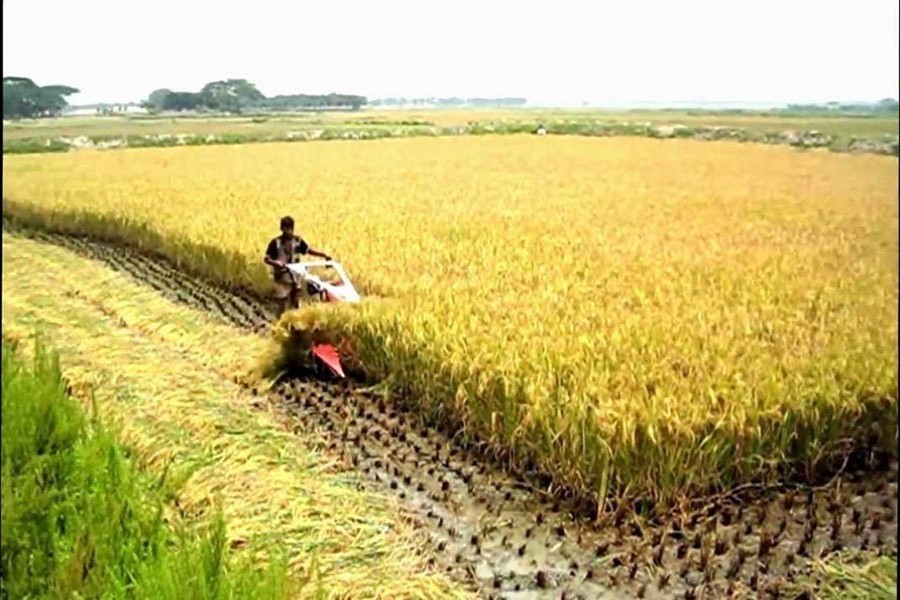
The study noted that mechanisation in harvesting has increased significantly over the years, while mechanisation for plantation remains limited. In 2023, 19.39 per cent of rice farmers used mechanical harvesters, compared to only 0.9 per cent in 2018. Equipment such as combined harvesters is mostly used by farmers in haor and coastal areas.
Two other papers were also presented at the session.
Ben Belton, IFPRI research fellow, presented a study titled "Wholesalers and the transformation of the hidden middle of the aquaculture value chain in Bangladesh."
The research highlighted that the aquaculture sector has created employment for more men and youth, though women remain largely excluded. The paper also pointed to a rapid transformation of the wholesale segment, market expansion across the country, reduced intermediaries, and fairer pricing.
Another IFPRI Research Fellow, Mehrab Bakhtiar, presented a paper titled "Promoting sustained poverty reduction and resilience through social protection in Bangladesh."
The study recommended increasing benefit levels in key social protection programmes to provide meaningful support to poor households.
saif.febd@gmail.com