
Bangladesh must first establish a functional conventional bond market before expanding into sustainable bonds, as raising funds through bonds remains more costly and time-consuming than borrowing from banks, said the chief of the securities regulator.
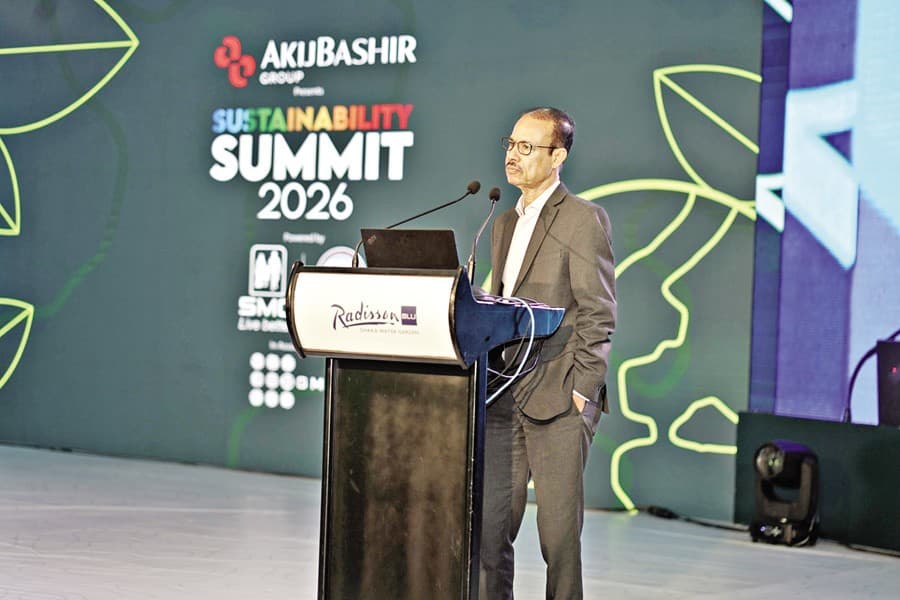
Speaking at the Sustainability Summit 2026 in Dhaka, Bangladesh Securities and Exchange Commission (BSEC) Chairman Masud Khan said the absence of a vibrant bond market had long remained one of the country's key weaknesses in developing its capital market.
"Apart from government securities (G-Secs), no other bonds are traded on the main board of the Dhaka Stock Exchange. That is the current reality," he said.
The day-long summit styled 'AkijBashir Group Sustainability Summit 2026' powered by SMC Enterprise Limited and American International University-Bangladesh (AIUB), in association with PRAN-RFL Group and BGMEA and organised by Bangladesh Brand Forum and Sustainable Brand Initiative under the Bangladesh Innovation Conclave, was held at the Radisson Blu Water Garden Hotel.
The event brought together business leaders, policymakers, academics, development experts and social entrepreneurs to discuss sustainability, responsible business practices and corporate governance.
Delivering a keynote address on "Sustainable finance: Mobilising capital for Bangladesh's green transition," Mr Khan said sustainable bonds would play an important role in financing the country's future development, but Bangladesh must first strengthen the foundation of its traditional bond market.
The BSEC chief said he had identified the problem soon after assuming office.
"If I borrow from a bank, I can secure financing within three months at a fixed cost. But issuing a bond takes around a year and costs more. Naturally, businesses prefer bank loans."
Mr Khan also said the securities regulator would undertake reforms to shorten the bond issuance process and reduce issuance costs so that bond financing became a more attractive alternative to bank borrowing.
Highlighting the importance of corporate governance, he said companies with strong governance standards enjoy greater investor confidence. He also observed that many independent directors in Bangladesh serve only to fulfil regulatory requirements rather than providing effective oversight.
"Many independent directors still do not know how to contribute meaningfully in board meetings. They require more training and greater awareness," Mr Khan said, referring to his experience of serving on the boards of multinational companies.
In his opening remarks, Bangladesh Brand Forum Founder and Managing Director Shariful Islam said sustainability must become an integral part of business strategy rather than remaining an annual discussion.
"As Bangladesh moves towards achieving the Sustainable Development Goals by 2030 and prepares for graduation from the least developed country category, responsible business is no longer optional. It is the foundation of our competitiveness," he said.
The fourth edition of the Sustainability Summit featured three keynote addresses, two panel discussions, three insight sessions, two case study presentations, an expert deep dive and a policy dialogue focusing on responsible business conduct, sustainable finance and environmental, social and governance (ESG) practices.
Among the keynote speakers were Professor Philip Kotler, professor emeritus at the Kellogg School of Management of Northwestern University, who joined virtually to discuss the future of sustainable value creation, and Dr Shraman Jha, chief executive officer of the Hindustan Unilever Foundation, who highlighted sustainability as a key driver of long-term business growth.
The summit also featured prominent speakers from the corporate, academic and development sectors, including M Mashrur Reaz of Policy Exchange Bangladesh, Grameenphone Chief Executive Officer Yasir Azman, LafargeHolcim Bangladesh Chief Executive Officer Mohammad Iqbal Chowdhury, DBL Group Chief Sustainability Officer Mohammed Zahidullah, Dhaka Stock Exchange Managing Director Nuzhat Anwar, BRAC Senior Director K A M Morshed and Professor Mohammad Nurunnabi, UNESCO chair.
Discussions throughout the day explored responsible business practices, ESG reporting, sustainable supply chains, carbon markets, foreign investment and the role of corporate governance in strengthening Bangladesh's competitiveness as it advances towards its Sustainable Development Goals and LDC graduation. The event concluded with the SDG Brand Champion Awards, recognising organisations for measurable environmental, social and economic contributions.
bdsmile@gmail.com