


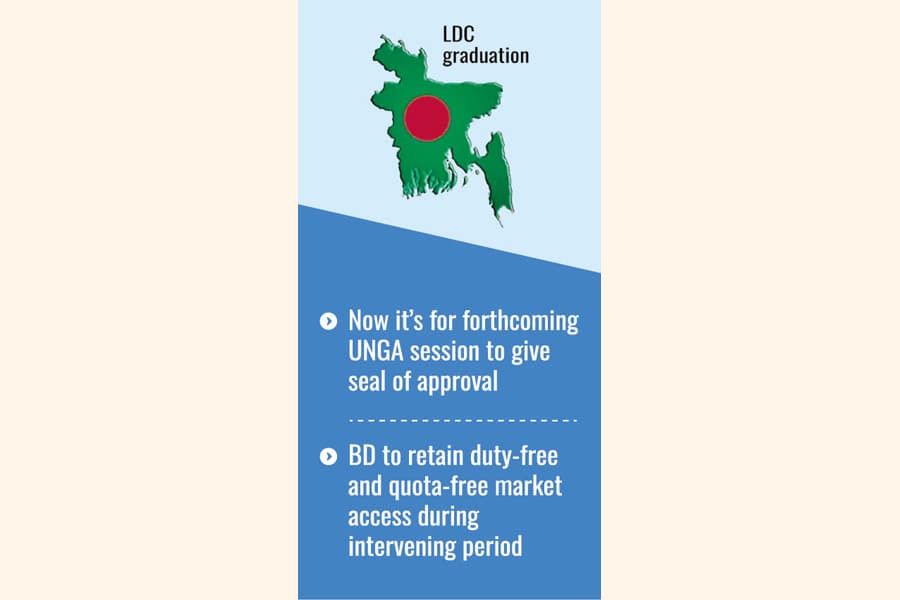
Bangladesh is set to get three-year extension for graduation from the least-developed country (LDC) status as the United Nations Economic and Social Council (ECOSOC) is going to recommend the much-needed breather, officials say.
Nepal is another South Asian nation likely to get the time extension for graduation alongside Bangladesh.
Highly placed sources have said both the countries are going to receive three more years up to November 2029 for the transition as well taking preparation for the graduation to a developing nation.
The recommendation will now be forwarded to the United Nations General Assembly (UNGA) for final ratification during its upcoming high-level session this September, they said.
The decision was made during an ECOSOC session in New York on July 21, a Ministry of Finance (MoF) official said.
Originally scheduled for the status upgrade in November 2026, Bangladesh and Nepal sought the timeline adjustment to cushion their economies against persistent global and domestic headwinds.
"The ECOSOC's recommendation will be finalised in the UNGA. The 192-member UNGA will finalise the extension proposal," said the senior MoF official.
"If any UNGA member demands voting for Bangladesh's LDC graduation-deferment proposal at the next meeting, then the country will need support from the majority member-countries.
"So, we are thinking to sensitize the 192 UN member-countries aimed at getting their support in the September UNGA," he added.
Economists, businessmen and policymakers have widely welcomed the move, noting that the extension offers a vital lifeline for Bangladesh's export-oriented sectors.
The primary benefit of the deferment is the preservation of international-support mechanisms, they said.
Under the extended timeframe, Bangladesh will retain its duty-free and quota-free (DFQF) market access across major global markets, including the European Union, the United Kingdom, and Canada, for an additional three years.
Businessmen say an immediate graduation in 2026 would have triggered a sharp rise in export tariffs, particularly for the ready-made garment (RMG) sector, which accounts for over 80 per cent of the nation's total export earnings.
Exporters warn that sudden tariff hikes could have compromised Bangladesh's competitive edge against global rivals in trade.
While Bangladesh comfortably met all three UN criteria for graduation -- Gross National Income (GNI), Human Assets Index (HAI), and Economic Vulnerability Index (EVI) -- the macroeconomic landscape has shifted drastically since its initial recommendation in 2021.
A severe foreign-exchange crunch, persistent domestic inflation, volatile energy prices, and recent domestic political transitions have strained the national economy.
The three-year window is viewed by international partners not as a pause but as a critical transition period to execute deep fiscal and structural reforms, diversify exports, and stabilise the banking sector.
Following ECOSOC's endorsement, the final procedural hurdle rests with the UNGA in September, where member-states are expected to formally adopt the resolution to secure the November-2029 timeline.
Meanwhile, a high-powered Bangladeshi team sat with the representative of the 54 ECOSOC member-countries as the UN social council takes decision on the deferment of Bangladesh's LDC-graduation date, they said
The Bangladesh team, headed by Commerce Minister Khandaker Abdul Muqtadir, sat with the representatives of the ECOSOC countries at the UN headquarters on July 15-18.
kabirhumayan10@gmail.com