


Advocacy groups on Wednesday in a post-budget reaction applaud Water, Sanitation, and Hygiene (WASH) budget hike in the 2026-27 fiscal proposed budget after years of downtrend.
They, however, remained unhappy with the allocation in different sub-sectors and urban and rural gaps, calling it discrimination. They demanded equity in the allocation for different government agencies in the WASH sector.
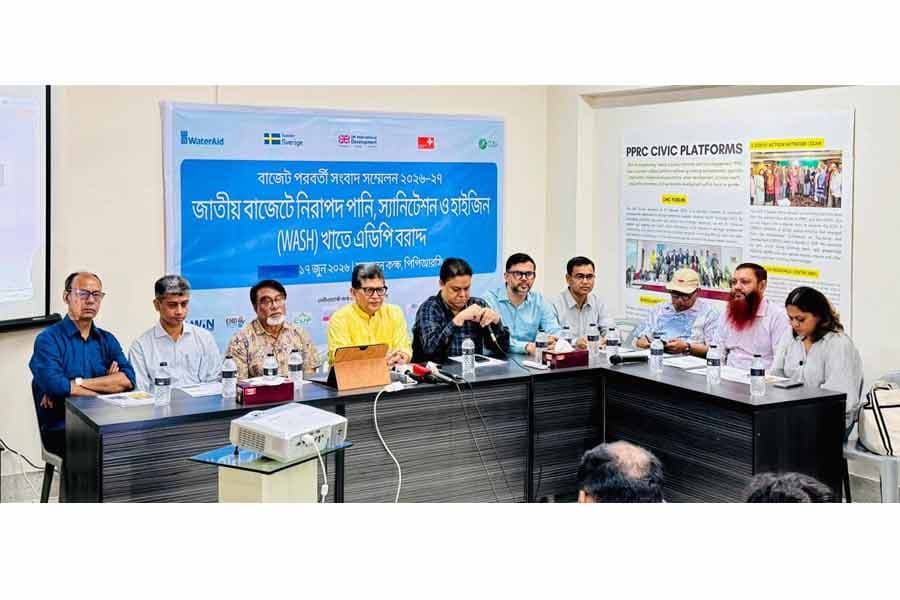
Sectors insiders said those at the post-budget policy brief organized by the Power and Participation Research Centre (PPRC) and WaterAid Bangladesh, in partnership with the Network of WASH Networks, were held in the city.
Hossain Zillur Rahman, Executive Chairman of PPRC, presented the key findings of their reaction.
The policy brief, titled "WASH Sector ADP Allocation FY 2026-27: Haor, Char Left Behind, Budget Misses Equity Targets", examined the proposed Annual Development Programme (ADP) allocations for water, sanitation and hygiene (WASH).
WASH allocation has increased by around 25 per cent to Tk 136.18 billion in FY 2026-27. This is a positive reversal after the sector had declined from its FY2022-23 peak of BDT 182.28 billion.
However, the overall national budget grew by 9.38 per cent and the total ADP grew by 3.16 per cent, whereas the WASH budget grew by a mere 0.13 per cent.
“So the challenge is no longer a lack of policy instruments but the failure to implement them effectively and translate allocations into real services for people,” said Fayazuddin Ahmad, Head of Policy Advocacy, WaterAid Bangladesh.
The disparity remained the big challenge as urban areas continue to receive nearly 72 per cent of the total WASH ADP allocation, despite large service gaps in rural and hard-to-reach areas, according to their analysis.
Dhaka WASA alone has received Tk 50.10 billion or around 36.78 percent of the total WASH ADP allocation.
The analysis of the groups also said that 45 per cent of the population still lacks access to safe water and safely managed sanitation. Around 41.8 per cent of Bangladesh’s population still lacks access to safe drinking water and 60.7 per cent lacks safely managed sanitation (BBS-UNICEF MICS 2025).
Hard-to-reach areas saw mixed progress with the Chittagong Hill Tracts Regional Council receiving higher allocation in comparison to coastal, char and hoar areas.
Furthermore, hygiene remained insufficiently visible as a distinct WASH sub-sector.
“Allocation is one thing, but proper use of allocation is another. Without monitoring, data and a dedicated WASH budget code, accountability remains weak. We must also bring performance failure into focus, particularly in overdue big WASH projects and in operations and maintenance,” the PPRC Executive Chairman said.
Representatives from Faecal Sludge Management Network, Bangladesh Water Works Association, Coalition for the Urban Poor, Bangladesh Water Integrity Network, Freshwater Action Network South Asia, End Water Poverty, and International Water Association also spoke.