


Restoring even partial operation of the accident-damaged floating storage and regasification unit (FSRU) will take some more days while households, industries and refueling stations across Bangladesh continue to suffer from gas crunch, reports say.


Foreign experts from the UK and Singapore have started work on the Unit at Moheshkhali and government officials expect its partial run within one week.
If one boiler -- out of total two in the FSRU -- resumes operation, some 300 million cubic feet per day (mmcfd) of regasified liquefied natural gas (LNG) could be supplied from the damaged FSRU, owned by US's Excelerate Energy, a senior official of state-run Petrobangla told The Financial Express on Sunday.
He said full-scale operation of the FSRU might resume in the next couple of weeks.
Country's overall natural gas supply fell to around 2,151mmcfd on Saturday from the pre-accident 2,640mmcfd following the closure of the FSRU after the accident on Tuesday.
Gas-fired power plants are the worst hit as electricity generation of around 2,000 megawatts is being affected due to the FSRU's operation disruption.
The gas-fired power plants are currently getting around 700mmcfd gas against the aggregated demand for 2,524mmcfd gas.
Foreign experts have assessed primarily the extent of the accident and damage to the FSRU and informed the Energy and Mineral Resources Division (EMRD) under the Ministry of Power, Energy and Mineral Resources (MPEMR) the updates on Sunday, said the Petrobangla official.
He said, "US's Excelerate Energy brought in foreign experts to repair the damaged FSRU in a couple of days of Tuesday's accident, which originated from electric short-circuit that resulted in fire incident."
The shutdown has already cut gas supply to the national grid significantly, reducing gas pressure in many areas, disrupting industrial production, squeezing generation in gas-fired power plants.
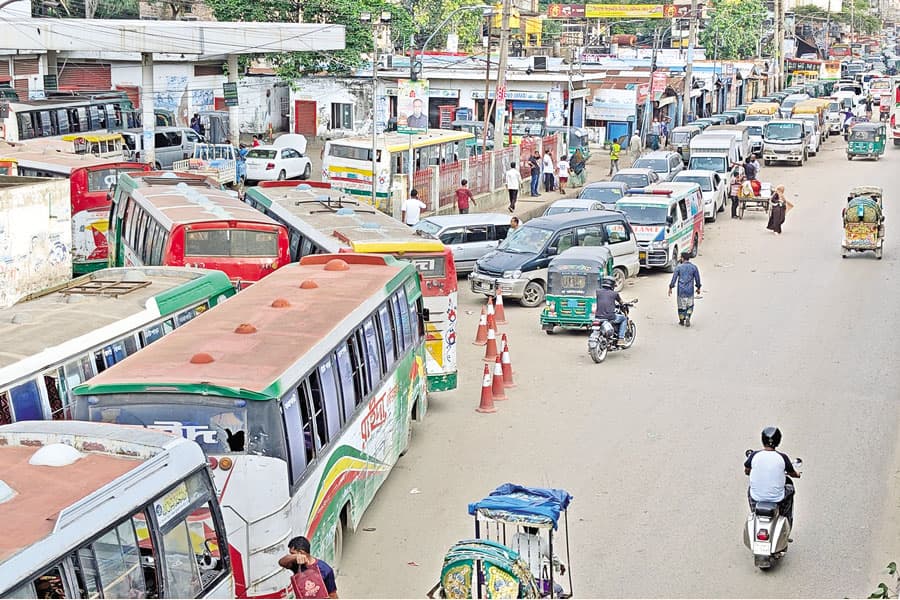
Long queues of vehicles in front of CNG (compressed natural gas) filling stations across the country are a regular scene as a consequence.
Consumers have said the disruption intensified gas shortages in Dhaka and other parts of Bangladesh, where many households have been left with little or no gas for cooking for much of the day.
In some areas, supplies have stopped altogether, while factories in key industrial zones have reportedly been forced to scale down production because of low gas pressure.
Meanwhile, a spot account of the fallouts from the sudden FSRU debacle said Dhaka city-dwellers continued to suffer as the gas supply to refuelling stations and households was yet to return to normal.
Long queues of CNG-run vehicles before filling stations continued across the capital, while many households resorted to alternative cooking methods as gas burners remained dry.
Visits to several CNG stations in the capital city revealed that drivers had to wait in long queues-mostly over kilometre-long requiring hours-to refill their vehicles' gas cylinders.
A CNG-run auto rickshaw driver, Saiful Islam, had waited more than two hours to refill his vehicle from Canada-Bangla CNG Filling Station in the city's Kawran Bazar area on Sunday afternoon.
Talking to the FE he said the situation was almost same at every refuelling station. He tried several other stations across the city before coming there.
"We are not only wasting our time but also losing income," he said, expressing frustration over the matter that authorities concerned were looking for ways to hike gas tariffs.
Like him, several drivers said they often waited three to four hours but could purchase only Tk 200 to Tk 300 worth of gas, which was insufficient for regular operations.
Station officials said gas pressure improved only between midnight and the early hours, forcing many drivers to queue overnight.
As a result, the number of CNG-run vehicles on the roads declined, leading to higher transport costs and inconvenience for commuters.
The situation in residential areas also remained no different.
Rokhsana Lina, a resident of West Tejturi Bazar, one of the affected areas, describes the impact on her household.
With limited gas supply to domestic gas burners for the last several days, her family had been relying on alternative appliances like electric oven and rice cookers.
Azizjst@yahoo.com & saif.febd@gmail.com