



Changes to the VAT-payment schedule could put immense pressure on field officials to achieve the government's ambitious VAT-collection target of Tk 2.23 trillion in the current fiscal year, according to tax officials.
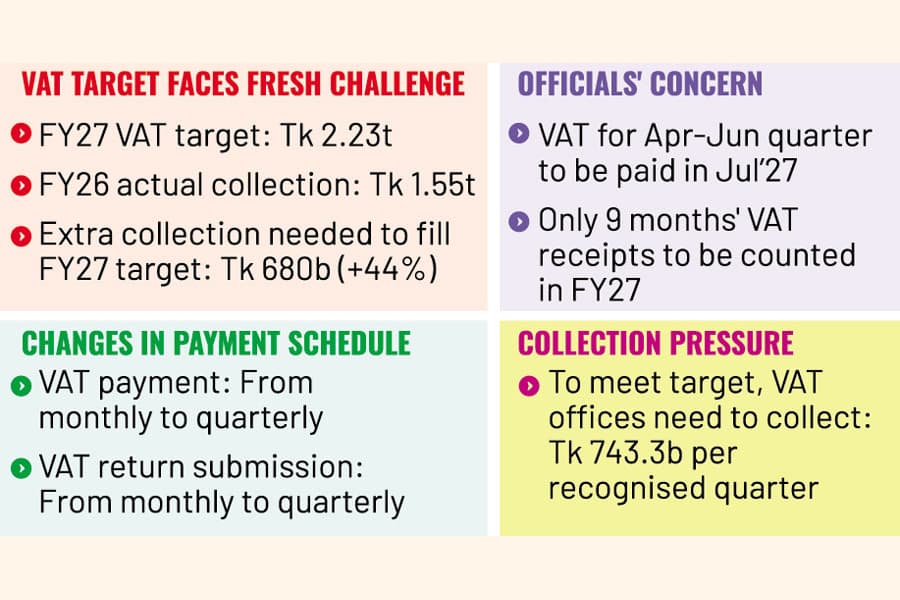
Field-level VAT officials say they would effectively have only nine months of revenue reflected in this fiscal year's collection as VAT for the final quarter would be deposited in July - the first month of the following fiscal year - under the revised payment schedule.
In the Finance Bill 2027, the government has made VAT payment and VAT return submission simpler by extending payment and submission schedules to three months from every month.
It was the long-awaited demand from businesses who found the monthly compliance requirements time-consuming.
Officials say VAT zones would have to mobilise exceptionally high revenue every quarter -- and every month -- to meet the target, making the goal extremely difficult unless the government amends the provision or makes special arrangements for the current fiscal year.
The original VAT collection target for FY26 was Tk 1.86 trillion, but actual collection reached Tk 1.55 trillion.
To achieve the FY27 target of Tk 2.23 trillion, the VAT wing will have to raise collections by approximately 44 per cent over last year's actual receipts.
This means an additional Tk 680 billion must be mobilised during the current fiscal year.
VAT contributes around 37 per cent of the total domestic revenue mobilisation.
Field officials say because the revised payment schedule would effectively leave only three revenue-generating quarters within the fiscal year, the burden would be even heavier.
They estimate VAT offices would need to mobilise around Tk 743.3 billion in each of the three recognised quarters to remain on track.
Unless there is a significant expansion of economic activity, stronger VAT compliance, resolution of pending litigation, improved enforcement, and substantial gains from digitalisation, and anti-evasion measures, achieving the target will be extremely challenging, officials say.
The new target is also substantially higher than last year's original target of Tk 1.86 trillion, underscoring the government's increasing reliance on VAT to meet its overall revenue objectives.
"The last quarter is traditionally the strongest period for VAT collection, with revenue often nearly doubling compared to that of the other quarters," a senior field-level VAT official says.
"If those receipts are shifted to the next fiscal year because of the revised payment schedule, the revenue shortfall this year could be significant."
Officials note that the FY27 VAT target is around 44 per cent higher than last year's actual collection, placing unprecedented pressure on field offices.
They warn that unless the government introduces a special transition arrangement for the current fiscal year, VAT collection is likely to fall well short of the target.
However, they believe the problem would largely disappear from the following fiscal year once the new payment cycle becomes fully operational.
Former VAT officials, however, downplay the concern, arguing that the impact may not be as severe because a substantial portion of VAT is collected at source.
A former VAT member says VAT deducted at source would continue to provide a steady stream of revenue despite the change in payment timing.
Current field officials disagree with this, saying only about 30 per cent of VAT is collected at source -- primarily through government entities -- while the remaining 70 per cent depends on regular payments by businesses.
The government has set a VAT collection target of Tk 2.23 trillion for FY27, up from the actual collection of Tk 1.55 trillion in the previous fiscal year.
In parliament, Finance Minister Amir Khosru Mahmud Chowdhury said on Monday the government collected Tk 4.10 trillion in total revenue during FY26 against a target of Tk 5.03 trillion, achieving 81.6 per cent of its overall revenue goal.
According to the minister, income tax collection stood at Tk 1.42 trillion against a target of Tk 1.86 trillion, representing an achievement rate of 76.7 per cent.
VAT collection reached Tk 1.55 trillion against a target of Tk 1.86 trillion, achieving 83.7 per cent of the target.
Meanwhile, customs revenue amounted to Tk 1.11 trillion against a target of Tk 1.30 trillion, meeting 85.3 per cent of its target.
Former VAT member Farid Uddin says the changes in VAT payment schedule would not be a problem; it would rather help businesses reduce time and cut the cost of doing business. Some 95 per cent of domestic VAT comes from tobacco, mobile, and pharmaceuticals companies and VAT deducted at source, he says.
The rest of the businesses pay a negligible amount of VAT that would not affect the collection much, he adds.
doulotakter11@gmail.com