


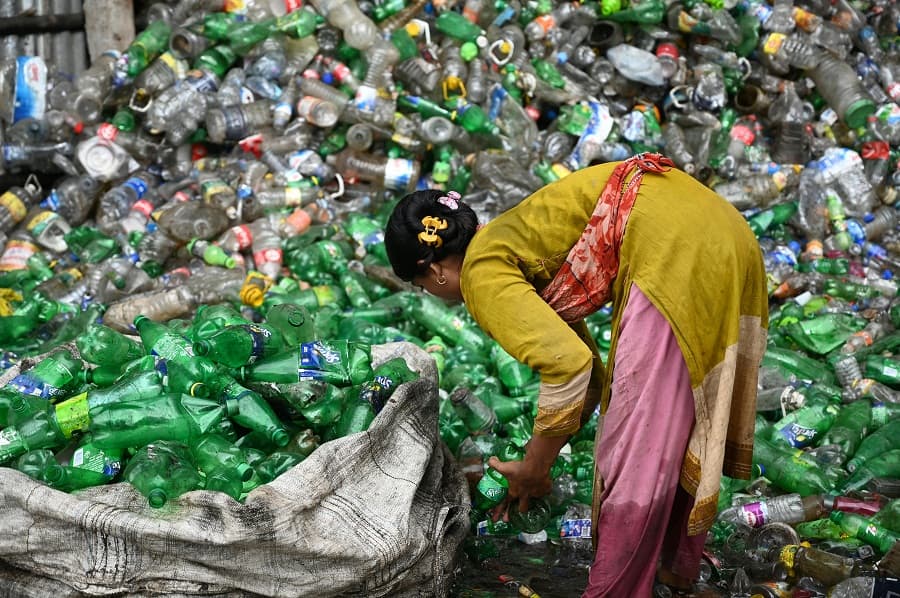


Tomorrow is International Environmental Day. The banners will call for green living. The speeches will praise small innovations. But in the low-lying lanes of Dhaka, a more uncomfortable question floats up with the monsoon water. Why does the country that did the least to create the plastic and climate crisis keep being asked to borrow money to clean it up?


Take a single image. A woman in a crowded neighbourhood ties a plastic shopping bag around her bicycle basket, hoping to keep her vegetables dry—the bag tears within an hour. Tiny shreds of polyethene wash into a roadside drain. They join a hundred others. They clog the flow. Grey water spills into nearby homes. That scene (rain, torn plastic, blocked drains, wet floors) repeats across the capital every wet season. It is ordinary. And it is extraordinarily costly.
Bangladesh produces about 87,000 tonnes of single-use plastic every year. Around 96 per cent of that is dumped instead of recycled, according to industry estimates.
That is not just ugly. It is a lost economic chance. Multinational brands sell cheap single-use packaging and book profits. Local waste workers pick through toxic piles for a pittance. Municipalities spend crores clearing choked waterways.
Households pay more when waterborne diseases spike from plastic-clogged drainage. Add it all up—lost material value.
Public health expenses, environmental damage. The figure runs into billions of takas that could have stayed inside the country if the system had been designed fairly.
Now overlay the climate debt. Bangladesh's share of historic global greenhouse gas emissions is under 0.5 per cent. Yet the bill we face for rising seas, stronger cyclones, and erratic monsoons is enormous. Researchers now put Bangladesh's per-person climate debt at roughly $79.6.
That is the unpaid cost of damage inflicted by others. Worse, the international money we receive to adapt and recover mostly comes in the form of loans.
For every one dollar in grants, Bangladesh takes on $2.70 in loans. That shifts the burden onto our own people. Many families report spending an average of Tk 10,700 extra each year on climate-related health expenses, home repairs, and lost income. That kind of recurring expense pushes people into debt and out of school fees into deeper insecurity.
Consider how these two crises collide in everyday life. The same monsoon rain that floods a low-lying lane also washes loose plastic into rivers and farmland. The same international trade system that lets rich countries export plastic waste also lets them offload carbon emissions. The same financial architecture that lends us money at high interest for climate adaptation also fails to tax the companies that make single-use packaging.
None of this is a coincidence. It is a design that protects profits in London and Tokyo while shifting costs to Dhaka and Khulna.
The same unfair rule links the plastics problem and the climate problem. Others make the mess, and we pay to clean it up with interest. Big companies in rich countries produce most of the world's single-use plastics and most of its emissions. They do not pay for the full cost of what they make. The result is that cleaning drains, treating diarrhoea, and rebuilding flood-damaged roads becomes a local jobs paid for from local pockets. That is not sound economics. That is injustice dressed up in spreadsheets.
Good local answers are trying to grow. Plastile turns shredded plastic waste into durable construction blocks—Biotech Energy experiments with converting used cooking oil and plastic into fuel.
Community-led recycling networks in several cities provide informal workers with a stable income and help keep some plastic out of rivers. These projects prove that change is possible without waiting for global permission.
But they cannot scale without better money and better policy. Small teams cannot replace national waste systems, and they certainly cannot absorb the cost of climate loans and mounting public health bills.
So what would a fairer World Environment Day look like? Three things. First, cancel or convert a substantial portion of Bangladesh's climate debt into grants tied directly to rebuilding and resilience—no more borrowing to survive.
Second mandate: extended producer responsibility. Every company that sells plastic packaging in Bangladesh must pay for its collection, recycling, and safe disposal.
If climate justice and circular economies mean anything, then tomorrow should not be a day of symbolic tree-planting alone. It should be the day we stop asking why the least responsible nations are still expected to borrow money to fix a crisis they did not create. The plastic bag in that Dhaka lane is small. The question it carries is not. On this International Environmental Day, let us measure progress not by speeches but by who finally pays the bill.
The authour can be found at rupok.du.ds@gmail.com