


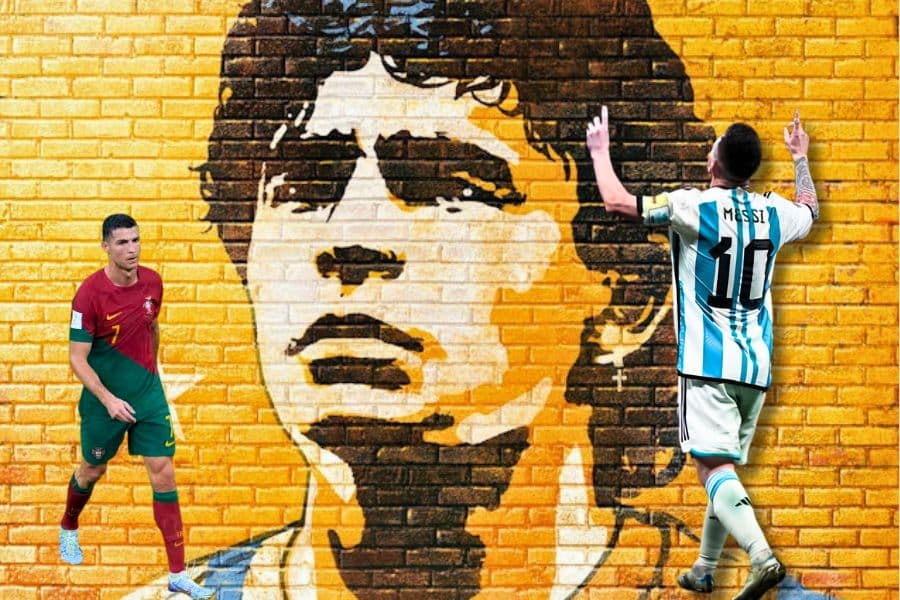
For a generation of football fans, the debate was simple. It was a binary choice. It was a decade-long war between Lionel Messi and Cristiano Ronaldo. We counted their goals like accountants. We mapped their Ballon d'Or trophies on charts. It was a neat, clinical rivalry made for social media. But it was always a distraction.
The real struggle for Lionel Messi was never with the Portuguese machine. His true rivalry was always with a ghost. It was a battle with the memory of Diego Armando Maradona. Maradona did not just play football. He lived it as a secular religion.
The 'rivalry'
The rivalry with Cristiano Ronaldo was born in the boardroom. It was fostered in the stadiums of Spain. Television rights and sportswear brands fueled it. It was a rivalry of statistics. It was about who could score more hat-tricks against mid-table La Liga sides.
To compare Messi to Ronaldo is to compare two elite sports cars. To compare Messi to Maradona is to argue about the meaning of Argentina itself. Ronaldo represents peak athletic engineering. Maradona represents a beautiful, chaotic, political storm.
Maradona was not just a player for Argentina. He was a cultural mirror. He was the dirt under the fingernails of the street child in Buenos Aires. He was the defiance of a nation still bleeding from the wounds of the Falklands War. He showed this when he faced England in 1986.
Messi left Rosario as a fragile boy with a growth hormone deficiency. Because of this, he spent much of his international career under a cloud of domestic suspicion. He did not sing the national anthem with enough fury. He won Champions Leagues in Barcelona, but Buenos Aires wondered if he was truly one of them.
The difference between the two men lies in their relationship with chaos. Maradona was a creature who thrived in the mud. He did not merely beat defenders. He humiliated them. He used his low centre of gravity to ride tackles that would be classified as assault in the modern era.
Maradona's life was an operatic tragedy played out in real-time. He was the rebel who fought FIFA, the champion of people with low incomes in Naples, and the flawed genius who succumbed to his own excesses.
He was larger than life because his failures were as spectacular as his triumphs. His illegal goal was considered the 'hand of god' where Leo scored from a fair penalty. Diego lived as a poet, a rebel, and a sinner. Leo lived as a professional footballer, an ultimate 'goodboy'.
Messi's genius is different. It is quiet, clinical, and scientific. He does not run. He walks, searching the pitch for pockets of space like a grandmaster studying a chessboard. He makes the extraordinary look routine.
For years, this efficiency worked against him. The Argentine public respected his genius, but they loved Maradona's struggle. You could not imagine Messi leading a revolution. You could only imagine him scoring a hat-trick and quietly going home to his family.
Everything changed under the desert sky of Qatar in 2022. By lifting the World Cup, Messi finally stepped out of the shadow of 1986. Yet, as he leads Argentina through the high-stakes pressure of the 2026 World Cup in North America, the comparison remains alive.
At 39, Messi is still the fulcrum of his nation's dreams. He still has the explosive pace of his youth. Still, he has something more dangerous: the absolute authority of a king.
If Messi can guide this Argentina team to a consecutive World Cup title in 2026, he will do what even Maradona could not. He will have conquered the tournament twice, scored more goals in the tournament than Maradona did, and established a period of international dominance that transcends eras.
The debate with Cristiano Ronaldo is long dead, buried under the weight of Messi's trophies. The final question is no longer about numbers. It is about whether the 'good boy' from Rosario has finally done enough to let the ghost of Diego Maradona rest in peace.