


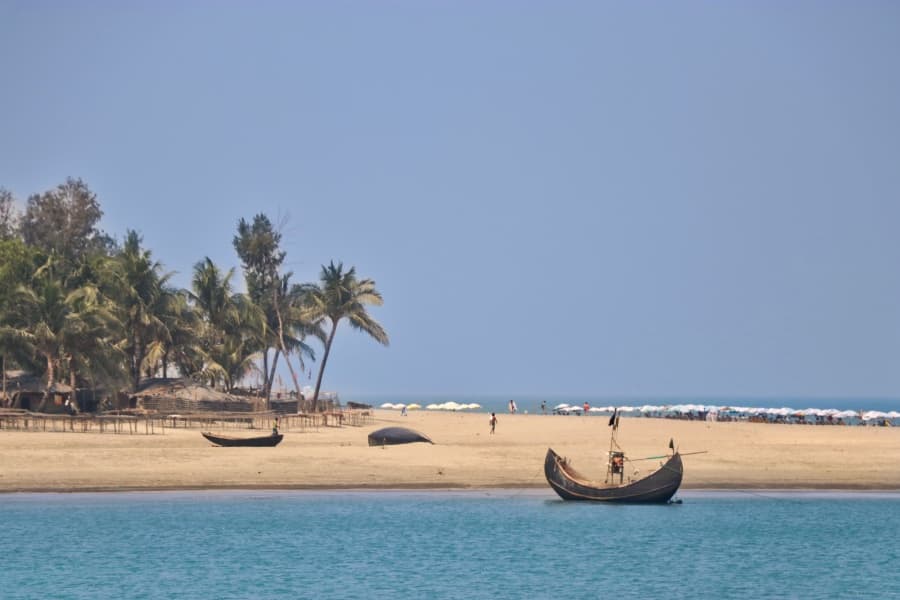
Just two years ago, several vessels sailed daily from Teknaf to Bangladesh’s only coral island, Saint Martin’s. The route was cheaper and faster, saving tourists both time and money.


However, the outbreak of armed conflict in Myanmar’s Rakhine State made that sea route unsafe. Since then, authorities have suspended all tourist vessels between Teknaf and Saint Martin’s.
The ships now depart from Cox’s Bazar, their movement dependent on tides. Setting off around 9am, they take six to seven hours to reach the island, arriving by late afternoon.
But under a new government directive, visitors in November must return the same day. Even if the ships depart Saint Martin’s by 5pm, they will not reach Cox’s Bazar before midnight.
That means a tourist will be able to spend, at most, two hours on the island.
Abdur Rahim Jihadi, president of the Saint Martin's Hossain Zuhura Foundation, questions the practicality of the plan.
“The jetty is broken,” he said. “Just getting off the ship and setting foot on the island takes about an hour. That leaves only one hour to look around.
“Now tell me who would spend 14 to 15 hours at sea for just one hour on the island? People go on holiday in November and December, but the government has banned overnight stays then.”
According to Rahim, overnight visits will only be allowed in December and January. “But February will bring the general election and Ramadan,” he said. “Given the political uncertainty, it’s doubtful that many tourists will come. We’re not expecting a good season.”
“How will the islanders survive 11 months on the income of just one?” he asked. “The maths doesn’t work.”
When asked about the upcoming tourism season, Teknaf Upazila administrator (UNO) Sheikh Ahsan Uddin could offer no optimism.
“I haven’t received any official communication yet about tourism on Saint Martin’s,” he said. “I’ve only heard about it through the media. Once I receive the letter, I’ll know more.”
GOVERNMENT’S NEW DIRECTIVES
On Wednesday, the government issued a gazette notification containing 12 new instructions for regulating tourism on the island.
The measures were based on the Environmentally Sustainable Tourism Guidelines for Saint Martin’s Island 2023, enacted under the Bangladesh Environment Conservation Act, 1995.
Key provisions include:
Tourists may visit the island only during the day in November, overnight stays are prohibited.
Overnight stays will be allowed in December and January, but the island will be closed to all tourists in February.
No more than 2,000 tourists per day will be allowed.
The BIWTA cannot authorise any vessel to operate without prior clearance from the Ministry of Environment.
Tickets must be purchased online through a Tourism Board-approved portal; each ticket will include a travel pass and QR code. Tickets without QR codes will be considered invalid.
To preserve the island’s ecosystem, beach lighting, loud music, and barbecues at night are banned.
Visitors are prohibited from entering or damaging Kewra forests, collecting fruits, or harming turtles, crabs, corals, birds, or any other wildlife.
Motorised vehicles, including motorbikes and sea-bikes, are banned on the beach.
Carrying polythene is prohibited, and single-use plastics, such as chips packets, spoons, straws, mini soap or shampoo sachets, and small plastic bottles, are discouraged.
Tourists are encouraged to carry reusable water flasks.
‘200 FAMILIES FORCED TO LEAVE’
Since the interim government took office, the environment ministry has imposed strict regulations on the island, pushing residents into what they call their “worst crisis in decades”.
Of the island’s roughly 10,000 residents, about 70 percent depend directly on tourism. The remaining 1,600 families are fishers whose livelihood also depends on the sea. Both groups are now struggling to survive.
Last season’s restrictions had already reduced tourist numbers drastically, causing severe losses for hotel owners and small traders.
“After the interim government took over, confusion began,” said Syed Alam, a member of Saint Martin’s Union Parishad. “Last year, the sudden travel ban by the environment ministry left islanders jobless. At least 200 families have been forced to migrate to Teknaf and Cox’s Bazar for work.”
Many now drive rickshaws or work as day labourers.
Hamid Hossain, who once ran a small business on the island, now drives an autorickshaw in Teknaf. “Life became unbearable,” he said. “We had to flee to survive. Many families like mine have left Saint Martin’s behind.”
Hotelier Hafez Abul Hossain added, “Some people are selling their wives’ jewellery to feed their families. Others have gone elsewhere in search of work. There’s no alternative employment here.”
Acting Union Parishad Chairman Fayezul Islam warned that famine-like conditions could emerge if the restrictions continue. “The government keeps promising projects and alternative jobs for islanders, but nothing has been implemented,” he said.
EMPTY RESORTS
Normally, resort owners start preparing in October, repainting and refurbishing hotels ahead of the November season. This year, there is none of that bustle.
“Every year around this time we’re busy repainting, repairing, and preparing,” said Abdur Rahman, president of the Saint Martin Resort Owners’ Cooperative. “Now the mood is gloomy. Uncertainty hangs over everyone.”
He urged the government to allow overnight stays for at least the first three months of the season. “We’re still hoping the decision will be reviewed,” he said. “If not, both the tourism business and local livelihoods will face another dismal season.”
PLAN TO SELL RESORTS
Hafez Abul Hossain, also the Khatib of the island’s central mosque, built a small resort named Dwip Kutir in 2017 on 20 decimals of land. Income from it helped him support his family of seven.
“Since the tourist limit was imposed last year, I’ve been struggling,” he said. “Prices have soared, and there’s no source of income left. I’ve decided to sell the resort.”
Fishing, the other mainstay of island life, is also in crisis. Violence in Myanmar’s Rakhine State and abductions by the Arakan Army have driven fear among fishers, many of whom now avoid deep-sea trips.
“Those who venture out are being captured with their trawlers,” said Mohammad Azim, president of the Saint Martin's Fishing Trawler Owners’ Association. “Some have returned, others remain hostage. Ninety-five percent of the island’s people depend on fishing and tourism and now both are paralysed.”
JETTY WORK DRAGS ON
Renovation of the island’s only passenger jetty, the lifeline for tourists, remains incomplete. Without it, tourist vessels cannot dock, raising fears that this might even be deliberate.
Former Union Parishad member Habibur Rahman said, “The work started long ago but is slow and careless. If it’s not finished before the season, there’s no point later.”
Ali Haidar, representing contractor SS Rahman International Ltd, said: “The new jetty has a Tk 70 million allocation. Most of the 70 support pillars are done, and we’re working on railings and stairs. Despite weather delays, we aim to finish before the season.”
ISLANDERS CALL FOR EMBANKMENTS
Rising tides, fuelled by climate change, are now flooding Saint Martin’s during storms and monsoons, something unseen in the past. Residents are demanding a protective embankment around the island.
“Water never entered the island before,” said Nur Mohammad, a resident. “Now our homes and fields go under during high tides. We need an embankment to survive.”
However, Mohammad Mizanur Rahman, sub-assistant engineer of the Water Development Board in Cox’s Bazar, said: ““The government has declared 590 hectares of St Martin’s Island an ecologically critical area to protect biodiversity. There are many environmental constraints on St Martin’s.
"If any government agency suffers damage and requests it, work may be carried out. However, there is no plan to build an embankment.”