


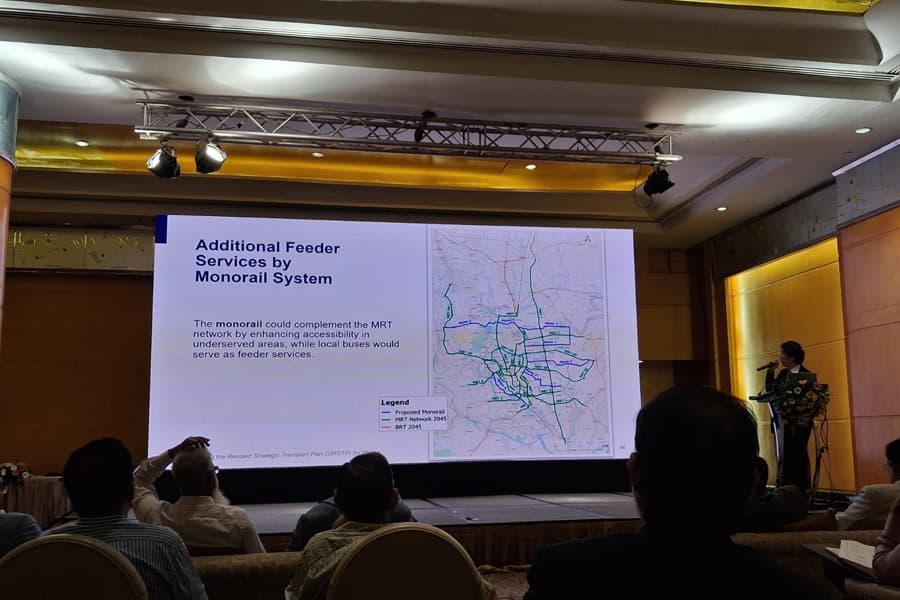
The city's new transport plan has proposed a massive investment programme over the next 20 years, including two new metro rail lines and five monorail routes to serve as feeder services.
Incorporating commitments outlined in the government's election manifesto, the 20-year transport policy, titled 'Updated Revised Strategic Transport Plan (URSTP)', also recommends the construction of nine tunnels and the implementation of Transit-Oriented Development (TOD) schemes in nine areas of the city.
The proposals for tunnels, expressways and TOD aim to establish road connectivity between the eastern and western parts of the capital, which have long been separated by restricted zones, including Dhaka Cantonment and the old and new airport areas.
The proposals were presented at a seminar on the dissemination of the Updated Revised Strategic Transport Plan (URSTP) for Dhaka, held at a city hotel on Tuesday.
The seminar highlighted possible transport solutions for the capital, where road density stands at only 0.8 per cent. The study found that around 25 per cent of roads experience average vehicle speeds of less than 10 kilometres per hour, while the citywide average speed has fallen to about 8 km per hour. The economic loss resulting from transport inefficiencies and reduced travel speeds is estimated at US$2.43 billion.
URSTP Project Director Mohammad Rabiul Alam and Team Leader Tomokazu Wachi presented the key findings and recommendations of the updated plan.
The seminar was organised by the Dhaka Transport Coordination Authority (DTCA) and chaired by its Executive Director, Mohammad Moshiur Rahman.
DTCA launched the URSTP project in 2022 to conduct a mid-term review and update of the Revised Strategic Transport Plan for the next two decades.
The final report was prepared based on 11 primary transport studies, secondary data collected from 27 agencies under 11 ministries, and extensive consultations with stakeholders.
The consultants proposed two new metro rail lines—MRT Line-3 and MRT Line-8—in addition to the six MRT lines included in the RSTP.
The updated plan also recommends extending several metro rail lines that are currently under implementation.
The study suggested developing bicycle lanes through footpath widening and constructing skywalks. It also recommended widening selected roads to six lanes to facilitate dedicated bus services.
The team leader presented findings showing substantial economic losses caused by traffic congestion, including losses arising from reduced transport efficiency and declining travel speeds. The study also highlighted a significant decline in the modal share of public transport between the Strategic Transport Plan (STP) of 2009, the Revised Strategic Transport Plan (RSTP) of 2014, and the URSTP assessment conducted in 2023.
The updated plan further recommends measures such as congestion pricing and other sustainable mobility initiatives to reduce traffic congestion and improve commuting conditions in the capital.
smunima@yahoo.com