


More than one-fifth of the bearing pads on Dhaka's MRT Line-6 have been found defective, forcing speed restrictions and raising wider concerns over the structural integrity of Bangladesh's first metro-rail system.Geographic
Trains have been slowed to as little as 40km/h at several locations, just 30 months after the country's first metro line began operations.
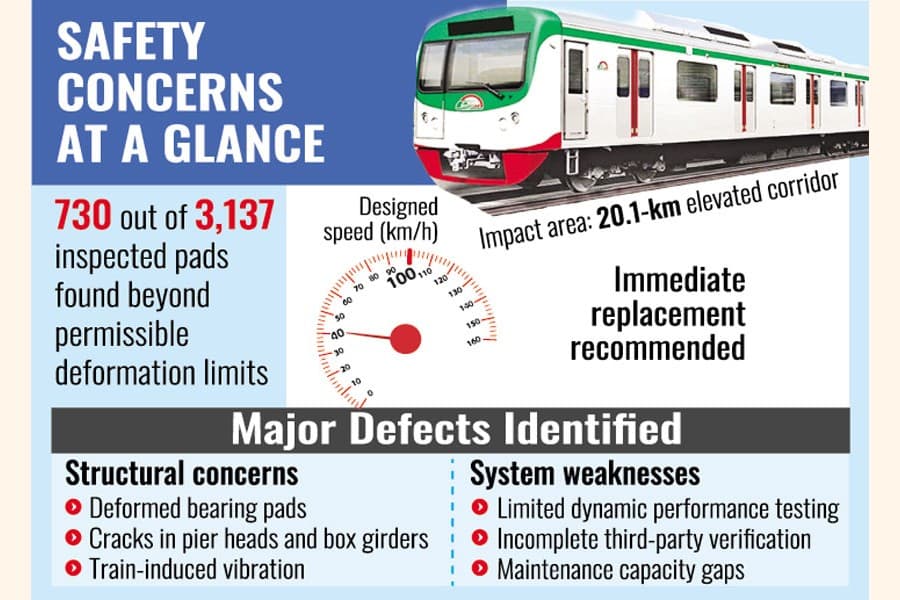
The Dhaka Mass Transit Company Limited (DMTCL) has reduced train speeds at several points along the 20.1-kilometre elevated corridor from the designed operating speed of more than 100 km/h after an expert inspection detected serious defects in bearing pads, pier heads, box girders and station structures.
According to the technical expert committee, 730 bearing pads, or 23.28 per cent of those inspected, were found to have deformed beyond permissible limits and require immediate replacement.
The committee said settlement associated with the defective pads was likely contributing to poor ride quality and the temporary speed restrictions.
The defects have already affected daily operations, with commuters frequently complaining of jerking and bumping at several locations along the route.
The independent committee, headed by former Chittagong University of Engineering and Technology Vice-Chancellor Professor Dr Jahangir Alam, inspected the elevated MRT Line-6 corridor between January and May to identify operational risks.
The committee was formed in December following a High Court directive after a bearing pad fell from a pier near Farmgate station in October last year, killing a pedestrian.
DMTCL had earlier experienced another bearing-pad dislodgement from a nearby pier in September 2024 without any casualties, although such incidents are considered extremely rare in metro rail systems worldwide.
The report, titled Identification of Operational Risks, Safety Audit and Structural Integrity of the Constructed Corridor of MRT Line-6, was submitted to the High Court this week through the Road Transport and Highways Division.
In addition to the defective bearing pads, the committee identified cracks and through-cracks in pier heads, concrete bases and box girders, excessive train-induced vibration, deficiencies in dynamic performance assessment, rolling stock undershooting, excessive jerks, abnormal wheel wear, incomplete third-party verification and certification, the absence of a permanent structural health monitoring system, and shortages of maintenance tools, testing equipment, spare parts and institutional capacity.
The report also found that structural testing had relied largely on static loading, while comprehensive assessments of train-induced vibration, resonance, fatigue, moving-load effects and full rail-structure interaction had not been adequately demonstrated.
The committee noted that MRT Line-6 was partially opened at the end of December 2022 before the entire corridor had been completed and before the operational and maintenance teams had reached full readiness.
However, the committee stressed that the findings could not be characterised as isolated maintenance defects.
Rather, they indicate "a broader pattern of weaknesses in design assurance, third-party verification, construction quality control, dynamic performance validation, monitoring, maintenance readiness and operational reliability."
The committee further observed that station buildings had been designed in a fragmented manner, with substructures, superstructures, steel roofs and skywalk interfaces handled separately rather than through an integrated structural model.
According to the report, this has raised concerns over inconsistent design assumptions, unclear load paths, inadequate assessment of lateral stability and insufficient consideration of train-induced dynamic effects.
The committee recommended that the authorities immediately replace defective bearing pads, repair damaged structural components, eliminate operational hazards, complete independent third-party verification, install a permanent structural health monitoring system and strengthen maintenance capacity without waiting for further long-term studies or additional international validation.
It also recommended appointing an internationally accredited independent auditor to verify the safety and structural integrity of MRT Line-6, saying such a step is essential to safeguard passengers, restore public confidence and ensure the long-term reliability of the country's first mass rapid transit system.
smunima@yahoo.com