



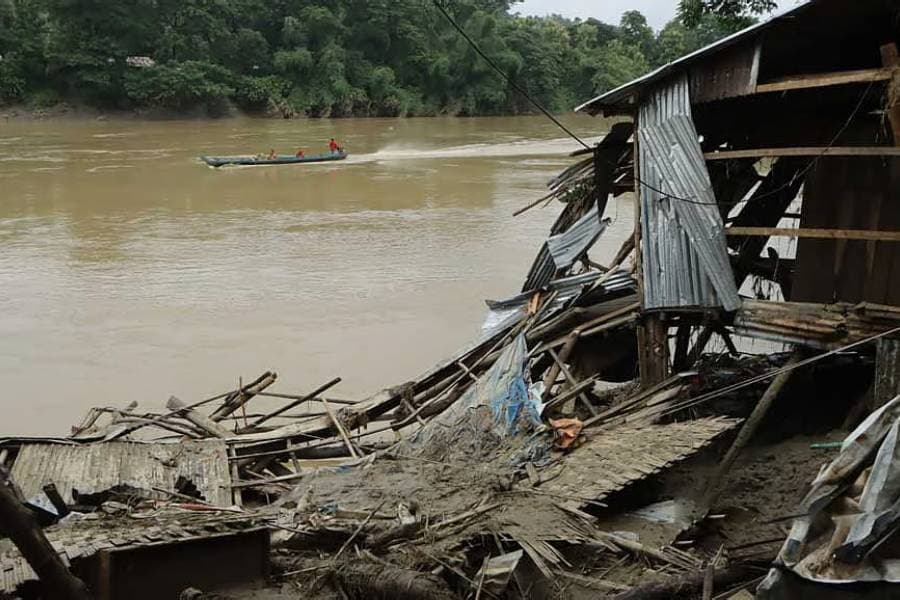
The death toll from recent floods, flash floods, and landslides triggered by torrential rainfall had risen to 58, while 40 people had been injured, said the Ministry of Disaster Management and Relief report on Thursday.
The ministry said the disaster had affected 43 districts across the country, nine severely, afflicting around 1.24 million people.
Many victims left flood shelters, but 1,000 were still staying in 87 facilities in various places.
To assist victims, the government allocated cash, rice, and other emergency relief materials, including dry food, baby food, and cattle feed, to the local authorities in districts.
Relief distribution continued in coordination with the local authorities, armed forces, Fire Service and Civil Defence, Bangladesh Red Crescent Society, and other humanitarian organisations.
The ministry said damage to houses, roads, embankments, cropland, and other infrastructure was being assessed.
The local authorities were instructed to ensure adequate food, drinking water, medical services, and sanitation facilities for those staying in shelters and other vulnerable communities.
Meanwhile, the disaster management authorities said they were closely monitoring weather conditions and river water levels, asking the district authorities to remain alert as intermittent rainfall might continue in parts of the country over the coming days.
Meanwhile, the overall flood situation in Bangladesh continued to improve on Thursday as water levels receded in most of the affected rivers, although several rivers in the north and northeast kept rising due to upstream rainfall, according to the Flood Forecasting and Warning Centre (FFWC).
It said water levels of the Sangu, Matamuhuri, Halda, Feni, Muhuri, Manu, Dhalai, and Khowairivers were on a falling trend, improving the flood situation in Bandarban, Chattogram, Cox's Bazar, Moulvibazar, and Habiganj districts.
However, rivers in parts of the Brahmaputra-Jamuna and Surma-Kushiyara basins were still rising because of continued rainfall in upstream catchments, although they remained below danger levels.
During the past 24 hours, the highest rainfall in Bangladesh was recorded in Bandarban at 58mm, followed by Chattogram (Ambagan) at 56mm, Cox's Bazar at 55mm, Rangamati at 45mm, and Khagrachhari at 38mm.
Heavy rainfall was also recorded in the adjoining Indian states, particularly in Meghalaya, Tripura, and Assam. Cherrapunji received 74mm of rainfall, followed by Shella in Meghalaya at 68mm, Kailashahar in Tripura at 44mm, Agartala at 36mm, and Silchar in Assam at 28mm.
The upstream rainfall increased runoff through the transboundary rivers flowing into Bangladesh, contributing to fluctuations in river water levels.
According to the latest FFWC assessment, water levels in most major rivers are expected to remain stable or continue declining over the next 24 hours, leading to further improvement in flood conditions in the southeastern districts.
However, rivers in parts of the Surma-Kushiyara and Brahmaputra-Jamuna basins may continue to rise slightly depending on upstream rainfall, though they are likely to remain below danger levels.
The Bangladesh Meteorological Department forecast light to moderate rain or thundershowers in many places across the country during the next 24 hours, with moderately heavy to very heavy rainfall at isolated places, particularly in Chattogram, Sylhet, and Rangpur divisions.
The authorities said they would continue to closely monitor river levels as additional rainfall was expected both in Bangladesh and the adjoining Indian catchments.
tonmoy.wardad@gmail.com