


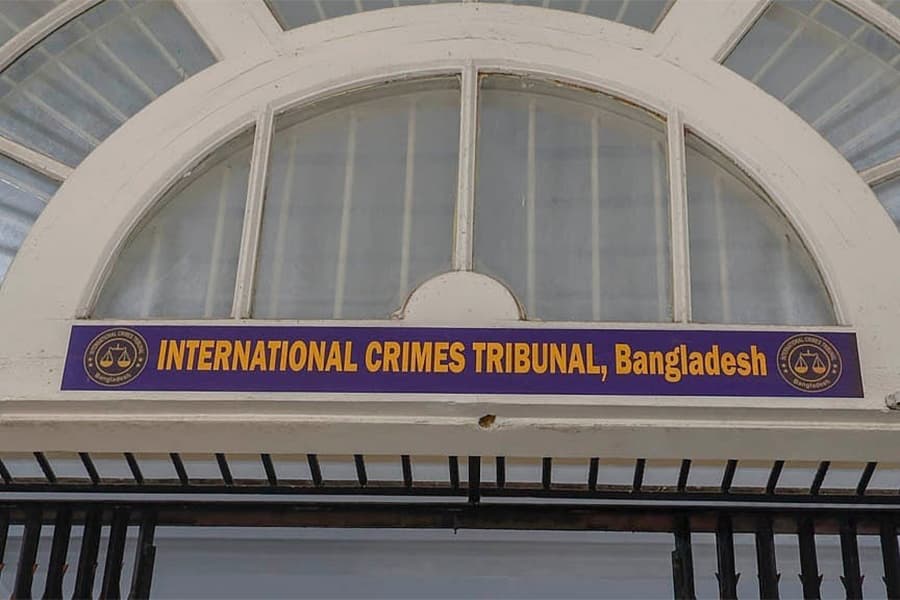
The High Court has dismissed a writ petition challenging the legality of the International Crimes (Tribunals) Act, 1973.


The order came on Tuesday from a bench of Justice Khizir Ahmed Choudhury and Justice Md Ziaul Haque, bdnews24.com reports.
Supreme Court lawyer Md Mohsen Rashid, who also heads a faction of the Bangladesh Muslim League, filed the petition on June 24, naming two secretaries of the Ministry of Law, Justice and Parliamentary Affairs as respondents.
The petition described the 1973 law as obsolete, ineffective and a tool for political persecution or "judicial murder".
It sought a directive for the government to repeal the law and a rule asking why the International Crimes (Tribunals) Act should not be declared void.
Attorney General Ruhul Quddus Kazal represented the state at the hearing, while Rashid argued the case himself.
After the order, Rashid said that there was no legal or historical justification for retaining the law and that he would appeal.
He said the law had been enacted in a specific historical context to prosecute 195 Pakistani prisoners of war accused of genocide, murder and rape during Bangladesh's Liberation War.
Parliament amended Article 47(3) of the Constitution on Jul 15, 1973, and enacted the International Crimes (Tribunals) Act five days later for that purpose.
According to Mohsin, the 1974 Delhi Agreement, following the Simla Agreement, led to the unconditional repatriation and pardon of those prisoners of war.
As a result, he argued, the original purpose of the law no longer existed and its legal basis had effectively ended.
He also argued that the then Awami League government had used the law after 2009 to prosecute Jamaat-e-Islami leaders and that it was now being used against ousted prime minister Sheikh Hasina over the events of 2024.
"If the law remains in force, it could similarly be used against any future ruling party," he said.
Bangladesh enacted the International Crimes (Tribunals) Act in 1973 to prosecute crimes against humanity committed during the 1971 war.
The law was amended in 2009 to allow the prosecution of both individuals and organisations and to “strengthen the tribunal's independence”.
The amendments paved the way for trials of Jamaat leaders over 1971 war crimes, which began in 2010 during the Awami League government's tenure.
Five senior Jamaat leaders and one BNP leader were later executed following death sentences handed down by the tribunal.
After the Awami League government was ousted in 2024, the interim administration led by Muhammad Yunus used the same tribunal to prosecute alleged crimes against humanity linked to the suppression of the July Uprising.
The law was amended again to allow the prosecution of political parties, including the Awami League.
Since the tribunal was reconstituted, it has delivered verdicts in four cases, sentencing Hasina and 12 others to death.