


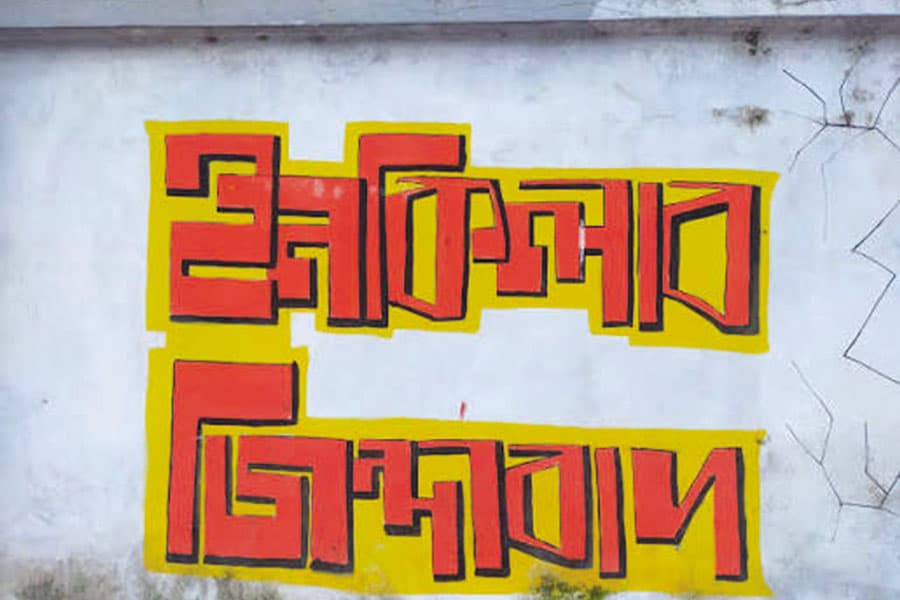
Political movements that brought about a sea change in the history of humankind began with powerful messages that found expression in unforgettable words. These slogans include ‘Liberty’, ‘Equality’, ‘Joy Bangla’, ‘We Shall Overcome’ and ‘Freedom’. However, in South Asia there are only two such slogans that hold historical and emotional significance. These are: ‘Azadi Zindabad’ (Long Live Freedom) and ‘Inquilab Zindabad’ (Long Live the Revolution). Together, these slogans have played a defining role in the political imaginations of many generations of people who struggle against colonialism, tyranny, and injustice.
Despite the frequent use of both these slogans in public protests, there are distinct historical and philosophical meanings behind them. ‘Inquilab Zindabad’ is a slogan coined by Maulana Hasrat Mohani (1875-1951), an Indian freedom fighter, poet, journalist, and political ideologue. Hasrat Mohani coined this slogan during the struggle against the British colonial masters for revolutionary change and the country’s independence. Later on, this slogan became immortal due to the boldness of Shaheed Bhagat Singh and his comrades who used it in the Hindustan Socialist Republican Association.
On the other hand, there is no single known originator of ‘Azadi Zindabad.’ The slogan did not emerge from the mind of any individual but rather through the collective experience of political discourse in South Asia against colonial rule. The combination of the two Persian words ‘Azadi’ (liberty) and ‘Zindabad’ (long live) gave birth to the political slogan that is an expression of liberty and freedom. It differs from Inquilab Zindabad as the authorship of the former is known but not of the latter. Azadi Zindabad does not have a specific author since it was developed over time and has come to be an expression of democratic values in South Asia. This fact differentiates it from the myth that associates its creation with Bhagat Singh.
From Revolution to Freedom: This difference in the slogans highlights two aspects of political development. ‘Inquilab’ is associated with a revolution, which means the destruction of the old political regime and the formation of a new society. ‘Azadi’ stands for the more comprehensive concept freedom from colonization, authoritarianism, discrimination, fear, injustice, and marginalization.
With the independence of India and Pakistan in 1947, and the subsequent emergence of Bangladesh in 1971, the connotation of Azadi was no longer restricted to liberation. Over time, the term came to be associated with democratic participation, constitutionality, accountability of government, freedom of speech, social justice, and human dignity. Universities became important arenas where students interpreted Azadi in their own language of civic activism.
Bangladesh July Movement: The contemporary significance of Azadi Zindabad became evident during the Bangladesh’s July 2024 (July ‘36) student-led movement. What started out as a movement against the reforms to the public sector quota system soon grew into a larger debate on issues of governance, accountability, transparency, and the rights of citizens.
As the movement gained wider acceptance among the public, many protestors expressed their demand for reform in terms of Azadi Zindabad. In this sense, Azadi Zindabad became a cry for freedom from oppression, tyranny, and injustice. For many protestors, the slogan did not mean weakening the power of the state, but making it more responsive to its citizens.
It showed how modern student activism goes further than just complaints about specific policies and addresses larger issues such as governance, legitimacy, and the relationship between the citizen and the state.
India’s Student Movements: This slogan has also appeared in several protests and civil society movements throughout India. Protests related to academic freedom, educational policies, constitutional rights, social justice, and freedom of speech have occurred on university campuses. In these movements, Azadi Zindabad has been used as a slogan that calls for participation in democracy and constitutional rights.
There have, however, been differences in its interpretations based on the political situation. While supporters of the slogan describe it as a symbol of democratic rights as defined by the constitution, there have also been alternate views expressed by its opponents. It shows how complex political symbolism can be and also illustrates that the meanings of political slogans come from both language and historical context.
Slogans in Politics: Azadi Zindabad and Inquilab Zindabad are two of the many slogans that have stood the test of time, according to social movement theory. According to Resource Mobilisation Theory, which was founded by John McCarthy and Mayer Zald, successful social movements rely on effective leadership, communication, organisation, and networks. Universities automatically have all these resources since they are full of educated youth who can communicate through digital communication channels and have organisational abilities. Both the July movement in Bangladesh and the student demonstrations in India exemplify how symbolic slogans can bring together various groups with decentralized leadership.
Political Process Theory, introduced by Charles Tilly, Doug McAdam, and Sidney Tarrow, explains that social movements are formed whenever citizens see political institutions as an opportunity to bring about change. When there is political ambiguity or a crisis in political institutions, slogans become a powerful tool for citizens to express their demands for change together.
According to Framing Theory, proposed by David Snow and Robert Benford, movements succeed because they put forth grievances in such a way that people can easily relate them with the popular values among the masses. Freedom is one of the most universally acceptable concepts. Thus, Azadi can be seen as a master frame that brings different people together under a single common goal of respect, justice, accountability, and participation.
Just like Framing Theory, according to Collective Identity Theory, which was forwarded by Alberto Melucci, successful movements build their collective identity before making any political changes. As thousands of people shout in unison ‘Azadi Zindabad’ or ‘Inquilab Zindabad’, they convert individual grievances into a collective civic identity.
Importance of Political Slogans: Unlike rhetorical tools, political slogans are much more than that. Not only do they make political ideas easy to remember, but they also motivate citizens to participate in politics. Slogans have historically proved to be far more durable than political events. In other words, their meanings are transformed in response to societal changes to fit the problems of each new generation. That is what makes slogans emerging during anti-colonial struggles relevant in democratic movements in South Asia.
Beyond Protest: Despite the great mobilising effect that political slogans exert, lasting transformation toward democracy can happen only when institutions, not slogans alone, are developed. Independent judiciary, accountable governance, professional public service, freedom of press, active civil society, and constitutional checks and balances are still necessary tools for guaranteeing the freedoms and rights that political campaigns aim at winning. In this way, the current instances of activism in universities are exemplified by the events that took place in Bangladesh in July 2024 and India. In both cases, the universities acted as an important tool in the struggle for democracy despite differences in political results between the two countries. Beyond that, Azadi Zindabad and Inquilab Zindabad are not only slogans of protest but also an everlasting reminder of democracy, which needs constant revitalisation. The freedom that is attained through political activism must eventually be ensured by institutions which are dedicated to justice, openness, plurality, and the rule of law.
Conclusion: The history of the slogans Azadi Zindabad and Inquilab Zindabad tells us about the incredible changes and development that occurred in the sphere of political language in South Asia. The first one was developed based on revolutionary ideas described in the literature of Maulana Hasrat Mohani and became famous after it was said by Shaheed Bhagat Singh. The second one is the product of the collective democratic efforts of millions of people striving for freedom.
Their current relevance in the case of the July 2024 movement in Bangladesh and in parts of Indian student activism confirms that the language of freedom remains relevant amid new political realities. Though their interpretations vary by context, their significance lies in motivating people to participate in civic life and democratic discourse.
In essence, experience shows that the most important political slogans are those that do not just call people to protest but encourage people to create better institutions and to strengthen democracy and constitutionalism. Thus, slogans like Azadi Zindabad and Inquilab Zindabad, apart from being slogans of the past, remain slogans expressing the desire for liberty and justice in South Asia.
Therefore, history remembers the slogans that awakened nations, but democracy endures through the institutions those slogans inspire. Azadi Zindabad and Inquilab Zindabad are not merely cries of resistance; they are enduring moral commitments to liberty, justice, constitutional governance, and the unending responsibility of every generation to transform the dream of freedom into the practice of democratic citizenship.
sibhuiyan@yahoo.com