



There are semifinals that feel like stepping stones, and then there are semifinals that arrive with the weight of a final.
Spain against France belongs in the second category. It has the players, the styles, the history, the tension and, perhaps most importantly, the contrast.
This is not just a meeting between two of the best sides left in the World Cup. It is a meeting between two very different ways of seeing the game.
Spain want to own the ball, shorten the pitch, suffocate the opposition and turn possession into control.
France can live without the ball, almost disdain it at times, because they know what they can do once space opens and Kylian Mbappé starts running at retreating defenders.
That is what makes this semifinal so rich. Spain will not want chaos.
France may not need much of it.
Spain arrive here after a draining 2-1 win over Belgium, a match that reinforced both their strengths and their doubts.
They were excellent for long spells, especially without the ball immediately after losing it. Against a Belgian side whose counter-attacking plan leaned heavily on Jérémy Doku, Spain understood the danger.
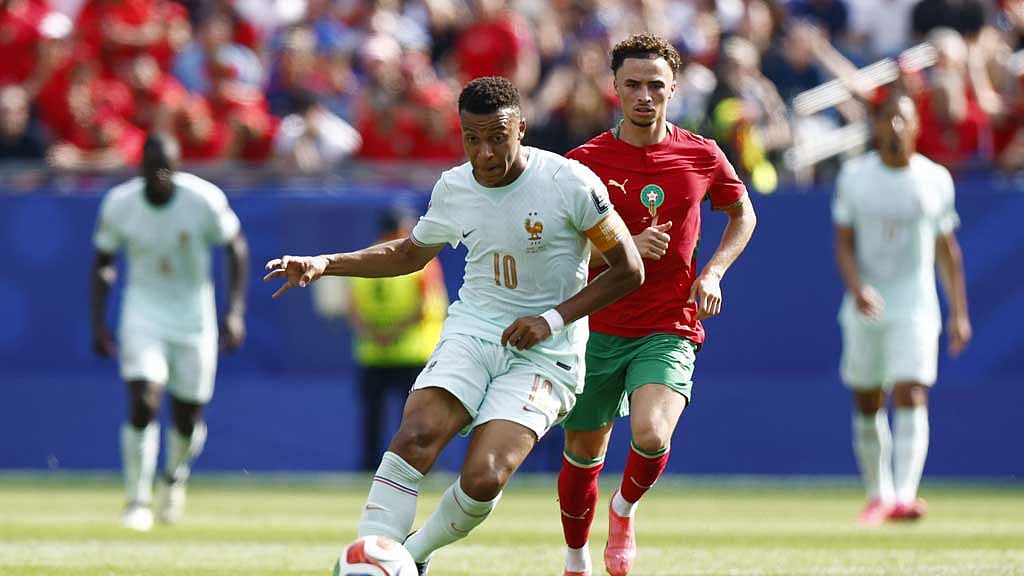
France's Kylian Mbappé battles for the ball with Morocco's Chemsdine Talbi during their FIFA World Cup 2026 quarter-final in Foxborough, Massachusetts. Photo: Reuters
They did not simply attack and hope for the best. They swarmed. They pressed. They closed the first pass.
Aymeric Laporte and Pau Cubarsí played high, sometimes almost on the halfway line, allowing Spain to compress the game and recover possession before Belgium could properly break.
That detail matters because France are Belgium with more weapons, more speed, more certainty and a sharper edge. Belgium had Doku.
France have Mbappé, Michael Olise, Ousmane Dembélé, Bradley Barcola and others capable of turning a loose Spanish pass into a sprint towards goal.
If Spain’s counterpress was good against Belgium, it may need to be close to perfect against France.
This is where Rodri becomes central. Not because he is spectacular in the obvious way, but because Spain’s entire game depends on the quiet authority he brings. Against Belgium, his performance was close to complete: circulating the ball, protecting the centre-backs, reading danger, and stepping into precisely the right spaces before those spaces became emergencies.
His block on Kevin De Bruyne, when Unai Simón was stranded and the Belgian had the vision and technique to score from distance, was the kind of moment that rarely makes highlight reels in the same way as a goal. Yet it may have saved Spain’s tournament.
Rodri is Spain’s insurance policy. He allows the defenders to push up. He allows the full-backs to join attacks. He allows Pedri, Fabián Ruiz, Dani Olmo or whoever plays ahead of him to think forward.
But against France, even his positioning will be tested in ways Belgium could only hint at. If Spain lose the ball with Pedro Porro high and Lamine Yamal ahead of him, the channel behind them becomes France’s invitation. Mbappé does not need many invitations.
That duel — or rather that zone — could decide the semifinal. It will be tempting to call it Mbappé against Cubarsí, but Spain cannot treat it as a simple one-on-one. Cubarsí is an outstanding young defender, calm beyond his years, brave with the ball and already trusted in the most demanding spaces.
But Mbappé for France is different from Mbappé in club football. With the national team, the hierarchy is clear. He is the king, the reference point, the man around whom the rest of the attack bends.
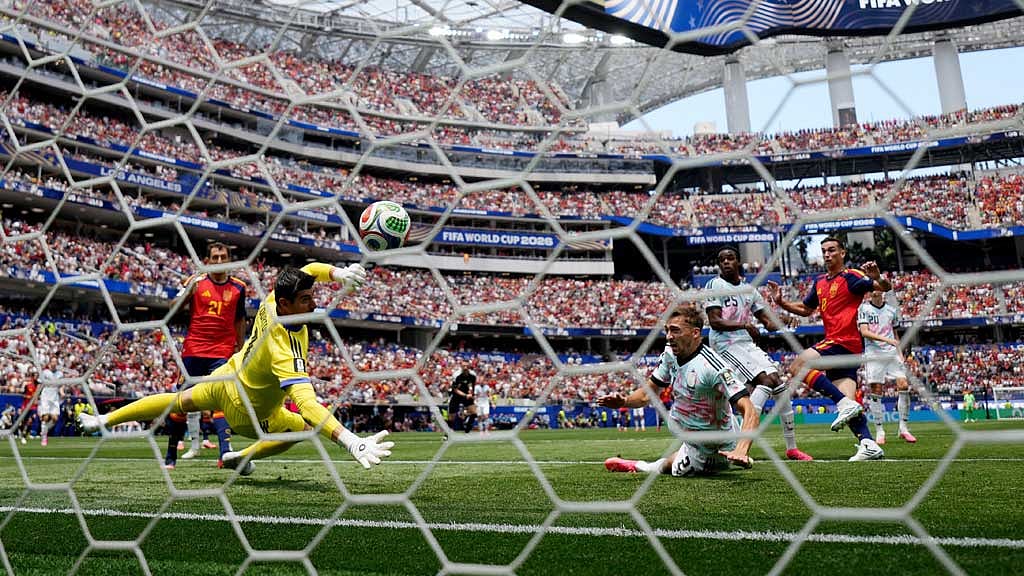
Spain's Fabian Ruiz scores their first goal past Belgium goalkeeper Thibaut Courtois during their FIFA World Cup 2026 quarter-final at Los Angeles Stadium, California. Photo: Reuters
That certainty seems to make him more collective rather than less.
He does not have to prove he is the main man because everyone already knows it.
For Spain, that means Mbappé must be controlled by structure, not ego. Porro cannot spend the whole night standing next to Lamine in attack. Rodri will have to shade across.
The nearest centre-back will need cover. The midfield must press the passer before the pass is played. The worst thing Spain can do is defend Mbappé only after he has received the ball and turned.
Yet Spain have their own prodigy, and their own question. Lamine Yamal has been good at this World Cup, but not quite free. That is the strange burden of being so gifted so young.
Spain look for him constantly. Sometimes too constantly. Against Belgium, there were moments when teammates who had shooting chances or simpler passes still seemed to glance towards Lamine, as if the special thing had to come from him.
He tested Thibaut Courtois repeatedly and carried danger, but there is a thin line between using your best winger and becoming dependent on him.
France will know this. They will try to crowd him, delay him, force him inside or outside depending on the support around him, and make Spain find other routes. That is where Spain’s evolution becomes interesting. This is not the sterile possession team of old caricature, passing endlessly in front of a defence until the game suffocates.
Luis de la Fuente’s Spain have more variation. They can go wide through Lamine or Nico Williams. They can use Mikel Oyarzabal as a pivot. They can send runners beyond. They can go long when the opponent has been drawn in. They can bring on Ferran Torres or Mikel Merino and change the texture of the game.
Merino, in particular, feels like a symbol of modern Spain. He is not easily categorised. Is he a midfielder? A forward runner? A fixer? A late-arriving threat? In older Spanish sides, players like him might have been seen as not pure enough for the model.
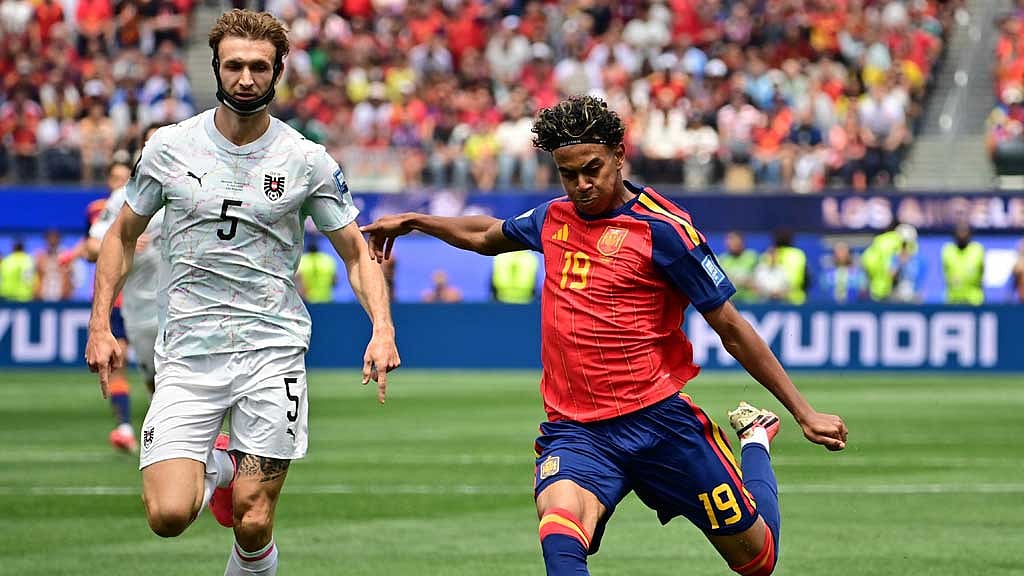
Spain's Lamine Yamal battles for possession with Austria's Stefan Posch during the FIFA World Cup 2026 Round of 32 clash. Photo: Reuter
Now he feels essential precisely because he gives the model another dimension. Spain still have the old hairstyle, if you like, but the outfit has changed.
That evolution is why France cannot simply wait and assume Spain will pass themselves into exhaustion. Spain’s possession has two purposes. It creates chances, yes, but it also defends.
When Spain have 65 or 70 percent of the ball, they are not only trying to score three or four. They are trying to make sure you cannot score at all. It is a defensive idea dressed as an attacking one: if France do not have the ball, France cannot run.
The problem is that France do not need much of the ball to hurt you. That is the fear. They can have 30 percent possession and still produce the five most dangerous moments of the match. They have the quality to be clinical in the way Belgium were not. They can walk through periods of games, almost casually, because they believe the decisive moment will come and that they will have the players to take it.
There is a confidence about France that borders on arrogance, but it is not empty. It is the confidence of a side that knows it can beat anyone. They did not have to overextend themselves against Morocco. They have had an extra day’s rest. They have looked like a team playing within themselves, saving gears for when the road rises.
And yet World Cups have a habit of punishing teams who start to believe in their own inevitability. The Netherlands in 1974, Brazil in 1982, France themselves in other eras — history is full of beautiful, superior, self-assured teams who met an opponent willing to turn their confidence against them. Spain will try to do exactly that.
They will invite France to prove how good they are. Come and press us. Come and leave your centre-backs one-on-one. Come and take risks. Then we will see.
The French centre-backs, likely comfortable defending high and trusting their recovery pace, may find themselves dragged into uncomfortable duels if Spain are brave enough to vary their play. Upamecano and Saliba can defend space, but Spain will try to manipulate that space: short passing to attract pressure, then a sudden ball into Oyarzabal, Olmo, Lamine or Williams. The question is whether Spain have enough cutting edge.
They create, they circulate, they control — but do they finish?
That remains the concern. Oyarzabal fits the system, but he is not Erling Haaland. Olmo, Ferran, Baena, Merino — all can contribute, but none is a ruthless tournament striker.
Lamine has the talent to decide any game, but he has not yet exploded in the way Spain probably imagined before the tournament. Spain may not need many goals; their 2010 world champions won largely through control and narrow margins. But this France are not most opponents. One goal may not be enough.
The timing adds another layer. A France semifinal on July 14, Bastille Day, against a Spain side built on possession and patience: the symbolism writes itself. Whose fortress falls? Whose idea survives?
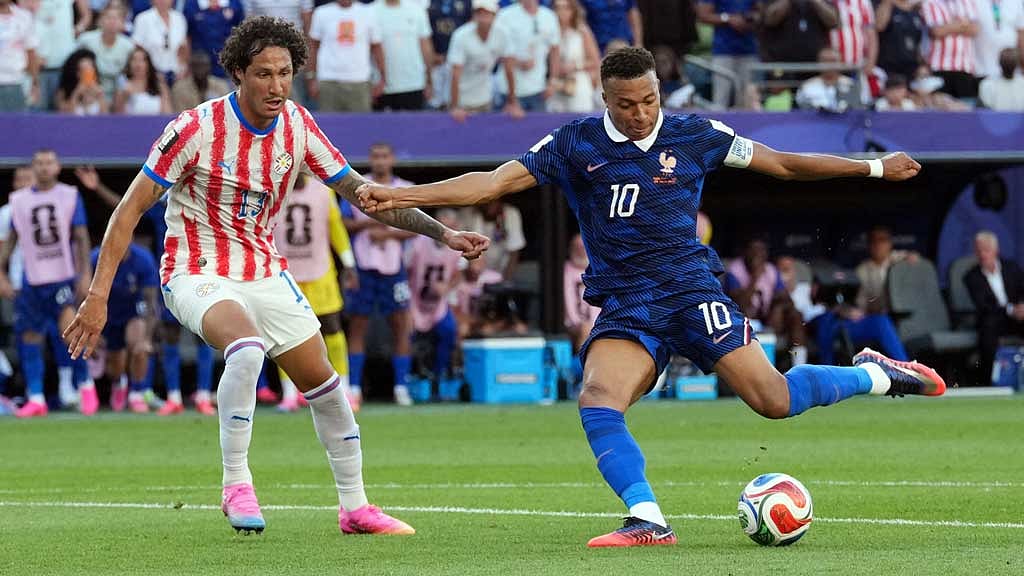
France's Kylian Mbappé shoots at goal during their FIFA World Cup 2026 Round of 16 match against Paraguay in Philadelphia, Pennsylvania. Photo: Reuters
The hope is that the game lives up to its billing. Sometimes matches this big become cautious, each side waiting for the other to blink. This one feels different.
Spain have too much belief in their identity to abandon the ball. France have too much attacking authority to spend the night hiding. Lamine and Mbappé are not just footballers now; they are performers in a global theatre, aware that their careers are built not only on medals but on moments.
That is why this semifinal feels like the final before the final. Spain will try to make the game small, controlled and suffocating. France will try to make it large, open and frightening. Spain’s best chance is to turn possession into protection, to press with intelligence, and to make France defend for longer than they want.
France’s best chance is to survive those spells, wait for one Spanish mistake, and then release the fastest, most devastating player in the tournament into space.
It may come down to one loose pass, one Rodri intervention, one Lamine dribble, one Mbappé burst. But behind those moments is the real contest: control against explosion, system against superiority, identity against inevitability.
Spain will bring the ball. France will bring the fear.
On Tuesday night, one of those beliefs will carry a team to the World Cup final.