


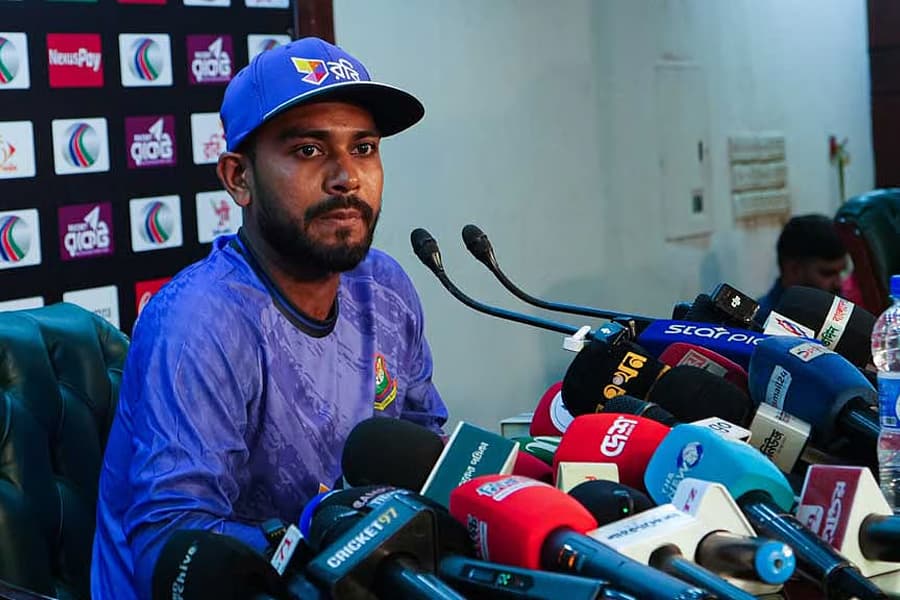
The decision by the Bangladesh Cricket Board (BCB) to change the ODI captain for the national men’s team has drawn many questions. The main one being – “Is it right to change the captaincy after a failure in a single series after four consecutive series wins?”


Yet, the decision-makers firmly believe that the change is necessary for the sake of the team's overall coordination across all formats, with a view to the next World Cup, to correct the mistakes of the previous board, and for former captain Mehidy Hasan Miraz himself.
After speaking to several BCB directors, it became clear that board President Tamim Iqbal played a key role in the decision.
Tamim is not only the BCB president but also the head of the board's cricket management department.
Activities related to the national team fall under this department.
He himself explained the decision in detail during his talks with Miraz, as well as in his talks with the board’s directors to clarify his thinking. Still, the decision was not easy.
In the context of Bangladesh and according to its cricket culture, such a decision is never easy.
There is no precedent for removing a captain who has won four of the last five series. Miraz’s success rate as captain in 24 ODIs is 43.75 per cent, a commendable effort for Bangladesh. Despite this, the BCB considers it necessary to look ahead and make a change, and that delves deep into the leadership structure.
Tamim highlighted several reasons for picking Litton Das as the new ODI captain.
He said the desire to get Miraz back as a performer, the tensions of coordination with three captains in three formats, and the hope of getting the eye-catching performances from Litton in ODIs after his success as T20 captain all played a role in the decision.
However, speaking to some BCB officials, it was learnt that the biggest deciding factor was the shakiness of Miraz's place in the ODI squad, questions about his potential effectiveness in the upcoming World Cup venues of South Africa and Zimbabwe, and above all, doubts about his leadership qualities.
The BCB officials felt that Miraz did not have sufficient authority over the team or in the dressing room.
This authority does not simply mean control, but rather the impression he had on his teammates and his ability to influence them.
The question was whether he had been able to earn respect and admiration within the team as a captain. The answer to that question was not very positive.
The BCB also noted shortcomings in Miraz's leadership from a purely cricketing perspective. Even in matches the Tigers won, some of Miraz's on-field decisions came under scrutiny, and this has not escaped the attention of BCB officials.
Another major factor in the BCB pulling the trigger despite wins in four consecutive series – all these victories were on home soil. As captain, Miraz has lost all three series he played abroad.
After losing 2-1 in the Sri Lanka tour last year, the team was whitewashed by Afghanistan in Abu Dhabi. The loss to Zimbabwe sealed Miraz’s fate.
The reasons that Tamim highlighted in the press conference also backed the board’s decision. The BCB president specifically noted that even though the captain was bowling fine, his batting was not up to par and the statistics clearly testified to that.
While acting captain, Miraz scored fifties in three of the four ODIs he played. But after being announced as the regular captain, that form was lost. He has managed to score a single fifty in the last 17 innings. Since then, 13 innings have passed without a significant knock.
As the regular captain, his batting average in 17 innings is 19.42 runs, with a strike rate of 69.92.
During this period, Miraz has picked up 22 wickets while giving away 4.09 runs per over.
Although not extraordinary, his performances with the ball are solid. However, as an all-round package, it is not inspiring.
It is difficult for Miraz to maintain his place in the team with his bowling alone if he cannot consistently contribute with the bat. He can be effective on some wickets, against certain opponents, in particular contexts, but in others, a sharper bowler or a more effective batsman is needed.
The captain himself ended up being something of an obstacle for team balance. The BCB also said that he was not adding anything extra in the role.
The BCB officials said that a large part of Tamim’s talks with Miraz concerned batting, with the president urging him to focus and regain his form.
Timing was also a key part of the BCB’s thinking. They could have tested Miraz for another series or two. But since there were already doubts about whether he would be able to lead the team to the World Cup, the BCB did not see the benefit of wasting time.
Instead, they wanted to give the new captain time to plan before the series against India and sufficient run-up for the World Cup.
Another factor in the decision was the availability of an alternative like Litton. Having been impressed with Litton’s leadership in the T20 format -- his planning, depth of thinking, and the respect his teammates have for him -- BCB officials were eager to see a similar impact on the ODI squad.
Although the issue of Litton’s inconsistent batting form in the format has been debated, the board decided he was suitable for both white-ball formats.
After finalising the decision to replace Miraz, the main issue was the process, which has always been a deficiency in Bangladesh cricket. This was also evident in the process of removing Nazmul Hossain Shanto from the captaincy last year.
In June 2025, the board led by Aminul Islam Bulbul suddenly replaced Shanto and gave Miraz the captaincy of the ODI team.
The decision was catastrophic for Shanto. The impact became clear when he announced soon afterwards that he would be stepping down as Test captain.
Needless to say, there was a major lack of communication between the then board chief Aminul and the head of the cricket management department Nazmul Abedin Fahim. Although they later convinced Shanto to return to the Test captaincy, the previous wounds lingered.
Other players have also suffered the indignity of finding out through the news that they have been stripped of their captaincy.
Was a proper process followed this time?
Tamim, for his part, was quick to respond to the question.
"I followed the process that was supposed to be followed. Everyone involved in it has been informed. Everyone agreed. After that, the matter came to you (the media)."
So this time, it seems, there has been no fumbling.
Though it seems Miraz has accepted the decision, one cannot say that it was with a happy heart. During his conversations with the board president, he also explained his position, highlighted various circumstances affecting his situation, and indirectly asked for time. However, at some point, he was able to come to a common ground with Tamim. Perhaps it was because he understood the possible consequences.
After the official announcement of the change in leadership, Miraz told those close to him: "It feels like a big burden has been lifted."
His words may carry a sense of relief. However, those close to him also saw tinges of regret, disappointment and sadness in them. Still, Miraz told them that the board chief had a very strong reasoning for the decision, a solid argument, and, at the end of the day, there is not much room for disagreement.
Miraz said that he is now taking on the challenge of performing to bolster his spot in the team.
All in all, it seems that both the board and the outgoing captain are looking forward, a positive sign for the country's cricket.
There have been very few instances in Bangladeshi cricket of “bold” and “popular” decisions coinciding. It is to be hoped that in this rare instance where both came together, the outcome will be a positive one for the Tigers.