


Public health and economic experts on Sunday said the proposed national budget for FY2026-27 has left room for stronger tobacco tax reforms, arguing that a more ambitious tax structure could both increase government revenue and accelerate efforts to reduce tobacco consumption.
Speaking at a post-budget discussion in Dhaka, they said Bangladesh continues to maintain one of the world’s most complex cigarette tax systems, allowing smokers to shift to cheaper brands instead of quitting and limiting the effectiveness of tax increases.
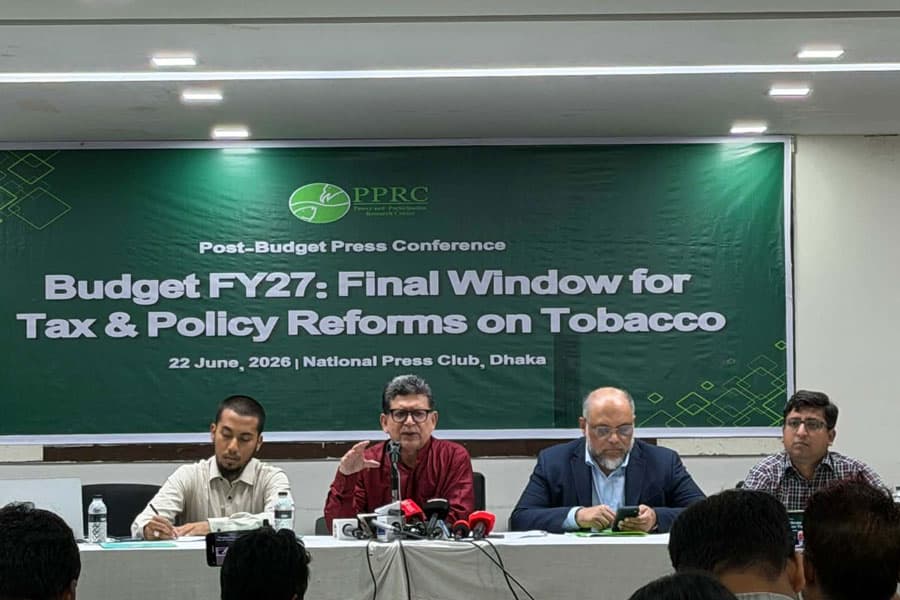
The observations came at a press conference titled “Budget FY27: Final Window for Tax and Policy Reforms on Tobacco”, organised by the Power and Participation Research Centre (PPRC) at the National Press Club on Monday.
Presenting an assessment of the proposed budget measures, PPRC Senior Research Associate Mohammad Ihtesham Hassan said the country’s four-tier cigarette tax structure remains a key obstacle to achieving both public health and revenue objectives.
According to the analysis presented at the event, government revenue from tobacco products has continued to rise while overall cigarette supply has started declining since 2024, suggesting there is still room for further tax-driven price increases.
Mr Hassan argued that the continued existence of a low-price cigarette segment enables smokers to switch brands rather than reduce consumption. He proposed merging the low and medium tiers, setting a minimum retail price of Tk 100 per 10 sticks and introducing a specific tax of Tk 4 per pack.
Director of the Institute of Health Economics at the University of Dhaka Professor Dr Shafiun N Shimul said Bangladesh still has a massive cigarette market, with around 70 billion sticks sold annually, despite successive tax increases.
He questioned whether recent tax measures were delivering the maximum public benefit, noting that a significant share of price increases may be captured by tobacco companies rather than the government.
“When cigarette prices rise, the key question is how much of the additional amount goes to public revenue,” he said, adding that revenue foregone by the government ultimately translates into a loss for citizens.
Dr Shimul also expressed concern over the emergence of new nicotine products, warning that delayed regulation could expose young people to growing health risks.
Associate Professor of Economics at the University of Dhaka, Dr S M Abdullah said tobacco taxation should play a central role in Bangladesh’s shift towards preventive healthcare.
He described tobacco taxation as one of the most cost-effective tools for reducing non-communicable diseases but noted that the existing tax structure remains overly complicated.
The economist also highlighted regulatory weaknesses in the smokeless tobacco sector, saying the absence of licensing, registration and traceability systems hampers effective monitoring and compliance.
Participants further stressed the need for stricter enforcement of existing tobacco-control laws to curb illicit trade, improve tax compliance and strengthen revenue collection.
PPRC Executive Chairman Dr Hossain Zillur Rahman said the debate should focus not merely on whether tobacco prices have increased, but whether the increases are sufficient to achieve public health and fiscal goals.
He warned that excessive reliance on technical adjustments without reflecting market realities could undermine policy effectiveness and result in missed revenue opportunities.
Dr Rahman also voiced concern over the government’s approach to e-cigarettes, arguing that the potential revenue gains from such products are limited compared to the long-term public health risks, particularly for young people.
The experts at the event urged policymakers to utilise the remaining Finance Bill process to address structural weaknesses in tobacco taxation before the FY2026-27 budget is finalised.
newsmanjasi@gmail.com