


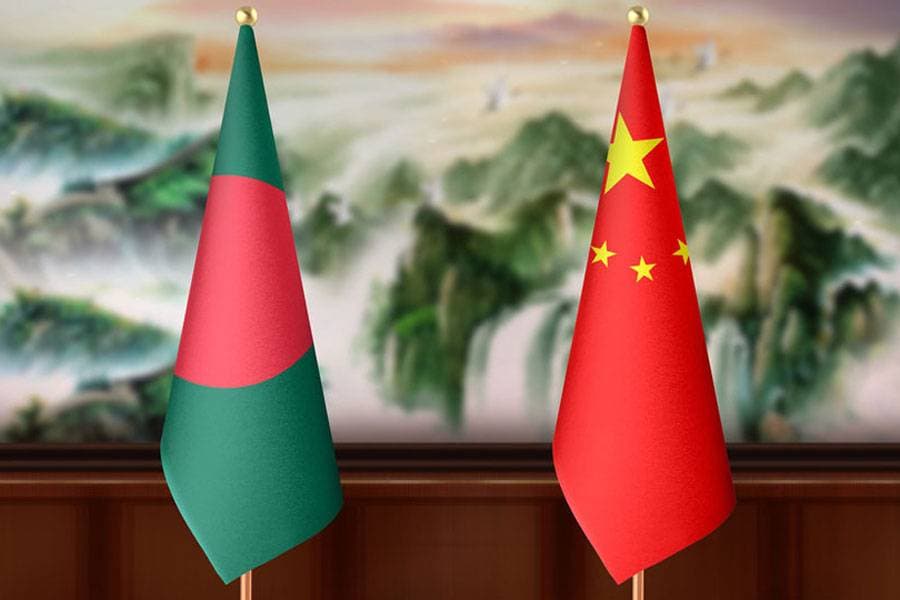
Prime Minister Tarique Rahman arrived in China on Monday evening for a four-day official visit that is being closely watched by regional and global powers amid growing geopolitical competition in the Indo-Pacific.
The Bangladeshi premier flew to the northeastern Chinese city of Dalian after concluding a two-day visit to Malaysia, his first foreign tour since assuming office in February. A special Biman Bangladesh Airlines flight carrying the prime minister, his wife Dr Zubaida Rahman and members of the delegation departed Kuala Lumpur International Airport at around 5pm local time.
The most closely watched aspect of the visit is whether Bangladesh will make any promise on participating in China’s Global Development Initiative (GDI), one of President Xi Jinping’s flagship international initiatives.
For several years Beijing has encouraged Dhaka to become part of the platform. However, successive Bangladeshi governments have adopted a cautious approach, seeking to maintain a balanced foreign policy and avoid being perceived as aligning too closely with any geopolitical bloc.
After Hasina’s Beijing visit in 2024, the joint statement mentioned “The two sides discussed various aspects of the Global Development Initiative put forward by President Xi Jinping. The Chinese side is ready to share experience on GDI issues with the Bangladesh side. The Chinese side also presented the Global Security Initiative (GSI) and the Global Civilization Initiative (GCI) to the Bangladesh side…”
In 2025, the joint statement issued after Dr Yunus’s visit, unlike the 2024 joint statement, did not prominently mention the GDI, GSI or GCI as issues for Bangladesh to join. Instead, the emphasis was on practical cooperation and broader concepts such as an “equal and orderly multipolar world” and “inclusive economic globalization.”
Diplomatic sources say there are differing views within the government over the issue.
Some officials argue that the GDI is fundamentally a development platform rather than a military or security alliance and that participation could further strengthen Bangladesh’s economic partnership with China.
“We are a sovereign country, so it is our choice whether we join the GDI or not. We should not be so nervous,” a senior diplomat said.
Others advocate greater caution, arguing that Bangladesh should preserve its strategic neutrality at a time when global politics is becoming increasingly polarised.
“We appreciate the GDI concept. We also find many positive elements in the Western-backed Indo-Pacific initiatives. If we join the GDI, we should also be open to engaging with other development platforms,” another senior official said.
Foreign Secretary Asad Alam Siam recently said the government was still evaluating the proposal.
“It is a positive concept, but we have not finalised our decision regarding joining the GDI,” he told reporters before the prime minister’s departure.
President Xi unveiled the Global Development Initiative at the United Nations General Assembly in September 2021 as a framework to accelerate implementation of the UN Sustainable Development Goals. The initiative focuses on eight priority areas, including poverty reduction, food security, pandemic response, development financing, climate change, industrialisation, digital economy and connectivity.
The GDI forms part of a broader package of Chinese global initiatives that also includes the Global Security Initiative (GSI), the Global Civilization Initiative (GCI) and the Global Governance Initiative (GGI). Chinese officials describe the four initiatives as complementary frameworks aimed at addressing development, security, governance and civilisational challenges facing the international community.
Bangladesh’s deliberations over the GDI are particularly significant because the country is already an active participant in China’s Belt and Road Initiative (BRI), launched in 2013.
Over the past decade, Bangladesh has emerged as one of the major recipients of Chinese infrastructure financing under the BRI framework. Chinese funding and technical support have contributed to a number of large-scale projects, including power plants, bridges, tunnels, road networks, special economic zones and port-related infrastructure.
According to official estimates, China has committed several billion dollars in loans, investments and development assistance to Bangladesh through various infrastructure and connectivity projects. Beijing has become one of Bangladesh’s largest development partners, playing a significant role in the country’s efforts to modernise transport, energy and industrial infrastructure.
Supporters of joining the GDI argue that Bangladesh has already benefited substantially from economic cooperation with China and that participation in another development-focused initiative would be a natural extension of the relationship.
Critics, however, contend that Dhaka should proceed carefully and ensure that any decision aligns with its broader foreign policy objective of maintaining constructive relations with all major powers, including China, the United States, India, Japan and the European Union.
During his stay in Dalian, Prime Minister Tarique Rahman will attend the World Economic Forum’s Annual Meeting of the New Champions, widely known as the Summer Davos Forum. He is scheduled to participate in discussions on global economic and climate issues before travelling to Beijing for meetings with President Xi Jinping and Premier Li Qiang later this week.
Observers say any announcement regarding Bangladesh’s participation in the GDI could emerge from those high-level talks and provide an important indication of how the new government intends to balance its economic interests with its long-standing policy of strategic neutrality in an increasingly competitive geopolitical environment.