



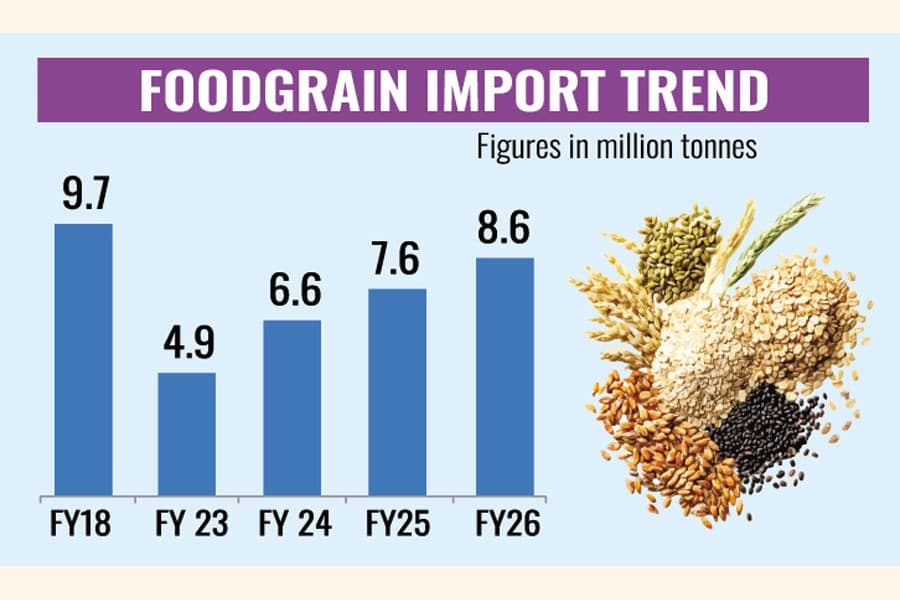
Bangladesh recorded its second-highest volume of foodgrains import in fiscal year (FY) 2025-26 due to surge in the wheat purchases by both the government and private sectors due to favourable prices in the global market.
According to the Ministry of Food, the country imported 8.6 million tonnes of foodgrains, including rice and wheat, during the last fiscal year (FY).
Bangladesh's highest volume of foodgrain imports was recorded at 9.7 million tonnes in FY 2017-18 as devastating flash floods damaged crops across large parts of the country, forcing the country to import a record 3.9 million tonnes of rice.
According to official data, rice imports remained almost unchanged in FY2025-26, while the wheat imports jumped by more than 49 per cent to 7.7 million tonnes.
Market analysts, however, attributed the higher imports to relatively stable prices in the international grain market, which encouraged both government agencies and private traders to increase volumes of foodgrains, despite having better domestic outputs.
Md Moniruzzaman, Director of the Directorate General of Food (DGoF), said higher domestic production, regular imports and increased public procurement helped maintain adequate foodgrain availability throughout the fiscal year.
He said the government's foodgrains stock currently stands at around 2.0 million tonnes and it is expected to increase further after completion of the ongoing Boro procurement drive.
According to the Bangladesh Bank (BB) data, the country's foodgrain import bill reached US$2.45 billion during July-April of FY2025-26, reflecting an 18 per cent rise over the corresponding period of the previous fiscal year.
Wheat import bill alone accounted for $1.93 billion, a 49 per cent surge from that of the previous year.
Professor Dr Rashidul Hasan said stable global grain prices enabled importers to purchase foodgrains throughout the year, thus keeping the system at a comfortable level.
He said international wheat prices remained mostly between $220 and $250 per tonne, while rice prices ranged between $380 and $450 per tonne, which allowed importers to replenish their stocks at relatively favourable rates.
Government purchases accounted for more than 15 per cent of total grain imports, it was learnt.
Despite having abundant supplies, consumer groups said households received little benefit out of the higher foodgrain imports as retail food prices remained stubbornly high throughout the year.
Secretary of the Consumers Association of Bangladesh (CAB) Humayun Kabir Bhuiayn said domestic wheat prices failed to reflect the downward prices trend in the global market, where its prices fell by around 12-16 per cent.
Retail prices of coarse wheat flour (atta) increased by Tk 4.0 to 5.0 per kg to Tk 48 and Tk 65 per kg, while refined flour (maida) was selling as high as Tk 65-78 per kg. Rice prices also maintained an upward trend in the domestic market, he said.
Coarse and medium-quality rice continued to sell at Tk 55-70 per kg, while finer varieties were priced between Tk 75 and Tk 100 per kg, despite having strong domestic outputs and higher imported grains.
tonmoy.wardad@gmail.com