

The government has yet to start implementing the National Logistics Policy even after nine months of its approval.
Despite its crucial need to ensure cost-effective and timely transportation of goods ahead of Bangladesh's expected graduation from the least developed country (LDC) status, no effort has been made to form a working group or hold stakeholder meetings as part of implementation, sources say.
They say an inter-ministerial meeting with the participation of all concerned could be the start to find a pathway or prepare a roadmap, which does not exist either, for the policy.
The initiative to formulate the policy began at the end of 2020, but it took years to finalise the draft.
The previous Awami League government approved the policy on April 28, 2024, but it was revised by the interim government on November 6, 2025, on the grounds of not addressing LDC graduation properly.
The demand for the policy was raised by the business community, who endured various problems in the transportation of goods, including export-import consignments, in the absence of efficient logistics services integrating rail, road, water, port, and air sectors.
The policy was formulated across five themes -- policy and regulatory framework, institutional and capacity development, infrastructure, technology and digitalisation, and investment attraction.
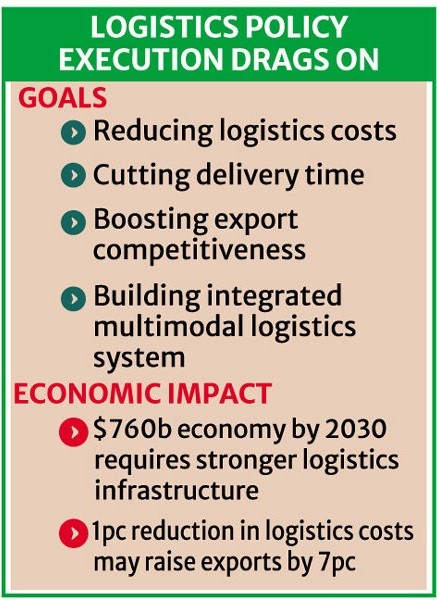
Its focus includes reducing logistics costs and delivery time, improving competitiveness in exports, and developing an integrated multimodal logistics system by combining all sectors.
The policy has also addressed attractiveness for both domestic and foreign investments, as well as creating a regional logistics hub by 2050.
Various proposals were recommended in the policy for establishing a national logistics network, logistics parks, freight villages, inland container depots, dry ports, and multimodal terminals, as well as digitalising customs and border management, warehousing, and cold storage facilities.
Sources say implementing the policy requires reforming various government agencies for better coordination among over a dozen ministries and agencies.
The Ministry of Commerce is the lead ministry in formulation and implementation, but the engagement of industries, road transport and bridges, railways, shipping, civil aviation and tourism, and others is necessary for integration.
Various quarters have proposed forming a national logistics authority, but the original policy proposed forming two national committees under the Prime Minister's Office, one of them headed by the principal secretary.
Meanwhile, various chambers at various meetings expressed concern at the procrastination in implementing the policy, saying the long-standing weaknesses had continued to hinder trade and supply chains.
They said logistics had been increasingly seen as a quiet constraint on economic growth.
According to Policy Exchange Bangladesh, logistics infrastructure and port capacity expansion are critical to support the country's projected $760 billion economy by 2030.
It said a 1.0 per cent reduction in logistics costs could increase exports by around 7.0 per cent while the country was approaching the LDC graduation.
smunima@yahoo.com