


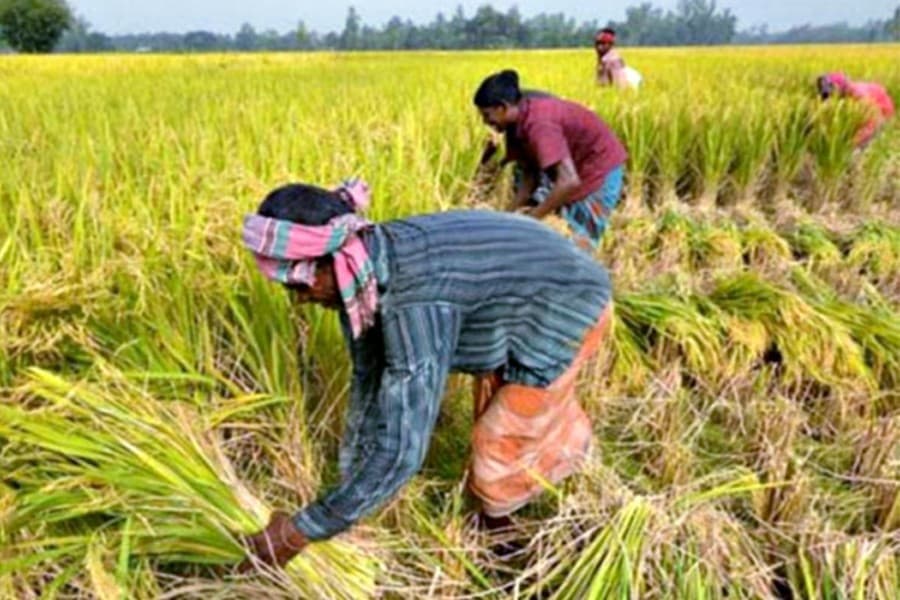
Bangladesh's renewed dependence on agriculture for employment presents a paradox that should concern policymakers as much as it comforts them. In a country where agriculture has historically been the backbone of livelihoods, the sector's ability to absorb workers during economic uncertainty is undeniably reassuring. Yet the latest evidence suggests that this trend is not the result of a thriving rural transformation, but rather a symptom of stagnation in the manufacturing and services sectors -- the very engines that once drove Bangladesh's remarkable poverty reduction and economic ascent.


A recent World Bank study presented at a discussion meeting in the capital paints a sobering picture of the labour market between 2016 and 2024. Nearly seven out of every 10 new jobs created during the period emerged from agriculture, while manufacturing steadily lost momentum and shed workers. Most troubling is the gender dimension of this reversal. Women, who had gradually entered factories and urban services over the past two decades, bore the brunt of the setback. Around 1.1 million female jobs disappeared from industry and another 0.8 million from services, pushing many women back into low-productivity agricultural work.
This reversal represents more than a statistical shift; it signals a retreat from the structural transformation that once defined Bangladesh's development story. For decades, export-led industrialisation -- especially through the ready-made garment sector -- enabled millions of rural women to join the formal workforce, gain financial independence and contribute to household mobility. The migration of labour from farms to factories was not merely economic progress; it was social progress. The current re-concentration of labour in agriculture, therefore, raises difficult questions about the sustainability of Bangladesh's growth model.
Agriculture undoubtedly remains essential to the nation's economy and food security. However, when workers move into agriculture because better opportunities are unavailable elsewhere, the outcome is fundamentally different from a productive agricultural renaissance. The World Bank rightly notes that this shift towards low-productivity employment weakens labour income growth and slows poverty reduction. Low wages, seasonal instability and limited technological advancement continue to characterise much of the rural economy. As more workers crowd into the same sector without corresponding productivity gains, underemployment inevitably deepens.
The consequences are becoming visible. High inflation has eroded purchasing power across the country, particularly among low-income households whose wages have failed to keep pace with rising living costs. According to the study, an additional 1.4 million people were expected to fall into poverty in 2025, while the national poverty rate may rise from 18.7 per cent in 2022 to 21.4 per cent this year. Such projections serve as a stark reminder that economic resilience cannot be measured solely through GDP figures.
The broader economic outlook also reinforces these concerns. Bangladesh's projected GDP growth slowdown to 3.9 per cent in fiscal year 2025-26 reflects not only global uncertainties but also deep domestic structural weaknesses. At the heart of these weaknesses lies the inability of the private sector to generate sufficient employment for a rapidly expanding working-age population. As World Bank economist Dr Dhruv Sharma observed, improving the business environment is central to reversing this trend. Regulatory uncertainty, inconsistent taxation policies and barriers to firm expansion continue to discourage investment and job creation.
Indeed, one recurring theme throughout the discussions has been the lack of coherence in Bangladesh's economic incentives. The country's export success has long been concentrated within a narrow industrial base, particularly ready-made garments, while other sectors remain constrained by unequal tax treatment and excessive protectionism. Protective tariffs may shield domestic industries temporarily, but they also keep prices artificially high and discourage innovation and export diversification. An economy overly dependent on one sector inevitably becomes vulnerable to shocks, whether external or domestic.
The challenge becomes even more urgent when viewed through the lens of youth unemployment. With nearly 40 per cent of young people estimated to be unemployed, Bangladesh faces the risk of a demographic burden rather than a demographic dividend. A generation entering adulthood without meaningful employment opportunities may lose confidence not only in the economy but also in the institutions governing it.
The reflections shared by economists and business leaders at the Policy Research Institute (PRI) event underscore the need for a strategic reset. The future of the country lies in productivity, skills, innovation and institutional credibility. Emerging industries may require temporary state support, but such protection must come with clear sunset clauses and accountability mechanisms.
At the same time, restoring investor confidence remains critical. Concerns raised by business representatives regarding abrupt fiscal measures and inconsistent taxation policies highlight a deeper issue of policy unpredictability. Investors, whether domestic or foreign, require stability and transparency to commit long-term capital. Without investment, sustainable job creation will remain elusive.
Bangladesh's development journey over the past three decades has been remarkable precisely because it demonstrated how growth, employment and poverty reduction can reinforce one another. That virtuous cycle now appears under strain. Agriculture's capacity to absorb workers may provide temporary relief, but it cannot be a substitute for a vibrant manufacturing sector and dynamic services economy. The country's next phase of development will depend not on preserving old advantages, but on building new ones - through institutional reform, diversified industrial growth and a labour market capable of offering dignity, security and opportunity to its people.
wasiahmed.bd@gmail.com