



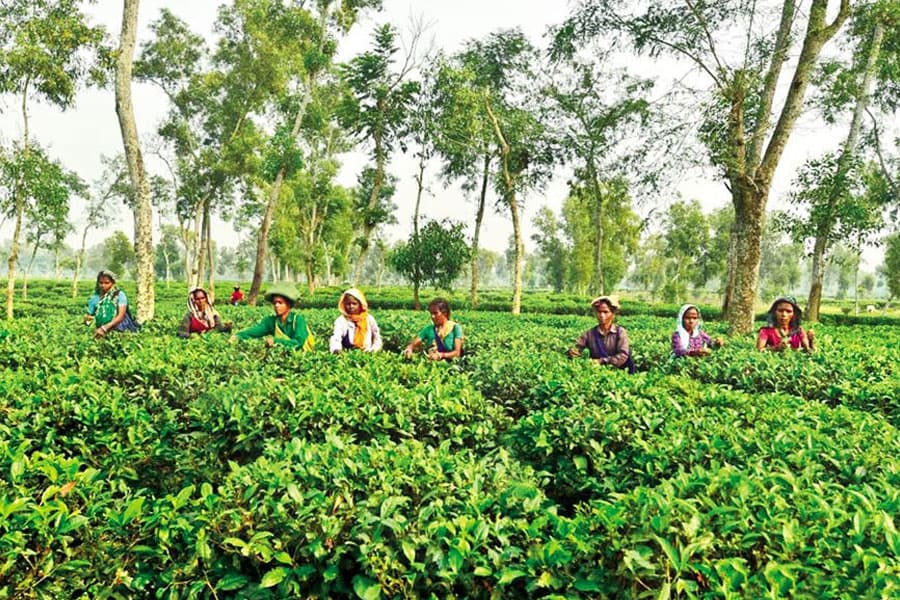
The tea sector contributes approximately 0.81 per cent to 1.0 per cent to Bangladesh's national GDP. It is the country's second-largest export-oriented cash crop after jute and supporting millions of livelihoods, especially in rural communities. The sector provides direct and indirect employment for roughly 3.0 million people, primarily in the tea estates of Sylhet, Moulvibazar, Habiganj and in Chattogram division's tea estates mostly located in the Fatkchhari upazila. There are some tea gardens also in Rangunia, Banshkhali and Rangamati. Add to these the small-grower networks of Panchagar in the northern district of Thakurgaon. As a vital domestic cash crop, it is a primary driver of socioeconomic stability in rural regions.
Tea output in 2026 reached 94.91 million kg, a 2.01per cent increase over the previous year. Basically an agricultural crop, historically the tea sector has been considered an industry. But tea's production, like any other agricultural crop, is highly dependent on weather condition. Usually, its production begins to rise from May, and in July the yield increases to around 10 million to 15 million kg. However, with the decline in rainfall from November, the yield begins to fall. Since, tea harvesting remains suspended in February for maintaining and tending of the tea gardens, the yield is naturally the lowest in this month of the year.
A rapidly expanding middle class and rising urbanisation have driven annual domestic consumption of tea to roughly 85 to 90 million kg. Despite a slight increase in production, the sector faces headwinds such as rising fuel, fertiliser, and labour costs. Industry analysts point to the need for better irrigation, modernised land management and a shift towards value-added premium teas to improve global competitiveness and profitability. But this important sector of the economy is also plagued by some inherent issues that need to be addressed before it can make its mark in the international market. In fact, tea is a vital driver for economies across South Asia including Bangladesh and India. But it is burdened by systemic hurdles that suppress productivity and profitability. The sector's stability requires addressing the core bottlenecks and their solutions.
These include unpredictable rainfall and seasonal droughts which stunt leaf growth and significantly slash yields. Over 50 per cent of tea bushes are aging and underproductive. Combined with old processing machinery, this hurts the final product's quality. The costs of inputs including fertilisers, pesticides and labour have skyrocketed, while tea is still heavily taxed or subjected to commercial interest rates (10-14 per cent) rather than agricultural rates. Stagnant wages, housing challenges and outdated headcount ratios hamper worker motivation and productivity. Rigid weekly floor-priced auctions (such as in Chattogram) restrict direct export negotiations and depress local prices. Most tea is exported in bulk. Without strong, centralised branding (like Sri Lanka's 'Ceylon Tea' or India's 'Darjeeling Tea'), the industry misses out on premium global revenues. If tea is reclassified from a commercial industry to agriculture, it will enable garden owners to access 4.0-6.0 per cent subsidised agricultural credit for modernisation. While the industry contributes significantly to the economy, it faces other challenges. Because local demand outpaces supply, tea exports have generally declined over the past three decades to prioritise the domestic market. Despite the overall drop in exports, established brands continue to compete internationally. Leading companies like SEYLON, Finlay, and Ispahani dominate the market, with SEYLON maintaining its position as the country's top branded tea exporter. The good news is that tea cultivation has expanded beyond the traditional hills of Sylhet and Chattogram. The transformation of flatlands in northern districts, such as Panchagarh and Thakurgaon, has been highly successful, now contributing over 10 per cent of total national production. With per capita consumption rising, the local tea market is expected to continue growing at an annual rate of over 8.0 per cent. This provides a massive, reliable revenue stream for local producers. Further utilisation of unused or fallow flatlands for tea production remains the most viable way to meet the escalating demand. The government and the Bangladesh Tea Board are encouraging smallholder farming in these regions.
To revive exports, the industry must focus on producing premium/specialty blends that satisfy international standards, such as Maximum Residue Level (MRL) compliance for European markets. Against this backdrop, the government is now pushing for global competitiveness, sustainable production and digital supply chain management. So, it can be said that the tea sector is undergoing a strategic renaissance. With domestic consumption absorbing almost the entirety of the Tk22.26 billion crop, major investment avenues lie in premium export development, cold-chain logistics and modern plantation automation. The Bangladesh Tea Board (BTB) is actively urging growers to diversify into aromatic, oolong and specialty blends for the international market. Brands like Seylon and Finlay continue to dominate the export space, but there is high-yield potential in smallholder investments in northern districts. Investors are increasingly looking to develop eco-tourism and luxury lodging near major tea estates, specifically in Moulvibazar and Habiganj (which account for roughly 77 per cent of national production). As a result of reforms in BEPZA, attractive packages are being offered for foreign investors within Export Processing Zones (EPZs), including tax holidays and 100 per cent foreign ownership permissible. The government has advanced plans to amend the Customs Act to establish free trade zones and to lift the 49 per cent foreign shareholding cap in private Inland Container Depots (ICDs) to attract international-standard logistics players. Auctions-which occur at Agrabad in Chattogram and Srimangal-are increasingly digitised, speeding up trade cycles.
The Commerce Ministry has formed task teams to chart the future of the tea supply chain. Meanwhile, estates are modernising their distribution, with major firms like bKash facilitating digital payrolls for estate workers, creating a more reliable labour supply chain. There is no question that the tea sector has its immense growth potential seeing that at least its domestic consumption is continuously on the rise, thanks to increasing population, particularly of the middle class. But what about the tea garden workers, who are among the most unfairly treated segments of the working class in the country? Regrettably though, some 360,000 tea garden workers of the country face multidimensional deprivations, generational poverty and hazardous working conditions. Despite the historic nature of their work-primarily in regions like Sylhet and Moulvibazar-systemic underpayment, lack of land rights and poor access to healthcare and education keep these communities in substandard living arrangements. Daily wages, for instance, remain exceptionally low, forcing workers to rely on micro-debt leading to child labour, not to mention, chronic malnutrition. Workers often put in long hours in extreme weather without adequate protective gear. Many face strict daily plucking quotas (e.g., upwards of 25 kg). Research by organisations like the Bangladesh Institute of Labour Studies show that a vast majority of workers lack formal appointment cards or service books which hinder their job security. Families are frequently confined to cramped, dilapidated estate housing with limited access to safe drinking water and sanitation. In the circumstances, alongside formulating the growth strategy of the tea sector, the condition of its workers, the prime mover of its growth, needs improvement. They are, as though, still bound in chains, which harks back to the colonial era. That should come to an end, if only to ensure an inclusive growth of the tea sector.
sfalim.ds@gmail.com