



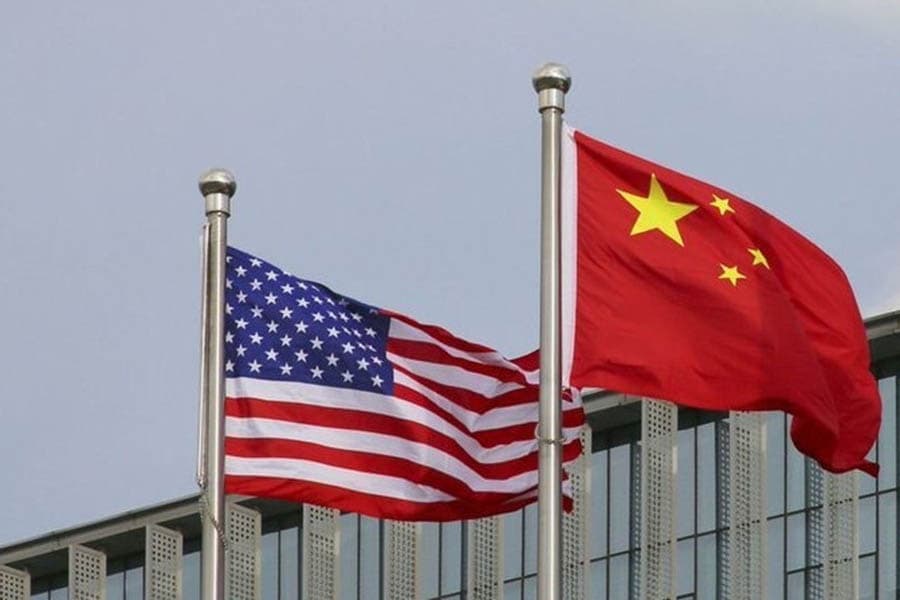
More people around the world now hold favourable views of China than of the United States, according to a new study by the Pew Research Center.
It marks the first time the non-partisan, US-based think tank has recorded such a result, the BBC reports.
The findings show favourable views of China have reached record highs in many countries, while perceptions of the US have worsened.
Respondents expressed low confidence in both President Donald Trump and Chinese leader Xi Jinping overall, though Xi scored higher than Trump, the BBC said.
More than 42,000 people across 36 countries took part in the survey between February and May, reports bdnews24.com.
Participants were asked whether they held very favourable, somewhat favourable, somewhat unfavourable or very unfavourable views of China and the US.
According to the survey, 25 of the 36 countries have more people with favourable views of China than of the US.
Jonathan Schulman, one of the study's researchers, told the British broadcaster this is the first time the research centre has recorded such a result since it began tracking global attitudes towards the two powers in 2002.
Pew previously recorded declines in positive views of the US in 2008, towards the end of former president George W Bush's administration, and in 2017, at the start of Trump's first term.
Even then, favourable views of China generally matched or remained slightly below those of the US, Schulman told the British broadcaster.
Spain, Indonesia, Italy, Greece and Canada recorded some of the biggest shifts in favour of China.
Only six countries continued to view the US more favourably than China: Poland, the Philippines, South Korea, India, Japan and Israel.
In a separate analysis, Pew found the median favourable opinion of the US across 20 countries has steadily fallen in recent years, while the median favourable opinion of China has risen.
Researchers also found that favourable views of China have increased in more than a third of the countries surveyed in recent years, based on an expanded dataset that includes the US.
Positive views of China reached record highs this year in Italy, Spain, Colombia, Mexico, Indonesia, Malaysia, Nigeria and Turkey.
The survey found middle-income countries generally viewed China more positively, while wealthier countries tended to hold less favourable opinions.
Singapore stood out as an exception, with one of the highest gross domestic product (GDP) per capita levels among the countries surveyed, while also recording a high level of favourable views of China.
The strongest support for China came from Pakistan, where about 90 per cent of respondents viewed the country favourably, while Japan recorded the lowest level at 11 per cent.
The survey also measured confidence in Trump and Xi to do the right thing in world affairs.
Xi received his highest rating in Pakistan at 83 per cent and his lowest in Japan at 7 per cent.
Trump's highest confidence rating came from the Philippines at 68 per cent, while his lowest was 4 per cent in the West Bank and East Jerusalem.
Schulman told the BBC that people generally do not hold particularly strong opinions about Xi compared with other global leaders.
He added that respondents were more likely to express stronger and more polarised views about Trump.
The survey also found that more people still believe the US government respects personal freedoms than China's government does, although the gap has narrowed.
Pew asked additional questions in several middle-income countries about the foreign policies of the two powers.
A median of 75 per cent of respondents said the US interferes a great deal or a fair amount in the affairs of other countries, compared with 45 per cent who said the same about China.
The broadcaster said other organisations have reported similar findings in recent years.
Polling company Gallup found last year that China overtook the US in global approval ratings, recording its widest lead in two decades.
The Asia Society's annual Global Public Opinion on China survey, however, suggested China's image, which weakened during the COVID-19 pandemic, has recovered only modestly.
Chong Ja Ian, a non-resident scholar at Carnegie China, told the broadcaster that the findings were not surprising.
He said the volatility of US policy, including the use of force and the resulting economic harm, has unsettled many countries.
Pew's survey began shortly after Trump intensified his rhetoric about annexing Greenland and after the US captured Venezuelan leader Nicolas Maduro.
The US also launched military action against Iran during the polling period, as per the BBC.
Chong said China currently appears to many countries as a more predictable actor and that Beijing has worked to improve its image, particularly in developing countries.
He added that China's higher favourability does not necessarily translate into stronger confidence in Xi, describing him as an “authoritarian leader”.