

Stock brokerage firms and merchant banks have significantly strengthened their financial position by increasing provisions against long-standing negative equity arising from margin loans, although the decade-old problem continues to weigh on the capital market.Finance
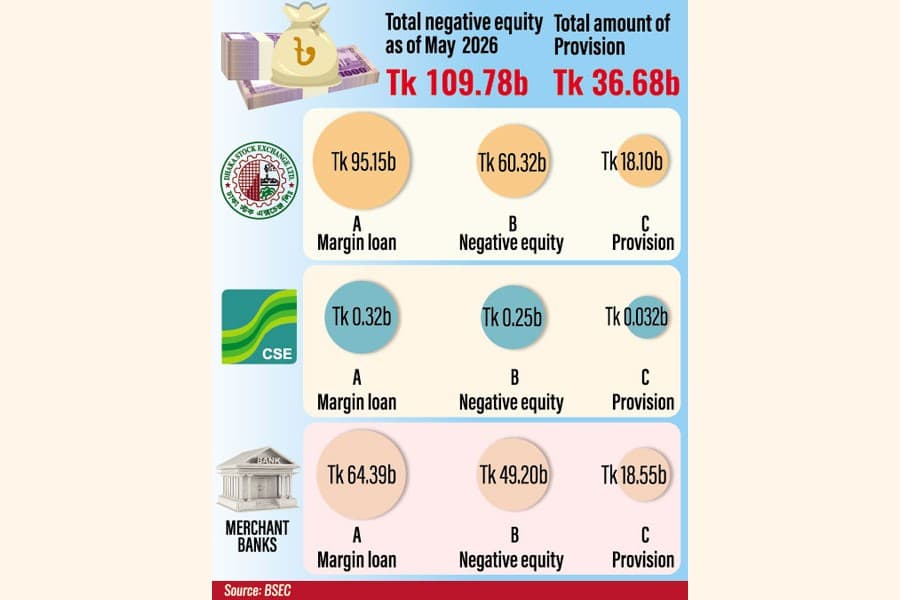
Provisioning against negative equity surged by 36 per cent over the past 18 months to Tk 36.68 billion as of May 30, up from Tk 27.0 billion in October 2024, as brokerage houses and merchant banks are complying with regulatory directives to build stronger financial buffers against potential losses.
Market insiders point out that this reflects a gradual improvement in the financial health of brokerage firms, as many institutions have strengthened their balance sheets through higher provisioning and tighter risk management practices following regulatory directives.
The Bangladesh Securities and Exchange Commission (BSEC) last year granted market intermediaries additional time to complete provisioning for unrealised losses and adjust negative equity.
Depending on board-approved roadmaps, most institutions received one- to two-year extensions, while a few were granted deadlines stretching to 2030 or even 2032.
The regulator also instructed all institutions enjoying extended deadlines to submit quarterly progress reports until full compliance is achieved.Economics
The scale of the exposure
The latest progress report, prepared by the securities regulator as of May 30 this year, showed that 146 brokerage houses and merchant banks, operating under the Dhaka Stock Exchange (DSE) and the Chittagong Stock Exchange (CSE), collectively extended Tk 160.41 billion in margin loans.
Of that amount, the industry's outstanding principal stood at Tk 78.20 billion, while accrued interest reached Tk 27.27 billion, taking the total outstanding exposure linked to negative equity to Tk 109.78 billion.
The report also showed that unrealised losses remained high at Tk 40.43 billion, reflecting the prolonged weakness of the stock market and the large number of defaulted margin accounts.
Despite the sharp rise in provisioning, outstanding negative equity has increased slightly from Tk 105.2 billion reported in October 2024. At that time, outstanding principal amounted to Tk 78.6 billion and accumulated interest stood at Tk 26.6 billion.
According to the latest data, the capital market had 1.41 million active beneficiary owner (BO) accounts, including 131,524 margin accounts. Among them, 36,610 accounts remained under negative equity, meaning the market value of pledged shares was lower than the outstanding margin loan balance.
Emergence of negative equityMaps
Before the 2010-11 stock market crash, lenders disbursed margin loans aggressively, boosting liquidity in the market. Some lenders exceeded regulatory limits and provided margin loans to artificially push certain stocks.
Stockbrokers and merchant banks provided margin loans using funds received from parent companies, most of which are banks.
The market surged in 2010 driven largely by margin loans and then crashed, causing massive erosion of asset values.
The problem, persisting since the 2010 debacle, has intensified over the past 16 years, becoming a heavy burden on the equity market and restricting its growth.
Over time, negative equity ballooned as lenders refrained from selling securities in margin accounts to make adjustments, hoping for a market rebound that never came.
Market operators said margin loans deepened financial distress and weakened intermediaries and banks, ultimately straining the entire capital market-even those who did not take margin loans.Exchanges
Previously, the securities regulator extended the deadline for negative equity adjustment at least six times, but most intermediaries failed to comply due to a prolonged bearish market.
As the market failed to recover as expected, unrecovered losses accumulated over the years, leaving brokers and merchant banks burdened with a large volume of negative equity.
Recognising the issue as one of the capital market's most persistent structural weaknesses, the BSEC in 2024 sought the intervention of the Financial Institutions Division under the Ministry of Finance to explore a permanent solution.
Nevertheless, the latest data indicate that market intermediaries have made substantial progress in strengthening their balance sheets through increased provisioning.
An analyst said the higher level of provisions would improve the industry's capacity to absorb potential credit losses and enhance the financial resilience of brokerage houses and merchant banks.
They, however, cautioned that the continued increase in outstanding negative equity underscores the need for sustained provisioning, recovery of long-overdue margin loans, prudent risk management and supportive policy measures to finally eliminate one of the country's longest-running capital market vulnerabilities.Economics
farhan.fardaus@gmail.com