


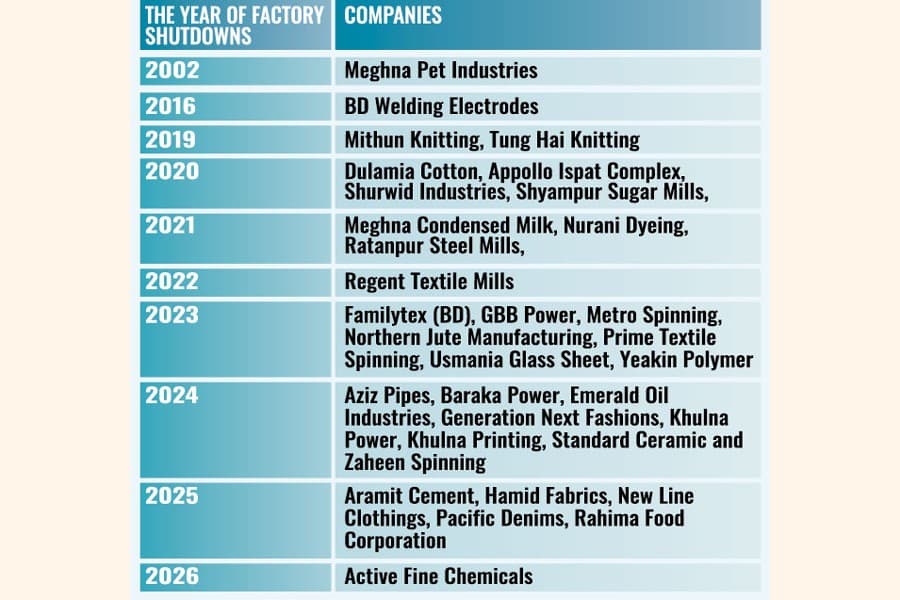
The Dhaka Stock Exchange (DSE) has found the factory of Active Fine Chemicals closed during an inspection, raising the number of non-operational listed manufacturing companies to 33.


The inspection, conducted on Thursday, is part of the bourse's ongoing drive to verify the operational status of listed companies and provide investors with a clearer picture of their actual business status.
According to DSE data, 32 listed manufacturing companies went out of operation between 2016 and Sunday, while another company has remained shut since 2002.
The list of non-functional companies becomes even longer when troubled financial institutions are taken into account. Five Islamic banks are currently undergoing merger, while five non-bank financial institutions (NBFIs) have been selected for liquidation.
Market analysts say the growing number of inactive listed companies exposes deep-rooted structural weaknesses in the country's capital market and highlights long-standing failures in regulatory oversight.
Many of these companies raised funds from the public through the stock market years ago but later became victims of sponsor disputes, financial irregularities, loan defaults, prolonged financial distress, or legal battles. Some failed to modernise operations or lost competitiveness amid changing market conditions.
Several manufacturing companies struggled with rising energy costs and persistent shortages of gas, making operations financially unviable.
Hamid Fabrics, for example, suspended factory operations in June last year, citing inadequate gas pressure. The company informed investors that production had already been disrupted for nearly two years before the worsening gas crisis forced a complete shutdown.
Appollo Ispat Complex has remained closed since October 2020. The manufacturer of Rani Marka Dheutin, which went public despite strong objections from the then finance minister AMA Muhith, fell into trouble within three years of listing after allegations of embezzlement involving its former directors.
Meghna Pet Industries has remained non-operational since 2002, making it the longest-closed company among listed firms. Company officials could not be reached for comment, as its page on the DSE website provides neither a contact number nor the name of the company secretary.
Market participants say the absence of timely regulatory intervention has allowed many troubled companies to remain listed years after production ceased.
The physical inspection is part of the exchange's broader initiative to verify the operational status of listed companies, said Md Sajedul Islam, shareholder director of the DSE.
In recent months, the exchange has intensified inspections as companies have not disclosed their operational status to investors.
Stock prices surged while factories remained shut
With factories remaining shut, machinery lying idle, and workers gone for long, several non-operational companies have posted sharp price increases on the bourses. Analysts suspect speculative trading and price manipulation behind the rallies.
Shyampur Sugar Mills, which has remained closed since December 2020, saw its share price jump about 42 per cent over the past month. The stock gained another 8.73 per cent on Sunday to close at Tk 225.50
Khulna Printing & Packaging, whose factory has not been producing anything for more than two years, rose 8.61 per cent on Sunday to Tk 16.40, its highest level in a month.
In some cases, companies appear to exist only on paper. Familytex (BD), for instance, no longer has any physical manufacturing assets. A recent investigation by a special team from the Chittagong Stock Exchange (CSE) found that the company's factory and other assets had already been sold to a private entity.
There are always some investors who are attracted to highly speculative stocks, said Saiful Islam, president of the DSE Brokers Association of Bangladesh (DBA). A segment of traders deliberately takes high risks, betting on sharp price swings rather than company fundamentals.
"They believe that once a stock starts rising, the relatively low free float of these companies makes it easier to drive prices further in their favour," Mr Islam added.
Analysts warn that continued trading of stocks of non-operational companies erodes investor confidence and damages the credibility of the capital market. They urge the regulator to take prompt action against the firms, saying cleaning up the trading board is essential to protect investors and foster the long-term development of the equity market.
Responding to concerns over the growing number of non-operational firms, Md Abul Kalam, executive director and spokesperson of the Bangladesh Securities and Exchange Commission (BSEC), said the stock exchanges are the frontline regulators and have the authority to take action against such companies.
"The stock exchanges can suspend trading or delist companies in accordance with the listing regulations," he added.
babulfexpress@gmail.com
L