


This article argues that the global economy in 2026 is not facing a single crisis, but a convergence of slower growth, persistent inflation, debt pressure, geopolitical fragmentation, technological disruption, and climate-related shocks. Together, these forces are testing the resilience of governments, markets, and developing economies.


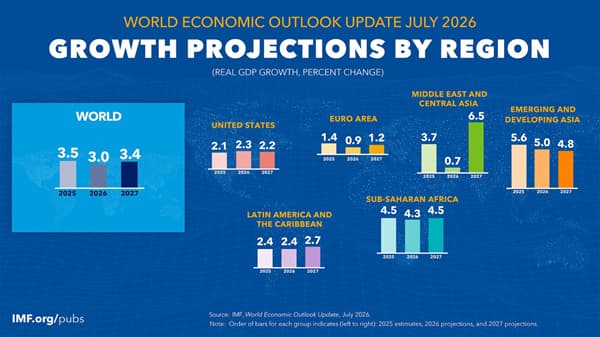
Global economic forecasts point to slower growth of around 2.7 per cent to 3.1 per cent in 2026. Although a 2008-style financial system collapse is not the baseline scenario, the global economy faces a structural stress test driven by persistent inflation, high public debt, geoeconomic fragmentation, and overvaluation in the AI and technology sectors.
The collapse of the Iran-US ceasefire, combined with the renewed threat of closure in the Strait of Hormuz, has sent global oil and refined-product inventories sharply lower. Oil and petrol prices are rising again, underscoring the failure and wider cost of Trump's military intervention in the Middle East-not only for the United States, but for the rest of the world. The latest escalation in the US-Iran war has done more than raise the geopolitical risk premium in global energy markets. It has also weakened the reassuring market assumption that such conflicts, while recurring features of the current landscape, will ultimately remain contained.
Key systemic risks include rising interest costs that are straining heavily indebted governments, with the United States facing annual interest payments above $1 trillion and Europe confronting major refinancing pressures. Persistent inflation, fuelled in part by supply-chain shifts and energy price spikes, is prompting central banks to keep policy tighter for longer, raising the risk of weaker consumer spending and business investment. Heavy capital spending on AI infrastructure, combined with limited near-term revenue, has increased concerns about a potential market correction and high failure rates among technology start-ups. Meanwhile, the rapid growth of unregulated private debt and non-bank lenders, known as shadow banking, has heightened vulnerability to sudden economic shocks.
A UNCTAD Report highlights that fiscal strains and tightening monetary spaces threaten to lock the world into a lower-growth path, particularly impacting developing nations. The report also mentions that the global economy has shown resilience, but the outlook remains clouded by trade tensions, fiscal strains and persistent uncertainty. Growth is expected to slow to 2.7 per cent in 2026, below 2025 levels and the pre-pandemic average, as subdued investment and structural headwinds weigh on momentum despite easing inflation and monetary loosening.
The report suggests without stronger policy coordination, today's pressures risk locking the world into a lower-growth path. Tight fiscal space, uneven disinflation and weakening multilateral cooperation are slowing progress towards the Sustainable Development Goals, particularly in developing and climate-vulnerable economies.
A recent New York Times article by Pierre-Olivier Gourinchas, the former chief economist of the IMF, gave a clearer view of the global economic situation. Gourinchas left the IMF in June, and the article came after the IMF's latest World Economic Outlook update. No longer speaking officially for the IMF, he was able to be more direct. He said that his time at the IMF, which began with Russia's invasion of Ukraine in 2022, was shaped by the economic impact of war - including Trump's tariffs and the conflict in the Middle East.
He described the global economy as being caught in the "crosscurrents of war and technology." It said there was a "modest slowdown" in global growth-to 3.0 per cent in 2026 and 3.4 per cent in 2027, compared to the average of 3.5 per cent in 2024-25. The slowdown reflected the effect of the war in the Middle east which had been partially offset by investment in AI technology. "Global economic activity and the outlook are being shaped by two major forces, pushing in opposite directions. First is the negative supply shock induced by the war in the Middle East. Second is the ongoing positive technology shock manifesting in accelerated momentum of the global technology cycle, in no small part driven by advances in and deployment of artificial intelligence (AI) tools."
"Too often," he wrote, "these shocks are viewed as isolated disruptions. They are not. They are interconnected symptoms of a deeper fragmentation reshaping the global economy. This fragmentation, both geopolitical and geoeconomic, risks ushering in what could become a new age of war. One defined not necessarily by constant military confrontation but by a persistent undercurrent of strategic economic rivalry and coercion and rising economic insecurity. And yes, also increased risks of actual wars." "The result," Gourinchas wrote, "is a dangerous feedback loop. As countries seek to insulate themselves from perceived risks, they risk fragmenting the global economy further still. This, in turn, encourages further insulation efforts-through tariffs, industrial policy, financial regulation, export controls or rising military spending."
He went on to recall a crucial historical experience and its obvious parallels with the present situation."We have seen such dynamics before. The world's economy was highly integrated at the turn of the 20th century, at the height of the British-led expansion of trade, capital flows and immigration. What followed was a period of intense deglobalization, coinciding with rising nationalism and militarization-and two world wars. To assume that today's economic integration-and peace-are here to stay would be complacent."
Gourinchas called for a "course correction" based on a "more cooperative system built on shared rules and continued integration. But in the next sentence he noted that developments are proceeding in the opposite direction.
The world's major powers are increasingly seeking strategic advantages by identifying chokepoints, adopting inward-looking policies, and expanding military spending. The future of American economic power will depend on the interaction between Trump's ambitions, the global response to them, and economic developments beyond direct government control, including advances in AI.Trump has reshaped economic statecraft by using tariffs, export controls, and industrial policy in new, often controversial, and at times unlawful ways.
The rise in war-related inflation was expected, but inflation had already been increasing before the conflict began. Higher oil prices intensified the pressure, and inflation is likely to remain well above the US Federal Reserve's 2.0 per cent target for the foreseeable future, even if the ceasefire holds and oil soon resumes flowing through the Strait of Hormuz. But now the ceasefire is over.
Some economists argue that the US economy has entered a period of structurally higher inflation, based on inflation rates in the 2020s that are consistently higher than those seen between 1995 and 2020. The key question is whether this reflects a lasting structural shift or simply a series of severe economic shocks.
In response to rising inflation, interest rates are rising as if this will simply compensate investors for the risk of inflation. The reality is that it will increase the economy's inability to cope with the breakdown that is already in progress.The guiding fiction in the idea that rising interest rates will slow price inflation by reducing investment and employment that banks help the industrial economy by creating credit to lend to companies to expand the economy. But that is not what banks do under the neo liberal economic system. They lend against assets already in place and available to be pledged as collateral, for the purpose of buying more real estate, bonds and stocks. The effect of these loans is to inflate asset prices, not consumer prices.
Governments and their central banks may pretend to be lowering interest rates to spur the economy, but the basic reason is to re-inflate prices for financial securities and real estate. That's the main aim of today's neo-liberal economic system. Its aim of increasing fortunes by creating debt-leveraged asset-price gains has turned economies into a great Ponzi scheme.
A global food crisis is also likely approaching - driven by the collapse of supply chains feeding the agri-food system, a consequence of the war against Iran and the resulting blockade of the Strait of Hormuz. The prospect has gone largely unnoticed by most political and economic actors.
Supply crises, as a rule, are resolved through the Law of Supply and Demand. When supply falls, prices rise; those who can afford to pay grumble but pay, while those who cannot find a cheaper substitute. Or do without.
Supply chain disruptions and extreme weather often affect individual countries and are usually absorbed through global trade. The current situation is different: farmers worldwide are facing shrinking supplies and rising input costs for fertilisers, pesticides, diesel, lubricants, and transport. One thing is certain: farmers everywhere follow news about a Super El Niño more closely than most people do.
Agriculture has always been a business of thin margins and constant uncertainty, where disincentives weigh heavily. Whether to skip this planting season - or to plant less - is a decision each farmer makes individually. Agriculture is a fragmented activity, loosely coordinated at best. There is simply no way to know how many producers have chosen not to plant. But since February 28, millions across the world have made that choice.
Food planted today will take several months to be harvested, processed, transported, distributed, and finally consumed. What we eat today was planted months ago - perhaps more than a year ago. This includes animal products, since livestock are fattened on plant-based feed. The implication is that the world is locking in a crisis that will not erupt tomorrow, but months from now - possibly next year.
On June 11, 2026 Bangladesh's finance minister presented the FY2026-27 national budget, a record BDT 9.38 trillion, or about USD 77 billion. The expansionary budget targets 6.5 per cent GDP growth, seeks to reduce inflation to 7.5 per cent, and supports the country's goal of becoming a trillion-dollar economy. However, recent data suggest that growth is slowing. The economy expanded by only 2.2 per cent in the third quarter of the previous fiscal year, compared with 4.53 per cent in the same quarter a year earlier. This slowdown has been attributed to a sharp decline in manufacturing activity, as well as weaker growth in agriculture and services.
Like many countries, Bangladesh's immediate concern is an inflation spiral that could worsen the cost-of-living crisis. Renewed US aggression against Iran has pushed oil prices higher again and threatens to add fresh inflationary pressure to the economy. Brent crude has risen from $72 to more than $96 a barrel in recent weeks, meaning Bangladeshis may have to adjust to higher fuel prices. Higher oil prices could not only drive inflation further upward but also weaken economic growth.
If inflation expectations become de-anchored, businesses will pass rising costs on to consumers, pushing prices higher still. That dynamic raises the risk of stagflation-persistently high inflation alongside an economic downturn-especially if the central bank responds with sharp interest-rate increases to bring inflation under control.
Catastrophic floods and landslides, which began around July 6 in Bangladesh and intensified over the following week, have killed at least 54 people. More than one million people in over 600,000 households have been impacted across seven districts, according to the Ministry of Disaster Management and Relief's update of July 14. The death toll is expected to rise further as floodwaters recede and damage assessments reach remote areas. As floodwaters begin to recede, thousands of survivors are returning to homes reduced to ruins, with food supplies, livestock and personal belongings swept away.
The deaths and destruction reflect decades of development policy that have left Bangladesh's urban and rural poor highly vulnerable and poorly prepared. In Dhaka, the two city corporations spent more than Tk 2.62 billion on drains and culverts between 2021 and 2024. Yet on July 12, more than 100 millimetres of rain inundated large parts of the capital, paralysing the city.
The central lesson is that global economy in 2026 is being tested not by one isolated shock, but by the interaction of several reinforcing crises. Slower growth, stubborn inflation, high debt, geopolitical rivalry, financial fragility, technological disruption, food insecurity, and climate-related disasters are converging in ways that expose the limits of existing policy frameworks. For countries such as Bangladesh, these pressures are especially severe because global instability quickly becomes domestic hardship through higher prices, weaker growth, fiscal stress, and greater vulnerability to natural disasters. Avoiding a deeper crisis will require more than short-term monetary tightening or emergency relief. It will demand coordinated public investment, stronger social protection, resilient infrastructure, food-security planning, and renewed international cooperation. Without such a shift, the world risks entering a prolonged period in which economic insecurity becomes the normal condition rather than the exception.