The benchmark index of the Dhaka Stock Exchange (DSE) extended gains for a second week, surpassing 5,800-point mark for the first time in nearly two years, as investors responded positively to market-friendly fiscal measures and a series of reform initiatives.
Market operators said the latest rally reflects a gradual return of investor confidence after a prolonged period of subdued trading, supported by improving macroeconomic indicators, political stability, stronger foreign exchange reserves and the government's renewed commitment to developing the capital market.
The week opened on a strong note, with broad-based accumulation of lucrative stocks, aided by renewed optimism surrounding regulatory support and resilient market participation.
However, the bourse witnessed a brief correction in the middle of the week as investors moved to realize gains from recently appreciated blue-chip, while selective buying in momentum-driven stocks limited the downside.
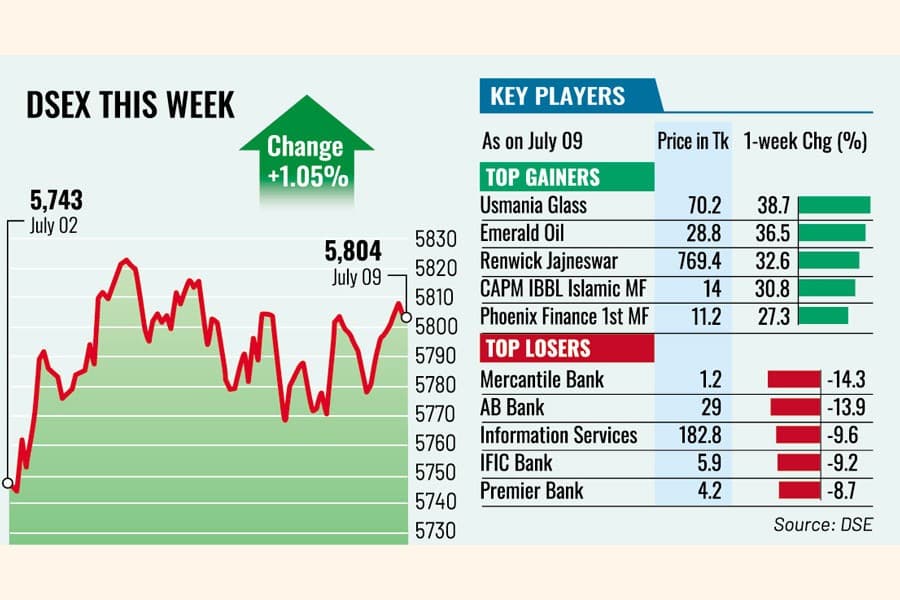
The benchmark DSEX index gained 60 points, or 1.05 per cent, to close the week at 5,804, hitting a nearly two-year high since September 2, 2024.
This week, the market traded for five sessions. Of them, three sessions closed higher while two saw marginal correction.
According to EBL Securities, the Prime Minister's remarks on capital market development and expectations of margin rule revisions, prompted broad-based buying interest and allowed the index to close the week higher.
Akramul Alam, Head of Research at Royal Capital, said the combination of supportive fiscal policies and regulatory reforms has created a more favourable investment climate, encouraging investors to gradually increase their exposure to equities.
"The market remained undervalued for a long time, so investors are gradually regaining confidence to invest in stocks," said Mr Alam.
According to him, investor sentiment received a major boost since the appointment of renowned chartered accountant Masud Khan as chairman of the Bangladesh Securities and Exchange Commission (BSEC) in early June.
"The new BSEC leadership has sent a strong signal that restoring discipline, transparency and investor confidence is now a top priority," he said.
The new BSEC leadership has already introduced several market-friendly reforms aimed at restoring investor confidence and improving market efficiency.
These include the withdrawal of floor prices on shares of Beximco and Islami Bank, restoring the stock exchanges' authority to determine circuit breakers and trading rules, and strengthening market surveillance to improve transparency and discipline.
"The regulator's reform initiatives have created positive expectations among investors, who believe the market is moving towards a more transparent and efficient environment," he added.
After assuming office, the BSEC chief also announced plans to conduct a comprehensive review of existing securities regulations, IPO approval procedures and reporting requirements to make the regulatory framework more efficient and investment-friendly.
If the reform momentum continues alongside further improvements in macroeconomic stability, the stock market could sustain its recovery in the coming months despite lingering challenges from tight monetary conditions and relatively high interest rates, added Mr Alam.
Investor confidence also received a further boost from several capital market-friendly measures incorporated into the approved Finance Bill 2026.
The fiscal measures include a lower tax on dividend income, removal of investment ceilings for claiming tax rebates on investments in mutual funds, and the continuation of tax exemptions on income earned from zero-coupon bonds for individual investors.
This week, two other indices of the the DSE also went up. The DS30 Index, which tracks blue-chip companies, advanced 16 points to 2,177, while the Shariah-based DSES Index rose 20 points to 1,189.
Price surge of selective blue chip stocks such as Beximco Pharma, Unique Hotels, Shepherd Industries, Bangladesh Spinning Corporation and GPH Ispat, collectively contributed one-third points to the benchmark index's weekly gain.
Market participation remained strong, with total turnover on the DSE reaching Tk 69.2 billion during the week, compared with Tk 57.4 billion in the previous holiday-shortened week.
Accordingly, average daily turnover stood at Tk 13.83 billion, down 3.5 per cent from Tk 14.33 billion a week earlier.
The textile sector accounted for the largest share of weekly turnover at 18 per cent, followed by general insurance (12 per cent) and pharmaceuticals (10 per cent) sectors.
Market breadth remained firmly positive. Of the issues traded, 251 advanced, 122 declined, and 15 remained unchanged, reflecting broad-based buying interest.
Almost all major sectors posted gains. The power sector recorded the highest gain of 2.2 per cent, followed by pharma, food, non-bank financial institutions, and telecom.
Malek Spinning emerged as the week's most-traded stock, with shares of Tk 2.08 billion changing hands. It was followed by Beximco Pharma, IT Consultants, Beximco and BRAC Bank.
The Chittagong Stock Exchange (CSE) also ended the week higher. Its All Share Price Index (CASPI) rose 108 points to 15,515, while the Selective Categories Index (CSCX) gained 57 points to close at 9,493.
babulfexpress@gmail.com