


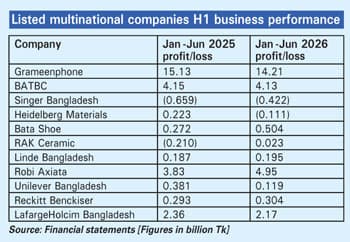
Listed multinational companies delivered mixed but largely weaker earnings in the first half (January-June) of 2026 as persistent inflation, subdued consumer demand and higher operating costs continued to squeeze profit margins.


Market analysts said prolonged inflation eroded consumers' purchasing power, while elevated energy costs and sluggish economic activity weighed on sales growth and corporate profitability.
Economic activity has remained subdued since the political transition in August 2024, with tight monetary and fiscal policies further dampening private investment and household spending.
Akramul Alam, head of research at Royal Capital, said overall economic activity remained sluggish amid lingering macroeconomic challenges, while higher input costs increased operating expenses, hurting the profitability of multinational companies.
He also said the tight monetary and fiscal stance maintained by Bangladesh Bank since the political transition continued to suppress demand.
Eleven listed multinational companies that follow the January-December financial year have so far released their financial results for the January-June period of 2026.
Of them, four reported lower profits, one remained in the red due to a heavy debt burden and another slipped into losses. Meanwhile, four posted profit growth and one returned to profitability.
Marico Bangladesh and Berger Paints Bangladesh were excluded from the comparison as they follow the April-March financial year instead of the January-December calendar year.
The combined net profit of the 11 companies edged up marginally to Tk 26.07 billion in the first half of 2026 from Tk 25.96 billion in the same period a year earlier.
Their aggregate revenue remained almost flat at Tk 219.40 billion, compared with Tk 219.56 billion in the corresponding period of 2025, according to their financial statements.
As multinational firms operate across diverse sectors, the reasons behind profit erosion vary from company to company, analysts say.
Higher finance costs significantly affected companies with large debt burdens, while lower government spending under the Annual Development Programme (ADP) weighed on cement manufacturers by reducing construction activity.
Singer Bangladesh, for example, remained in the red, reporting a loss of Tk 422 million in the January-June this year, although sales grew 3.4 per cent to Tk 14.15 billion during the time.
The company, however, said sales remained below expectations as persistently high inflation, geopolitical uncertainties and adverse weather conditions continued to dampen demand for consumer electronics and home appliances.
Broader slowdown in the construction industry and reduced public sector spending hit cement manufacturers. As a result, Heidelberg Cement entered into fresh losses, reporting a loss of Tk 111 million in the January-June this year while sales dropped 11 per cent during the time.
LafargeHolcim Bangladesh, another multinational cement maker, also saw 8 per cent lower profit to Tk 2.17 billion in the first half of 2026.
The multinational companies failed to see growth in revenue and profit mainly because of macroeconomic worries at a time when consumers had little disposable income with inflation hovering over 9 per cent.
Bangladesh's top two mobile operators --- Grameenphone and Robi Axiata, posted contrasting earnings in the January-June this year, owing to diverging cost structures and financial strategies amid a wider economic slowdown.
Robi's profit surged 29 per cent to Tk 4.95 billion in the January-June 2026, driven by strong revenue growth, higher data consumption and an expanding subscriber base.
On the other hand, GP's profit dropped 6 per cent year-on-year to Tk 14.21 billion while revenue registered 2.5 per cent de-growth as the challenging macroeconomic environment weighed on business performance.
GP Chief Executive Officer Yasir Azman said the company demonstrated operational resilience despite a difficult business environment.
"We maintained a healthy EBITDA margin of around 58 per cent, demonstrating continued cost discipline and operational efficiency despite higher investments and a challenging operating environment," he said in a statement.
Unilever Consumer Care experienced a 48 per cent decline in profit year-on-year to Tk 119 million in January-June 2026 because of various factors including a fall in revenue earnings.
British American Tobacco Bangladesh posted a marginal 0.5 per cent decline in profit to Tk 4.13 billion, while net revenue fell 6 per cent to Tk 38.31 billion amid persistently high inflation.
However, Bata Shoe Company (Bangladesh) posted an impressive 86 per cent year-on-year profit growth to Tk 504 million in the first half of 2026, supported by stronger sales and improved operating cost management.
The footwear manufacturer's revenue rose 10 per cent to Tk 5.68 billion, driven primarily by Eid festive sales, supported by new product assortments and improved customer response to updated designs, said the company in its earnings note.
Reckitt Benckiser (Bangladesh) secured 4 per cent year-on-year growth in profit to Tk 304 million in January-June 2026, despite 2 per cent fall in sales to Tk 2.75 billion during the time.
Akramul Alam, head of research at Royal Capital, said the pace of recovery in corporate earnings would largely depend on easing inflation, stronger consumer confidence and a sustained rebound in economic activity over the coming months.
babulfexpress@gmail.com