


The Economist Intelligence Unit (EIU), a sister concern of the Economist magazine has published its 2026 edition of liveability index. According to the EIU, Dhaka's position remains unchanged at 171st, like last year's, out of 173 cities in the world. Although its score has slightly improved from last year's 41.7 to 42 on a scale of 100, the position is the third worst, ahead of war-torn Tripoli and Damascus. It can be safely assumed that had there been no war in those two cities, Dhaka would have emerged at the bottom of the list.
This is disgraceful not only for the inhabitants of this capital city but also for the nation. The EIU's liveability index is based on 30 indicators across five categories---stability, healthcare, culture and environment, education and infrastructure. Dhaka's score is the lowest in infrastructure at 27 and highest in education at 67. The scores in healthcare, culture and environment and stability are 42, 41 and 42 respectively.
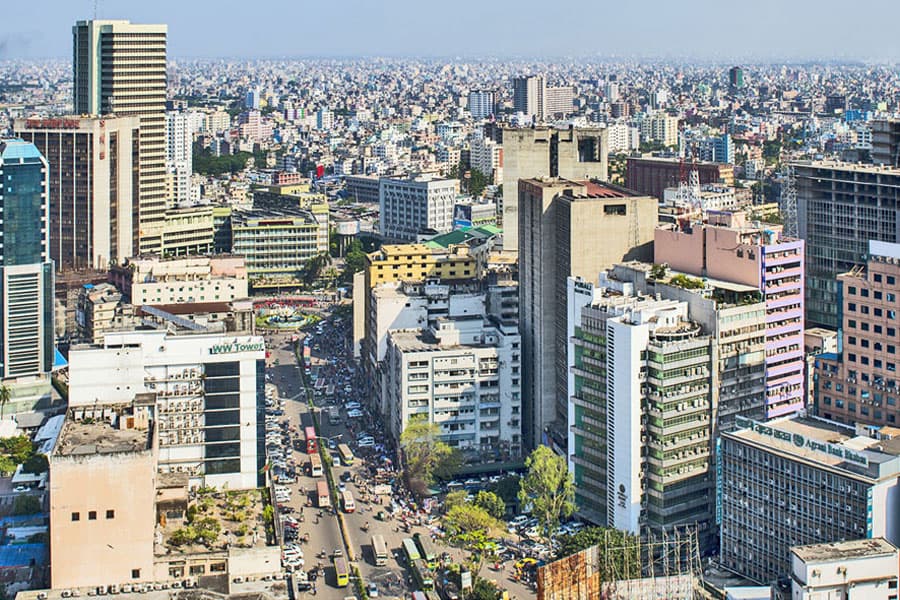
Dhaka's low category score in infrastructure is not for nothing. In fact, its poor public transport, road networks, utilities and green ecosystem are a cause for serious concern. Due to unplanned and haphazard growth of the city, its urban and natural ecosystems have become a casualty. Without applying the EIU's measures to determine the status of infrastructure, a close look at the rapid addition of concrete jungle over the decades should reveal how the mayhem of the biodiversity of the city has taken place. Apart from destruction of green covers, water bodies and low-lying flood retention areas have been brought under massive housing programme through land filling.
Both the capital city and the port city are now reaping the bitter fruit of unprecedented waterlogging on account of this inconsiderate spree of urban development. Construction of buildings including skyscrapers without the required road spaces and other amenities, the city's growth has been lopsided. Fifty-five years ago, it was a provincial city with a population of only 1800,000. The quality of life was modest and people enjoyed living here. Today its expansion to 1,600 square kilometre is overburdened with 36 million inhabitants. A few link roads have been added, a few others broadened but essentially they remain disproportionately inadequate.
The rivers girdling the city have served as the lifeline of the city for centuries but release of domestic garbage and industrial waste into these rivers along with encroachment on them are fast strangulating the Buriganga, Turag, Balu and Sitalakkhya. Heavily polluted and shrunk, they are now gasping for breath. Extraction of groundwater has led to the fall of water table to a precarious level. In case of a strong earthquake, the devastation of this city can be cataclysmic.
Apart from these topographic and environmental risks, the day-to-day life has been seriously handicapped by chaotic traffic and inadequate utility services. While the rural-to-city migration continues unabated, the utilities and transport networks fail to keep pace with the increase in the city's population. The entire service system in the city is overstressed. As a result, people's productivity in office works, factories and industries suffers a lot. This translates into economic losses of the city and the nation as well.
A fall in the liveability on such scores means the quality of life gets deteriorated proportionate to the fall of index. Mismanagement of traffic, poor waste--- including hospital waste, management, air and noise pollution continue to drag down the quality of life. Particularly Dhaka's air pollution is so severe that it stays at the top tiers of the world's worst polluted cities. All these factors make the city uninhabitable. If things continue like this and the population of this city predictably grow to a frightening size of 52 million by the year 2050, the liveability of this city will nosedive to an unimaginable depth.
It certainly points to a grim prospect. Unless the policymakers think of pragmatic solutions to the crisis likely to unfold, Dhaka will collapse under its own weight, forcing its abandonment. The one unchallenged solution ought to be decentralisation of administration and creation of economic zones in order to prevent further migration of people to Dhaka from all corners of the country. Even better it would be if a reverse migration can be initiated through creation of small clusters of productive zones after the Chinese models.
This needs a comprehensive plan and vision for the well-being of the population. Without creating opportunity for employment and small productive centres in rural areas, the streams of migration to the city cannot be stopped. At the same time, population growth now on the rise because of lax family planning has to be curbed immediately. The family planning programme has to be revived in order to keep the family size small. Bangladesh is struggling to feed the present oversized population. Climate change is threatening food security of the nation. The floods in the southeast, rather unprecedented in several areas, and northeast give an indication of what the nation has to brace for in the days to come.
Predictably, the coastal belt in the south is destined to be engulfed by the rising sea. Together with river erosion, the predicted coastal deluge can trigger influx of more and more climate refugees into the capital city. To avert such consequences, there is no alternative to developing smaller manufacturing and commercial hubs in small towns and even in rural areas.
nilratanhalder2000@yahoo.com