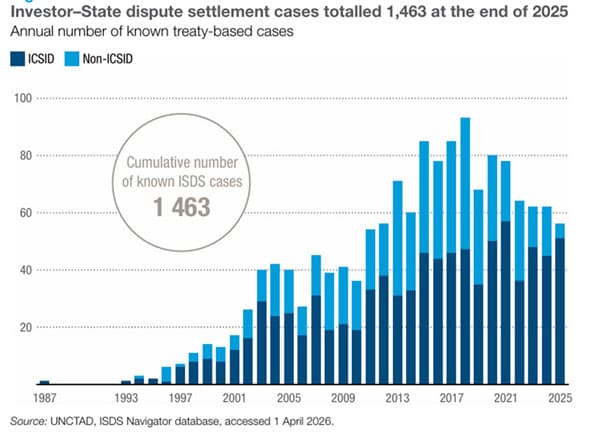
Globally, investor-state disputes have become a concern, especially for developing nations, as shown by the surge in investor-state dispute settlement (ISDS) over the last decade. At the end of 2025, the cumulative number of ISDS cases stood at 1,463, according to UN Trade and Development (UNCTAD). The actual number may be higher, as some arbitrations are confidential at initiation. These may become public later, increasing the total number of ISDS cases. Nevertheless, the number and status of revealed cases are sufficient to understand the implications.
UNCTAD, in its World Investment Report 2026, unveiled last week, focused on this matter as part of its annual review of foreign direct investment. Globally, UNCTAD is the only international agency that consistently tracks ISDS through its investment policy hub and compiles relevant statistics to provide a big-picture view. However, UNCTAD statistics cover investor-state arbitration cases brought under bilateral investment treaties (BITs) and treaties with investment provisions. They do not include cases based solely on investment contracts (State contracts), national investment laws, or cases in which a party has signalled intent to submit a claim but has not commenced arbitration.
Again, most ISDS cases are settled through the International Centre for Settlement of Investment Disputes (ICSID), one of the five organisations of the World Bank Group. It is the world's leading institution devoted to international investment dispute resolution. Established in 1966, it provides for the settlement of disputes by conciliation, mediation, arbitration, or fact-finding.
UNCTAD statistics showed that from 1987 to 2025, 137 countries and one economic grouping (the European Union) were respondents to one or more ISDS claims. The largest number of cases, 98, was reported by respondents in Europe and Latin America and the Caribbean, together accounting for about 60 per cent of all cases. In 2025, cases were initiated against 37 countries, and about 80 per cent of the new cases were brought against developing countries, including seven Least Developed Countries (LDCs). The LDCs are: Angola, Bangladesh, Comoros, Guinea, Myanmar, Senegal and the United Republic of Tanzania. Of these, the Comoros and Guinea faced their first known ISDS claims each.
In the last year, Bangladesh became a respondent as Mohammed Saiful Alam (S Alam) and others (Farzana Parveen, Ashraful Alam, and Asadul Alam Mahir) moved to ICSID to seek arbitration. The case was registered on November 25, 2025, by the Secretary-General of ICSID following the petitioner's request to commence arbitration proceedings. Under ICSID rules, a party must file a request for arbitration. Once screened by the relevant centre wing, the request may be accepted or refused. If refused, the petitioner may submit a fresh application. If accepted, the centre determines the number of arbitrators and the method of their appointment. The next steps are appointing tribunal members, constituting the tribunal, and holding the first session with the disputing parties.
S Alam and others invoked the Bangladesh-Singapore 2004 bilateral investment treaty as Singaporean investors, claiming that the Bangladesh government had violated it. Earlier, they also claimed that as Singaporean citizens, they should be protected by the rights granted by Bangladesh's 1980 law on foreign private investment. Interestingly, theirs Family obtained Singapore citizenship between 2021 and 2023, having renounced Bangladeshi nationality in 2020. S Alam Group is a major commercial and industrial conglomerate in Bangladesh, based in Chittagong. The Bangladesh government has accused the group for siphoning billions of dollars from Bangladesh during the autocratic regime of Hasina. The central bank also alleges that the conglomerate used fraudulent loans and inflated import invoices to drain multiple banks.
For Bangladesh, being dragged into ICSID by foreign investors is not unique. In the last two decades, the country was respondent to nine disputes filed by six multinational energy companies. Six disputes have been concluded, and three are pending. Of the concluded cases, one was annulled, and one ended without an award because the tribunal found it lacked jurisdiction. Of the remaining four cases, Bangladesh won one verdict, while investors won three. Proceedings before ICSID are time-consuming and costly for countries like Bangladesh. It requires skilled manpower, strong legal expertise, and sophisticated logistics. Besides ICSID, other entities exist for investment-related commercial dispute settlement. International Chamber of Commerce (ICC) Arbitration is one such mechanism.
The UNCTAD report showed that in the last year, at least 58 ISDS proceedings were concluded. 38 per cent were decided in favour of the State, and 29 per cent in favour of the investor, with monetary compensation awarded. Again, 17 per cent were settled; in most cases, the terms of settlement remained confidential. In the remaining cases, either proceedings were discontinued or the tribunal found an IIA breach but did not award monetary compensation.
In most cases, investors have invoked BITs, and around 85 per cent of the treaties in force today were signed in 2010 or earlier. In the last year, the majority of the cases were based on old-generation treaties concluded before 2010, with the largest share originating in the 1990s. These treaties give investors greater leverage to drag states into international dispute settlement due to broad, vague investment protection standards. In this connection, the UNCTAD report said: "This outdated system may constrain governments' ability to regulate in the public interest and leaves them exposed to ISDS claims." UNCTAD also argue that transitioning from this outdated framework to a more balanced regime requires decisive reform actions so that the modern treaties can promote sustainable investment and minimise the risk of disputes. Amid a surge in geopolitical tensions and conflicts across the world, balancing investment protection with the state's right to regulate is becoming more challenging.