



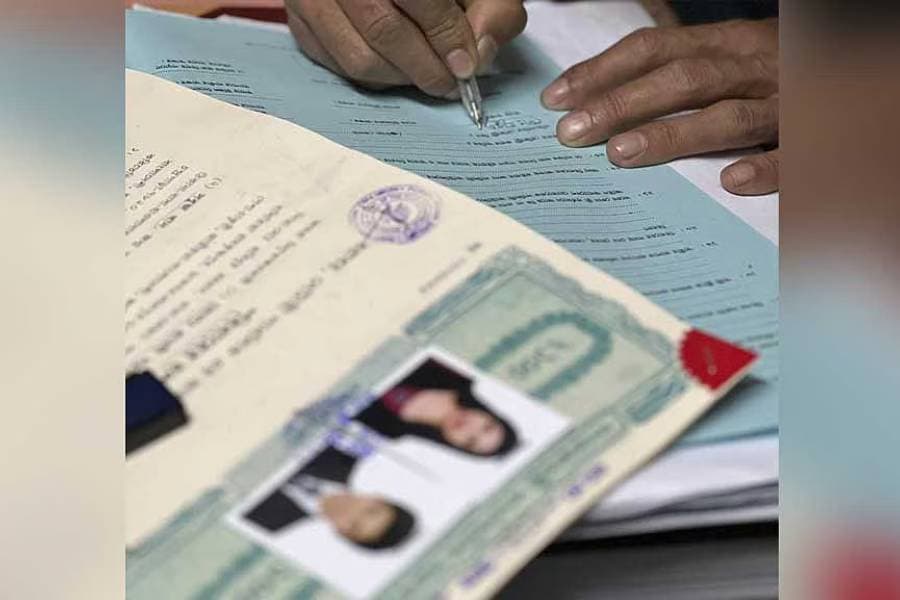
The High Court has issued a rule asking why the government should not be directed to formulate guidelines governing the payment and recovery of dower (Denmohor) in Muslim marriages, taking into account inflation and the declining purchasing power of money.
The bench of Justice Ahmed Sohel and Justice Fatema Anwar issued the rule on Monday.
The court asked the secretaries of the ministries of law, women and children affairs, religious affairs and home affairs, as well as the Bangladesh Law Commission, to respond.
The public interest writ petition was filed on Jul 5 by lawyer Fahmida Akter, who appeared for the petitioner during the hearing.
According to the petition, a policy should be framed under Section 10 of the Muslim Family Laws Ordinance, 1961 to protect women’s financial rights by considering inflation and the erosion of the value of money when dower is recovered after a long period.
The petition also referred to Articles 7, 27, 28 and 31 of the Constitution concerning fundamental rights.
Explaining the court’s rule, Fahmida said it sought to know why guidelines should not be introduced under Section 10 of the ordinance to determine the method, principles and procedure for assessing and recovering dower payable after a reasonable period from the date of marriage.
She said the directive had been sought to ensure justice in line with Shariah law and to safeguard women’s financial rights within marriage.
Describing the legal basis of dower, Fahmida said marriage under both law and religion is a civil contract, and dower constitutes the consideration for that contract.
She said payment of dower becomes the husband’s legal obligation from the moment the marriage is solemnised and is treated as a debt owed by him.
If the husband dies before paying the dower, the wife may recover it from his estate.
Likewise, if the wife dies before receiving the dower, the claim does not lapse, and her lawful heirs may pursue recovery through legal action.
Fahmida argued that long delays in payment significantly reduce the real value of dower because of inflation.
She cited the example of a marriage in which Tk 200,000 is fixed as dower, with Tk 100,000 paid immediately and the remainder deferred.
If the balance is paid 20 years later, its purchasing power would be substantially lower, depriving the wife of the financial protection intended by the law.
She said the court observed that dower is not meant to be treated as a permanently deferred payment under the law. Rather, the husband is legally obliged to pay it at the time of marriage or shortly afterwards.
The court also observed that widespread social practices have resulted in dower often remaining unpaid for years, stressing the need for proper enforcement of the law alongside greater public awareness of legal rights.
The court also observed that a wife is entitled to receive her dower in all circumstances and that the husband is legally bound to pay it.