

Scheduled banks now seem to be in a quandary with excess liquidity buildup following deposit resurgence and weak loan demand amid prolonged economic slowdown, bankers say.


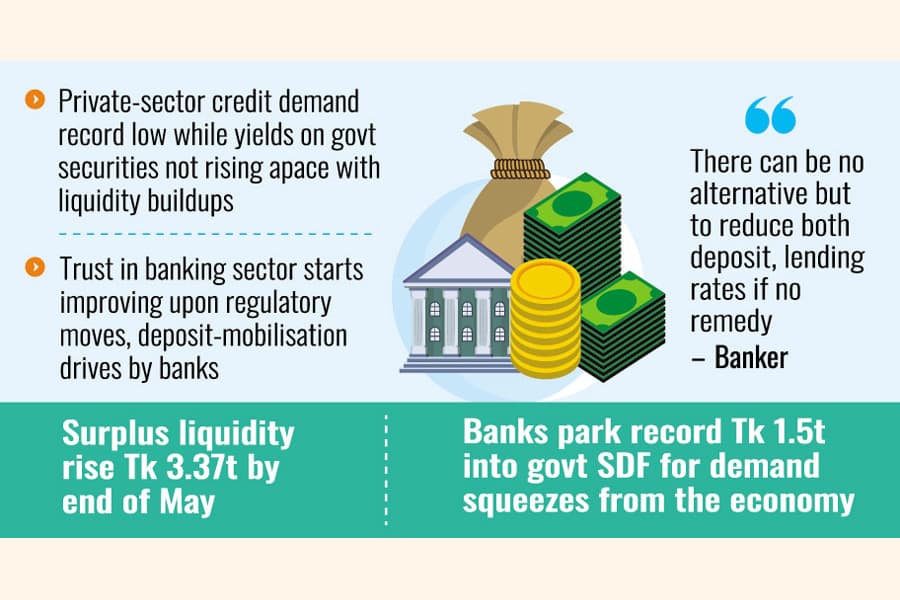
Amid various regulatory moves and deposit-mobilising drives by the country's banks, people's trust in the once-shaken banking sector started improving. As a matter of fact, the deposit growth keeps rising, which basically helps boost their stock of excess liquidity.
But such liquidity buildup fails to lighten up mood of the bankers because the demand for private-sector credit has fallen to a record low. On the other hand, yields on government securities have not risen apace with abundance of liquidity in the banking system.
As a result, banks are parking record amounts of surplus funds with the central bank's low-yielding deposit window called Standing Deposit Facility (SDF) where the rate is 7.50 per cent, much lower than that of call money.
According to Bangladesh Bank (BB) data, affluent banks altogether kept around Tk 1.50 trillion in the SDF in June last, which is a record in the history of the banking sector.
The official data showed that the monthly volume of funds banks parked into the SDF was recorded Tk 545 billion, Tk 578 billion, Tk 444 billion and Tk 444 billion in February, March, April and May.
Seeking anonymity, a BB official has said the volume of excess liquidity in the banking industry continued to rise in recent months due mainly to shrinking investment avenues under prevailing macroeconomic sluggishness.
Citing data, the central banker said the volume of excess liquidity was less than Tk 2.80 trillion few months ago but it rose to Tk 3.37 trillion by the end of May last-and the rising trend continues.
"So, this (excess liquidity) puts the banks in a problem as loan demand weakens. That's why banks are heavily relying on SDF," the BB official told The Financial Express.
Syed Mahbubur Rahman, Managing Director and Chief Executive Officer of Mutual Trust Bank (MTB), observes that the growing buildup of excess liquidity is likely to become a pressing challenge for many banks as investment avenues continue to shrink amid prolonged economic sluggishness.
He explains that, in terms of incremental deposit costs, "banks are barely making any money, while blended deposit costs remain manageable for some institutions -- at least for those considered better managed".
However, Mr. Rahman has cautioned that if the situation persists, commercial banks may ultimately have no alternative but to reduce both deposit and lending rates. "In such a scenario, deposit rates may even fall below the prevailing inflation rate, thereby rendering the real income of depositors negative."
Managing Director of Shahjalal Islami Bank Mosleh Uddin Ahmed has said the rising stock of un-invested liquidity in banks is turning into a headache for many banks in recent months due to plummeting loan demand.
The seasoned banker has said there are people who blame higher lending costs a prime reason behind the declining credit demand by the private sector. "Yes, it is one of the factors but not the prime one. The prime factor is energy crisis that needs to be solved as quickly as possible," he noted.
He suggests that the problem be discussed in an inter-ministerial meeting and a remedial plan taken to revive the economy. "Otherwise, banking business will not be sustainable at all."
According to the BB data, the private-sector credit growth reached 4.98 per cent by end May while the deposit growth rose to 11.41 per cent until May 2026 from 7.73 per cent recorded a year ago.
Director-General of Bangladesh Institute of Bank Management (BIBM) Dr Md. Ezazul Islam has said the liquidity glut in the banking sector is being created because of weak loan demand.
But the number and volume for opening LCs (letter of credit) is increasing gradually, which gives early indication of economic recovery under the regime of this elected government.
"It's a temporary problem. I believe the credit demand from private sector would go up from the last quarter this year," the economist said on a note of optimism.
jubairfe1980@gmail.com