


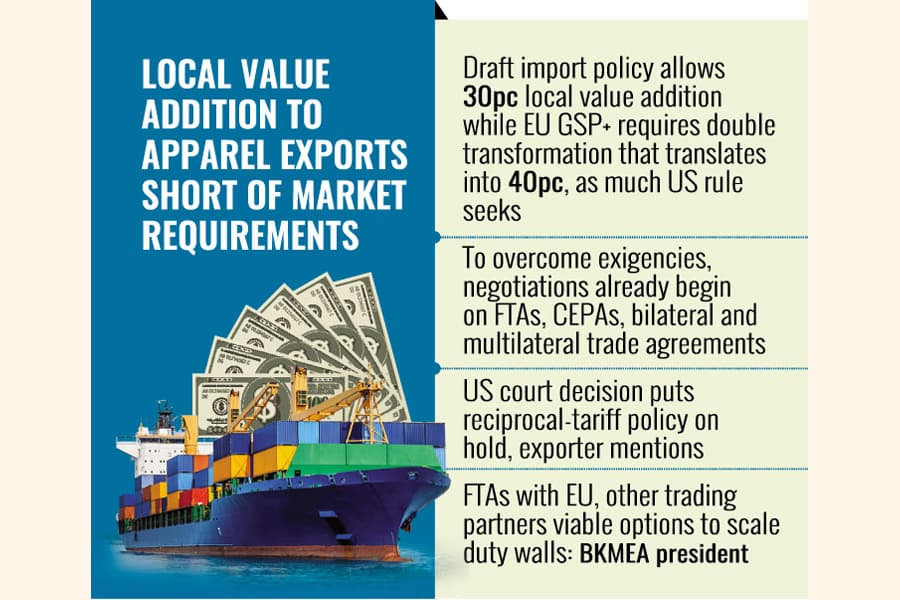
Bangladesh's import policy in the making appears at odds with emerging trade requirements in the European Union and the United States as it proposes allowing apparel exporters to qualify for incentives with a minimum 30-percent local value addition.
Industry leaders say the EU's proposed Generalised Scheme of Preferences Plus (GSP+) framework will require "double transformation" for garment exports, which they estimate would translate into around 40-percent local value addition.
Similarly, exporters say recent US trade rules require at least 40-percent local value addition, failing which shipments could be treated as transshipments.
To qualify for the EU's proposed GSP+ framework, Bangladeshi garment exporters will need to comply with the double-transformation requirement, which industry leaders estimate would require around 40-percent local value addition - a level already achieved by many knitwear manufacturers, though.
However, woven-garment manufacturers, which typically have lower domestic value addition, may find it more difficult to retain duty-free access to the EU market following Bangladesh's graduation from least-developed-country (LDC) status in November 2026, according to trade economists and industry insiders.
The government, however, has also sought a deferral of the country's graduation process to leave the world's poor-country club.
"We proposed lowering the threshold to 20 per cent," says BKMEA President Mohammad Hatem, in reference to the draft Import Policy Order 2026-2029.
He argues that high-value products, particularly those made from man-made fibres (MMF), would struggle to meet the proposed 30-percent threshold, as raw material costs for such products are significantly higher than those of cotton-based items.
"If the government does not revise the provision, it will discourage local industrialisation and efforts to increase domestic value addition in export-oriented apparel production," he predicts.
Hatem also raises concern over a proposed restriction on knit fabrics import in the draft policy. Referring to Commerce Ministry Additional Secretary Abdur Rahim Khan, he says the ministry had indicated that the issue would be addressed in the final version of the policy.
A recent Ministry of Commerce document states that following Bangladesh's graduation from the LDC status, exports to key destinations such as the EU, the United Kingdom, the United States, Japan and other markets will no longer enjoy duty-free access.
To maintain export competitiveness and safeguard market share, the ministry, in collaboration with stakeholders, has already initiated negotiations on free-trade agreements (FTAs), comprehensive economic partnership agreements (CEPAs), bilateral and multilateral trade agreements, and other preferential trade arrangements with major trading partners.
According to the document, maintaining duty-free market access after graduation will require major export-oriented sectors to raise local value addition to above 40-50 per cent. In some cases, compliance with product-specific rules (PSRs), including double-transformation requirements, will be necessary.
The policy on the anvil further notes eligibility for GSP+ preferences may require a minimum value addition of 40 per cent. Exports to countries such as Australia and Canada, which currently enjoy duty-free access, are already required to meet a value-addition threshold of at least 50 per cent.
"In nearly all recent trade negotiations, the requirement for double transformation as a condition for granting duty-free access to Bangladeshi exports has been strongly emphasised," the document reads.
It also highlights that Bangladesh has offered commitments in ongoing negotiations under which garments produced using yarn and fabrics originating from importing countries would be eligible for preferential tariff treatment in proportion to the share of such inputs used in production.
"Accordingly, if Bangladesh's garment industry, particularly knitwear manufacturers, becomes increasingly dependent on imported yarn, securing duty-free market access in the future may become significantly more challenging," the document forewarns.
Seeking anonymity, an apparel-sector leader says the government may consider cash support only for new product categories with 20-percent value addition, which could help diversify export offerings.
"The new items could include sportswear, wedding wear and tech wear, which may require imported fabrics and accessories. Once we start producing such products, the local industry will gradually develop around them," the exporter says.
BKMEA Executive President Fazlee Shamim Ehsan mentions that a recent US court decision put the implementation of the reciprocal-tariff policy on hold, meaning it is currently not applicable to Bangladesh or other countries.
According to the draft Import Policy Order, RMG exporters will be required to maintain a 30-percent value-addition threshold for children's garments, up from the current 15 per cent.
Knitwear and woven garment exports will also be required to attain 30-percent value addition, compared to the existing requirement of 20 per cent.
Exporters of underwear and other specialised garments made from synthetic fibres may face a minimum 40-percent value-addition requirement. Footwear exports, including both leather and non-leather products, may be subject to 30-percent threshold, while ship exports could face 40 per cent, and wooden furniture exporters 50 per cent.
Under the proposed policy, exporters who fail to meet the prescribed value-addition requirements will not be eligible for cash incentives or duty benefits on imported raw materials.
The Ministry of Commerce held a stakeholder consultation on the draft policy on May 22, bringing together industry representatives ahead of its finalisation.
newsmanjai@gmail.com