A significant amendment to Bangladesh's income-tax law has paved the way for taxing foreign digital businesses that have no physical presence in the country but serve 0.1 million or above Bangladeshi users.
The new provision, effective from July 1, targets non-resident entities-both companies and individuals -- that earn income from digital activities involving users in Bangladesh. Only the portion of income attributable to Bangladesh would be subject to tax.
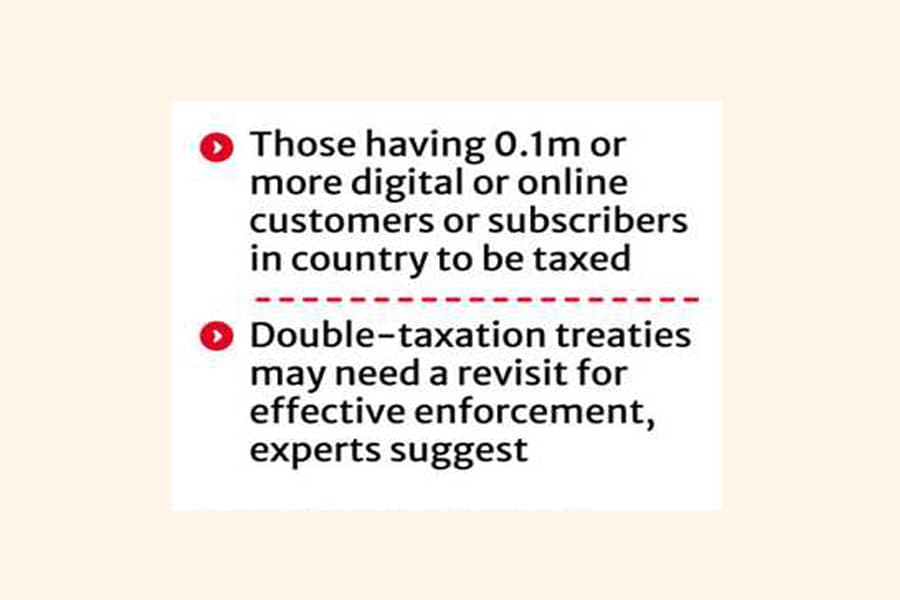
Under the amendment, a non-resident entity will be deemed to have a permanent establishment (PE) in Bangladesh if it has 100,000 or more digital or online customers or subscribers in the country.
Tax officials say information on the subscriber base of such digital businesses, including online content creators and "view-based" businesses, would be obtained from the Bangladesh Telecommunication Regulatory Commission (BTRC).
However, Bangladeshi freelancers and local content creators will not fall within the scope of the new provision.
A senior tax official says view-based businesses, including YouTube channels, have grown rapidly in recent years, with many individuals and companies attracting millions of subscribers or viewers.
"The owners of such pages will be taxed under the new provision if they are non-resident entities and meet the prescribed threshold," says the official.
He adds that identifying the number of subscribers would not be difficult because subscriber counts are publicly displayed on most digital platforms.
"Bangladesh is already collecting tax at source on payments made to Google, YouTube, Netflix, Meta and other global technology companies when users pay subscription fees," he told The Financial Express.
The change has been introduced through the Finance Act 2026 by expanding the definition of Permanent Establishment under Section 2(92) of the Income Tax Act.
The amended provision now includes: "Any digital or online activity or presence in Bangladesh by a non-resident entity where such entity has 100,000 or more digital or online customers or subscribers."
Tax experts say the amendment represents one of Bangladesh's most significant attempts to bring the digital economy within the tax net by recognising a substantial digital presence even without a physical office.
Adeeb H. Khan, Senior Partner at Rahman Rahman Huq, says the measure could be viewed as a step forward in taxing digital businesses at a time when countries worldwide are struggling to determine how to tax cross-border digital activities.
"However, it could also give rise to double-taxation issues, depending on the provisions of Bangladesh's tax treaties with other countries," he notes.
Bangladesh currently has Double Taxation Avoidance Agreements (DTAAs) with 36 countries to prevent taxpayers from being taxed on the same income in both jurisdictions.
Snehasish Barua, Chartered Accountant and Partner at Snehasish Mahmud & Co., thinks the practical effectiveness of the new provision could be limited by those international tax treaties.
"Under Bangladesh's income tax law, the provisions of Double Taxation Avoidance Agreements prevail over domestic law," he says.
"Most existing tax treaties require a physical presence before a country can impose tax. Therefore, unless these treaties are amended, the new provision may not, in practice, enable Bangladesh to collect taxes from many foreign digital businesses."
He also cautions that implementing the measure without adequate research and careful consideration could create complications with Bangladesh's trading partners.
The amendment strengthens Bangladesh's legal framework for taxing the digital economy. Although the income-tax law already taxes income derived from electronic sales and digital services connected to Bangladesh, the revised definition of permanent establishment provides a stronger legal basis by treating a significant digital user base as creating a taxable presence.
The key challenge, however, will be implementation.
Tax analysts say the success of the measure will depend on whether the National Board of Revenue (NBR) can identify qualifying individuals and companies, determine the portion of profits attributable to Bangladesh, and enforce tax collection from non-resident digital businesses, particularly where tax treaty-obligations apply.
doulotakter11@gmail.com