


Bangladesh Financial Intelligence Unit (BFIU) says assets worth Tk 760 billion linked to deposed prime minister Sheikh Hasina and her family and 10 business biggies have been frozen under investigations into suspected money laundering.
Ikhtiar Uddin Mohammad Mamun, Head of BFIU, disclosed the findings at a press conference at the Bangladesh Bank headquarters Wednesday while presenting the agency's activities for the financial year 2024-25-the time of political upheavals and regime change.
He said the assets had been frozen under court orders in connection with 11 joint money-laundering investigations.
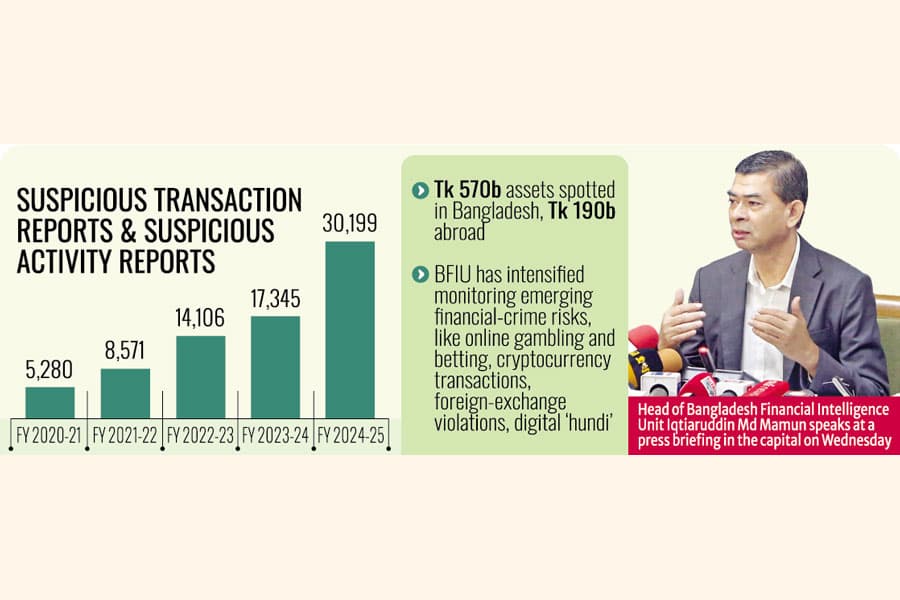
"Assets worth Tk 760 billion have been frozen under court orders in 11 joint investigations into money laundering. Of this, Tk 570 billion is located within the country and Tk 190 billion abroad," Mamun told reporters.
Asked about progress in recovering laundered funds, he said the process was continuing.
"Our work is ongoing. We are optimistic that by the end of this year, we'll be able to give the people of the country some good news," he said.
Following the fall of the Awami League government in the student-led mass uprising on August 5, 2024, allegations of corruption, financial irregularities and money laundering involving the previous administration came under renewed scrutiny.
Hasina left for India after losing power after her prolonged rule.
Under the then interim government led by Prof Muhammad Yunus, investigations into alleged money laundering had been carried out by the Anti-Corruption Commission, the BFIU and the Criminal Investigation Department (CID) of police.
To accelerate the investigations, the agencies prioritised cases involving Hasina, members of her family and 10 major business groups during the tenure of the post-uprising interim regime.
The BFIU wouldn't name the business groups or provide further details of the frozen assets during the briefing.
The intelligence unit received 30,199 suspicious transaction reports (STRs) and suspicious activity reports (SARs) during the fiscal year, up 74 per cent from the previous year, according to its annual report released Wednesday.
The reporting volume was nearly six times higher than the 5,280 reports submitted in the fiscal year 2020-21.
The fiscal year began in July 2024 and ended in June 2025, and the reporting accelerated after the political upheaval that culminated on August 05 when Sheikh Hasina left the country that prompted closer scrutiny of financial transactions linked to politically exposed persons and business groups.
Speaking at the press briefing, the BFIU chief said suspicious transaction reporting had risen significantly following the change of government.
"Earlier, banks were reluctant to report suspicious transactions. That fear has now diminished, resulting in a substantial increase in reporting," said Mr. Mamun.
He makes it clear that BFIU investigates suspicious transactions irrespective of political affiliation. "No individual receives preferential treatment if financial irregularities are detected."
He said they send the files to the relevant authorities to take further action against them.
Banks remained dominant source of reports submitting 28,755 STRs and SARs during the fiscal year, accounting for an overwhelming majority of total filings.
Under the Money Laundering Prevention Act 2012, as amended in 2015, and the Anti-Terrorism Act 2009, banks and other reporting entities are legally required to notify the BFIU immediately of any suspicious transaction or activity.
The report says the agency has intensified monitoring of emerging financial-crime risks, including online gambling and betting, cryptocurrency transactions, foreign-exchange violations and digital 'hundi' operations.
The BFIU said, "The increase in suspicious reports reflects tighter regulatory oversight, stronger compliance requirements for financial institutions, wider adoption of advanced transaction-monitoring technology and greater awareness of money laundering-and terrorist-financing risks across the financial sector."
jasimharoon@yahoo.com