


Bangladesh's overall price level has risen by almost 70 per cent over the past decade ending FY 2025-26, according to the latest GDP deflator data, underscoring the extent of economy-wide inflation and its impact on growth, incomes and purchasing power.
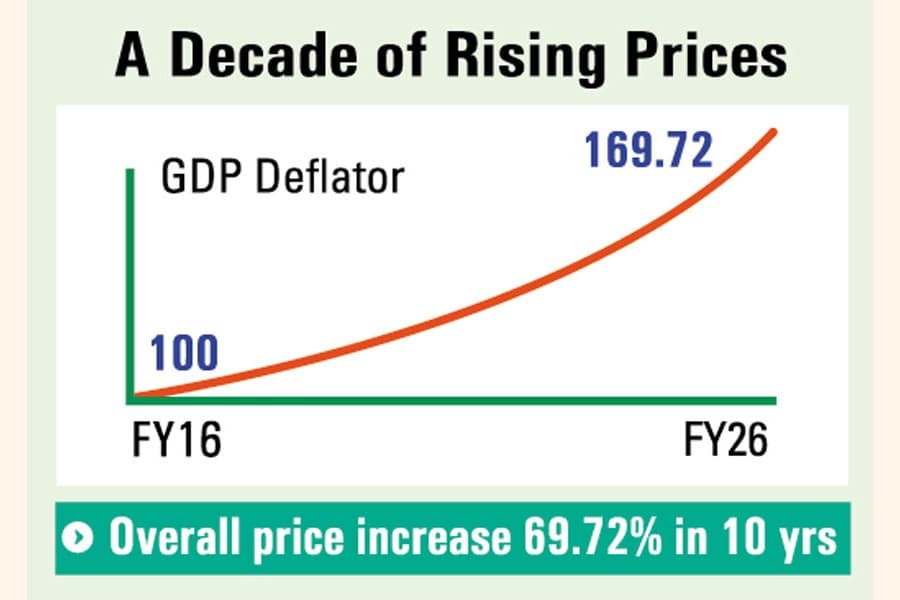
The GDP deflator stood at 169.72 in FY26 (provisional), compared with the base-year index of 100 in FY2016, indicating cumulative price growth of 69.72 per cent during the period, according to the latest GDP deflator data released by the Bangladesh Bureau of Statistics (BBS).
The GDP deflator, calculated by dividing nominal gross domestic product (GDP) by real GDP, is a broad measure of price changes across the economy.
Economists use it to distinguish between economic growth driven by increased production and growth resulting merely from higher prices.
Unlike the Consumer Price Index (CPI), which tracks a fixed basket of consumer goods and services, the GDP deflator captures price movements across all domestically produced goods and services.
Imported products are generally reflected in CPI calculations once they are included in the consumer basket, but they are not directly captured by the GDP deflator.
Economists and statisticians say the two indicators measure broadly the same phenomenon but differ in coverage and methodology.
The BBS recently published the latest deflator figures. With the base-year index set at 100, the latest reading of 169.72 suggests that the overall price level in the economy has increased by nearly 70 per cent over the past decade.
The indicator is widely used to assess economy-wide inflationary pressures.
A rise in nominal GDP may occur either because output expands or because prices increase. The GDP deflator helps policymakers and economists isolate real production growth from inflation-driven gains.
While the CPI focuses on changes in prices paid by consumers, the GDP deflator measures price changes across all domestically produced goods and services, making it a broader gauge of inflationary trends.
Economists say the indicator provides a useful measure of annual price movements throughout the economy.
Dr. A K Enamul Haque, Director General of the Bangladesh Institute of Development Studies (BIDS), told the FE that the GDP deflator is a globally recognised indicator that helps economists assess price changes and determine the economy's real growth performance.
"It may be more accurate to describe it as a measure of overall price changes rather than inflation alone, as it reflects movements at both wholesale and retail levels," he said.
However, Dr Haque noted that inflation measured through the CPI and the GDP deflator does not usually diverge significantly.
Dr M Masrur Reaz, Chairman and CEO of Policy Exchange Bangladesh, said the country's persistently elevated inflation in recent years is clearly reflected in the deflator data.
"The GDP deflator and inflation are closely related, although they are not identical measures," he said.
CPI inflation includes imported goods contained in the consumer basket, whereas the GDP deflator covers only domestic production and services. "Most items in the CPI basket, such as rice, onions, potatoes and eggs, are domestically produced," he said.
However, imported edible oils are reflected in CPI inflation but excluded from the GDP deflator. Their weight in the CPI basket is relatively small, limiting their overall impact on inflation readings, he added.
Similarly, imported fruits carry a comparatively low weight in the CPI basket, while locally produced substitutes such as mustard oil are included in the GDP deflator.
Meanwhile, an analysis by three European academics argues that central banks place excessive emphasis on CPI inflation and should pay greater attention to the GDP deflator.
The study, published by the Brussels-based Centre for European Policy Studies (CEPS), contends that policymakers are being "misled" by relying too heavily on consumer-price inflation as a guide for monetary policy.
The authors - Cinzia Alcidi, Matthias Busse and Daniel Gros - argue that the GDP deflator is a more comprehensive measure because it captures changes in prices associated with production and income developments across the economy.
They further contend that in a high-debt environment, the GDP deflator may provide a better guide for policymakers, as government and corporate debt sustainability depends more on nominal GDP growth than on changes in consumers' purchasing power measured by the CPI.
The BBS compiles CPI data using the Jevons and chained Jevons formulas. Price information is collected from 154 markets nationwide, including 90 urban markets and 64 rural markets.
The survey covers 127 food items represented by 242 varieties and 256 non-food items represented by 507 varieties. Prices are collected monthly in both rural and urban areas, while data from the city corporations of Dhaka and Chattogram are gathered weekly.
By contrast, the GDP deflator is derived from national accounts data by dividing nominal GDP by real GDP, providing a broad measure of economy-wide price changes.
jasimharoon@yahoo.com