
Pressures of climate-change impacts on Bangladesh's balance-of-payments (BoP) situation haunts their mind as an International Monetary Fund (IMF) team begins diagnosing in-depth the country's climate policy before framing a new lending package, sources say.
In the previous US$5.5-billion credit programme for Bangladesh, the IMF had earmarked US$1.3 billion under the Resilience and Sustainability Facility (RSF) arrangement.
However, the Fund had disbursed funds totaling $887 million under the RSF before Bangladesh new administration announced the scrapping of the programme while seeking a new lending arrangement.
Officials have said a six-member team of the IMF, led by Senior Economist Suphachol Suphachalasai, is now in Dhaka on a two-week mission and having discussion with the officials of different ministries and divisions concerned on the climate issues.
As part of the spadework, they are assessing Bangladesh's climate-policy framework, climate-related fiscal arrangements, adaptation and mitigation policies, disaster-risk financing, and climate-finance architecture to develop findings and recommendations for the authorities concerned.
"Like the previous loan programme, impacts of climate change on Bangladesh's overall economy and steps for mitigation will get priority in the proposed new programme," a senior finance division official told The Financial Express Tuesday.
He said the IMF team, thus, is now diagnosing the overall climate-related measures Bangladesh now pursues to fight its impacts.
Finance officials say Bangladesh is one of the most vulnerable countries to the adverse impacts of climate change, even though it accounts for less than 0.43 per cent of global greenhouse-gas emissions.
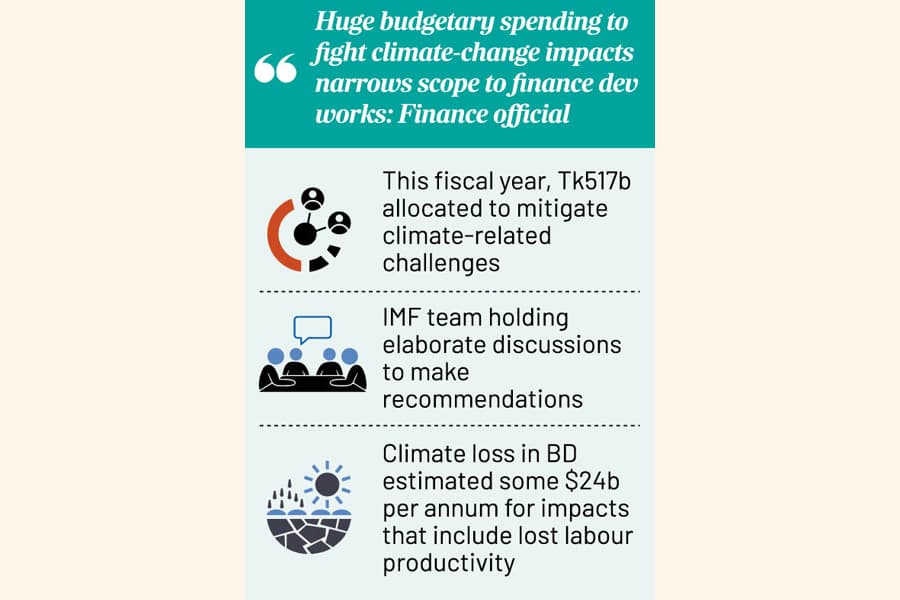
The country's climate-relevant budgetary allocation is rising every year to cope up with the impacts of climate change. In the current fiscal year, the government has allocated some Tk 517 billion in favour of 25 ministries and divisions for taking measures to fight climate-related challenges, up from the previous year's allocation of Tk 469 billion.
Data show while adaptation continues to receive the largest share of climate financing, with allocations coming to Tk 389 billion in the current fiscal year, the country is also spending a significant amount of Tk 99.25 billion for mitigation efforts.
According to different estimations, climate change costs Bangladesh between $3.0 billion and $4.0 billion each year in direct disaster-related damages. The economic losses reach up to $24 billion per annum when taken into account the extreme heat and reduced labour productivity that severely impacts agriculture and informal labour sectors.
"The significant budgetary spending to fight the impacts of climate change puts severe pressures on Bangladesh's economy, minimising scopes to finance development works of the country," another finance official said.
Sources have said at the meetings with the finance division officials this week the IMF team took stock of climate-and disaster-related works, status of Bangladesh Climate Development Partnership (BCDP), National Strategy for Disaster Risk Financing, the considerations of climate-related risks in macro-fiscal planning, budgeting and allocations of climate- and disaster-related spending, and subsidies on fossil fuels, electricity, and water supply.
At the National Board of Revenue, they inquired about tax policies related to electricity, fossil fuels, and petroleum products, and tax policies on natural and mineral resources, source said.
The IMF team at the Power Division discussed power-sector policies and strategies, renewable energy and energy efficiency, power-sector performance and reform roadmap, electricity subsidies, including capacity charge, electricity-tariff structure, and electric vehicle-sector development and implications.
At the ministry of environment, the visiting team discussed climate-related strategies, laws, and policies, NDC 3.0 and NAP implementation, status of Bangladesh Climate Development Partnership (BCDP), Bangladesh Climate Change Trust Fund, Bangladesh Climate Change Resilience Fund and sustainable forest management.
Sources said at the meeting with central bank officials, they also took updates on climate-related financial-sector policy and initiatives, sustainable financing and climate finance, role of banks and financial institutions in climate-and disaster-risk management, and financial-sector resilience and climate-stress testing.
syful-islam@outlook.com