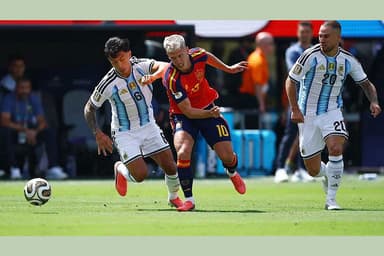
If the World Cup was decided solely by the Golden Ball, Spain's Rodri would have been its defining footballer.
Yet for millions who watched the tournament unfold, that conclusion is difficult to reconcile with what happened on the pitch.
FIFA's Technical Study Group awarded Rodri the tournament's top individual honour after Spain edged Argentina 1-0 after extra time in the final on Monday Bangladesh time at MetLife Stadium.
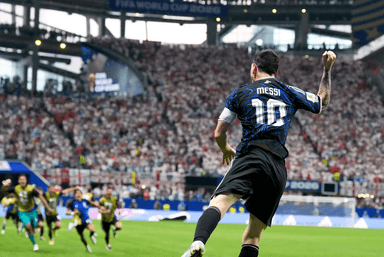
The decision immediately ignited debate among supporters, pundits and sections of the international media over whether Lionel Messi had been denied a third Golden Ball after producing one of the greatest individual World Cup campaigns of his career.
At 39, Messi finished the tournament with eight goals and four assists -- 12 direct goal contributions in eight matches -- while becoming the first player in the modern World Cup era to score or assist in every match from the group stage through the semifinals.
Rodri, meanwhile, was the lynchpin of Spanish champions. He controlled matches, dictated tempo and provided the tactical balance that underpinned Luis de la Fuente's side. But over eight matches, the Manchester City midfielder finished with no goals and no assists.
That contrast lies at the centre of the debate.
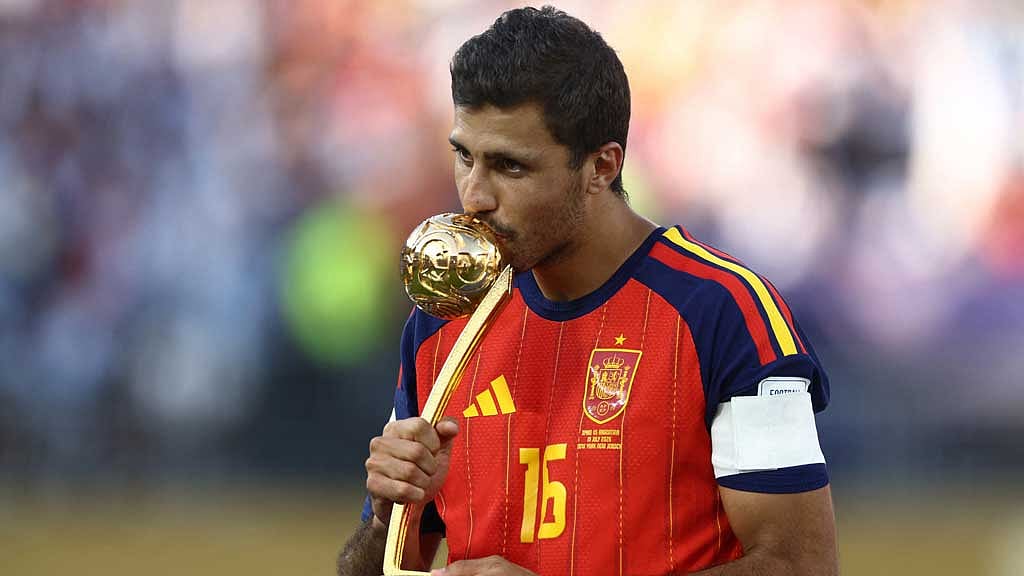
Spain’s midfield anchor Rodri kisses the Golden Ball trophy—a decision that triggered global outrage after he scooped the award despite posting zero goals and zero assists. Photo: Reuters/Lee Smith
Production Versus Possession
Football ultimately rewards moments that change matches.
By that measure, Messi's tournament stands almost alone.
He averaged a direct goal contribution every 61.6 minutes, surpassing even his Golden Ball-winning campaign in Qatar four years earlier, when he produced 10 goal contributions in seven matches.
Rodri's influence was of a different kind.
He orchestrated Spain's midfield, recycled possession and shielded the defence, particularly in commanding performances against France in the semifinals and Argentina in the final.
The question critics continue to ask is whether control alone outweighs decisive attacking impact.
The statistical comparison is stark.
Comparative Statistical Breakdown
|
Metric |
Lionel Messi 🇦🇷 (2022) |
Lionel Messi 🇦🇷 (2026) |
Rodri 🇪🇸 (2026) |
|
Age |
35 |
39 |
30 |
|
Matches / Minutes |
7 / 690 |
8 / 739 |
8 / 720 |
|
Goals |
7 |
8 (Silver Boot) |
0 |
|
Assists |
3 |
4 |
0 |
|
Total Goal Contributions |
10 |
12 |
0 |
|
Mins per Goal / Assist |
69.0 mins |
61.6 mins |
N/A |
|
Player of the Match Awards |
5 (Tied Record) |
5 (Tied Record) |
1 |
|
Sky Sports Index Rank |
#1 |
#1 |
#18 |
|
FIFA Award |
Golden Ball 🥇 |
Silver Ball 🥈 |
Golden Ball 🥇 |
Voices of Protest: Pundits, Legends, and the Press
1. The Argentine press and social media outrage: A critique published by Metro UK captured the fury reverberating across Buenos Aires and digital platforms, where fans universally labeled the snub as "the worst decision seen in a World Cup final":
"If the criteria is to give awards to the winners, then Infantino and his team need to be told that football is won with goals, not passes. Rodri didn’t just fail to score a goal in this World Cup: he made two billion passes and not a single one resulted in an assist."
2. Cafu (Brazil & World Cup winner): Brazilian icon Cafu expressed sheer astonishment over the outcome, warning that FIFA's decision undermines the spirit of individual merit:
"Lionel Messi deserves every bit of respect and recognition for this World Cup; he was outstanding in every single game for Argentina. If winning the World Cup trophy automatically gets you the Golden Ball award, then they should just retire the sport. No need for great players to waste their efforts and later get nothing out of it."
3. Analytical Data (Sky Sports' True Performance Model): Sky Sports' statistical evaluation -- which factors in over 40 positional metrics -- ranked Lionel Messi as the #1 overall player of the 2026 tournament.
In stark contrast, Rodri ranked 18th, revealing a glaring divide between FIFA's panel (which prioritised team outcome and possession volume) and independent algorithmic modeling (which prioritised match-winning impact).
4. MetLife backlash: The outrage was immediate inside the stadium. As FIFA President Gianni Infantino presented Rodri with the Golden Ball trophy on stage, large sections of the 80,000-strong crowd drowned out the presentation with deafening chants of "Messi! Messi!" -- a stupendous moment reflecting global disagreement with the verdict.
The Bigger Question
Rodri's importance to Spain's triumph is beyond dispute: Without him, Spain probably would not have become world champions.
But the Golden Ball is not awarded to the most important player on the winning team. It is meant to honour the tournament's best individual footballer.
On goals, assists, match-winning influence, consistency, Player of the Match awards and independent performance metrics, Messi built a compelling case that many believe was unmatched.
FIFA saw it differently.