


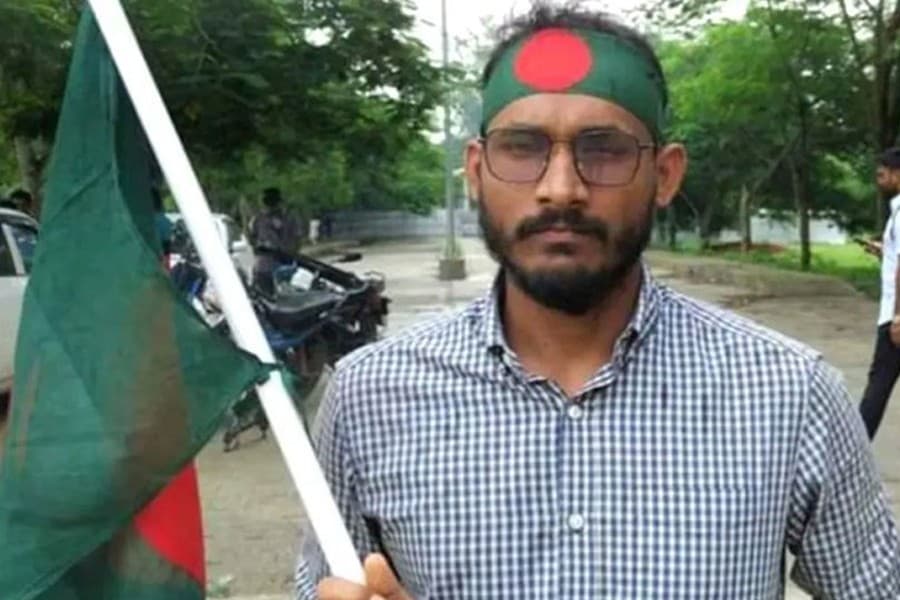
More than two years after Begum Rokeya University, Rangpur (BRUR) student Abu Sayed's killing became a defining moment of the July Uprising, there is still no sign of a permanent memorial in his honour at the university, leaving students, family members and visitors questioning why the campus has failed to preserve the memory of its most famous student and one of the movement's most iconic figures.


Sayed, remembered for standing with his arms outstretched in front of police moments before he was shot during the quota reform movement on July 16, 2024, became a symbol of resistance after images of his final moments spread across the country and beyond.
His death galvanised the student-led protests that, within 36 days, culminated in the collapse of the Awami League government, marking a turning point in Bangladesh's political history.
Although a few plaques bearing his name can be found around the campus, there is no monument, memorial tower or museum dedicated to the university student whose death inspired a nationwide movement.
After the change in the university administration following the July Uprising, the authorities announced an ambitious development project reportedly worth Tk 10.90 billion (Tk 1,090 crore).
The project included proposals for an Abu Sayed memorial gate, a museum, a monument and commemorative street installations.
The announcements were made at a high-profile event attended by senior government advisers, University Grants Commission officials and Sayed's parents.
Nearly two years later, however, none of the major memorial projects is visible on the campus.
Students seek lasting recognition
Standing at the site where police allegedly opened fire on Sayed, BRUR student Shamsur Rahman Sumon said students had expected the area -- declared "Shaheed Abu Sayed Square" during the movement -- to become a permanent place of remembrance.
"An Abu Sayed gate was supposed to be built here, with a museum behind it. A monument was also approved for this location, but no visible work has started yet," he said.
"Two years have already passed. We want these projects to begin without further delay so that future generations can remember Abu Sayed and understand the significance of his sacrifice."
Ashikur Rahman, a student of the university's Electrical and Electronic Engineering Department, echoed the frustration.
"Abu Sayed was one of the leading figures of the July movement. It is painful that even after two years there is no proper memorial for him on his own campus. We have repeatedly heard promises, but there has been no implementation. We hope the current government will expedite the projects so that Abu Sayed's memory and the spirit of July remain alive," he said.
The absence of any institutional memorial has also surprised many visitors to the university, who question why the campus where Sayed studied still lacks a permanent tribute to him.
Family seeks justice and remembrance
At Sayed's grave in Babanpur village under Pirganj upazila of Rangpur district, his father, Maqbul Hossain, said his foremost demand was the execution of the verdict in his son's murder case.
"My son was killed in front of everyone. I want the verdict to be implemented while I am still alive," he said.
He also expressed disappointment that a mosque proposed in his son's memory has yet to be built.
"I was told a mosque would be constructed in his name. Later I was informed that there was no budget. We want this to happen as soon as possible," he said.
With emotion in his voice, he also urged the government to promote industrialisation in Rangpur to create employment opportunities for local people.
Sayed's elder brother, Ramzan Ali, said the family had expected to see a memorial at the university by now.
"We hope the government will implement the projects without further delay," he said.
He also called for the swift execution of the court verdict in the murder case, saying their father wanted to see justice served during his lifetime.
University cites ongoing process
Acting Registrar of Begum Rokeya University, Dr Ferdous Rahman, said the process of naming the university gate after Abu Sayed had been completed and only the physical work remained.
He said the proposed mega development project also included four new residential halls, one of which would be named after Abu Sayed.
According to the registrar, work on the planned memorial has been delayed because several existing structures at the designated site need to be removed before construction can begin.
For many students, the delay in establishing a permanent memorial raises broader questions about how the nation honours those whose sacrifices shape its history.
While Abu Sayed's image remains one of the most enduring symbols of the July Uprising, supporters say the absence of a visible memorial at his own university stands in stark contrast to the legacy he left behind.