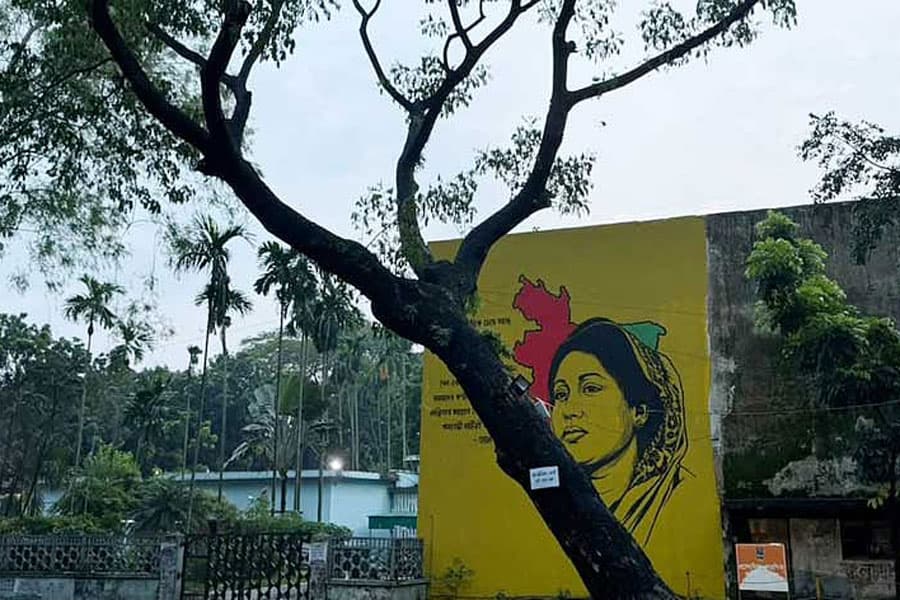
Of the 17,161 indigenous and foreign species of tree on the Dhaka University campus, 2,213 are at risk from falling, uprooting and disease. Trees from foreign species are at greater risk.
A census conducted by the Arbory Culture centre revealed the precarious state of a significant portion of the campus’s greenery. The results of the study may be published in a foreign journal soon, said Mohammad Jasim Uddin, director of Arbory Culture and professor of the Department of Botany.
The census identified a total of 277 species from 62 genera on the campus, 58 percent of which are indigenous and 42 percent of which are foreign.
Five of the 15 species most common on campus are foreign - mahogany (1st), deodar (4th), Macarthur palm (8th), raintree (11th) and teak (13th).
In addition, the total aboveground biomass, the total mass of all living plants and animals living on the surface of the earth at a given time, of the trees on the campus is 9,900 tonnes. The belowground biomass, the total mass of living organic matter below the ground of a plant or ecosystem, is 2,370 tonnes, and the total carbon stock is 4,650 tonnes.
According to the census data, 25 percent of the campus has fruit-bearing trees, 22 percent has trees that are helpful to wildlife, 21 percent of the trees are medicinal, 20 percent produce wood, and 12 percent are ornamental.
Regarding the health risks to the 2213 trees on the campus, the census said that the most common problem was that the crowns of the 1,052 trees are in contact with buildings, walls, or other structures, which could pose a risk to infrastructure and public safety. In addition, 722 trees are located very close to power lines, which increases the risk of accidents.
The survey found 402 trees to be unsteady, which could pose a risk of collapse in adverse weather conditions. The roots of 19 trees are damaging the road and 18 trees are located too close to the road.
According to the census data, a total of 1,811 trees were found to be suffering from various disasters according to five parameters. Of these, the highest number, 569 trees, had their normal root growth obstructed by roads or walls. The second highest number, 514 trees, had weeds.
Again, 159 trees have been nailed with posters and banners for various reasons, which damages them. The bark of 125 trees has been damaged, 113 tree branches have been broken, which has been identified as high risk. In addition, 99 tree trunks are weak, 94 trees are dead and 43 tree branches are at risk of breaking.
The census also revealed that 77 trees are infected with diseases or pathogens, 13 trees have damaged roots and five trees have altered leaf colouring.
Prof Jasim said that the number of trees at risk of breaking and uprooting is high in the areas adjacent to the mall, Fuller Road and Amtala in front of the Proctor's Office on the campus.
In addition, the two-sided deodar trees next to the Toran Gate adjacent to Nilkhet, various branches of the raintree tree in the center of the VC premises, the pterygota alata (Buddhanarikel) tree in the TSC area, the Indian cork (Akashneem) tree next to the gate of Mokarram Bhavan (inside the Pharmacy Garden), the eucalyptus tree next to the Curzon Hall Gate (in front of the EEE Department) and the Christmas trees opposite the Curzon Hall building are also at risk of being uprooted.
Prof Jasim also expressed concern that some trees inside Sir Salimullah Muslim Hall, some trees in front of Udayan Higher Secondary School on Fuller Road and along the road to the east of the mall premises could collapse and cause accidents at any time.
In this regard, Prof Jasim said: "It is quite difficult to save trees that are at risk because most of the trees are at risk mainly due to unplanned urbanisation.
"In this case, to save the trees, all the concrete must be removed as most of the trees die because their food intake stems are covered. In this case, we do not have the capacity to remove the concrete. Now we can only do one thing - remove risky trees and replace them with other trees. Through this, we will be able to fill the void left by those trees."
Dhaka University Pro Vice-Chancellor (Administration) Prof Mohammed Almujaddade Alfasane said, "It is no longer possible to save the trees that the Arbory Culture of Dhaka University has identified as risky. We will now work on removing them and replace them with new trees.
"We have asked Arbory Culture to provide us with a map of the trees they have identified. We will save the trees accordingly if we can. If it is not possible, other trees will be transplanted. We cannot just think about the trees, the safety of the students' lives is our biggest priority."