


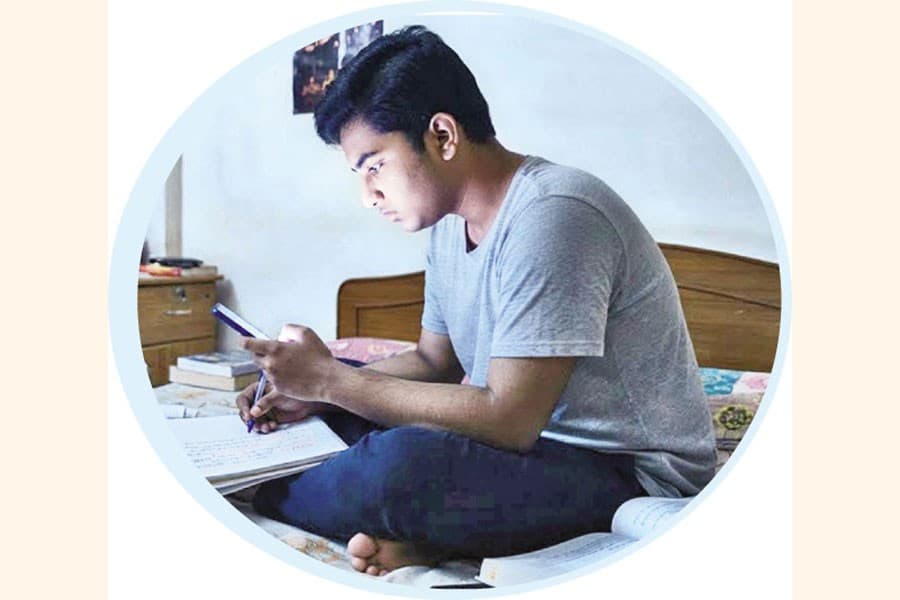


A growing generation of young people across the country is bypassing professional medical evaluations and diagnosing themselves with OCD, ADHD or even anxiety issues. They are confident in what they have analysed with some of the clicks on the phone, evaluations entirely, choosing instead to self-diagnose mental health conditions using social media platforms like TikTok and Instagram Reels. Even if someone tries to point out that the perpetually chaotic room and chronic lateness were not quite the hallmarks of OCD, they prefer not to take it. This is an issue Bangladeshi netizens, especially the younger ones, are dealing with.


The algorithm's curriculum
Social media has made clinical psychology more accessible than ever before. Terms like ADHD, OCD, BPD, PTSD, and bipolar disorder have migrated from clinical manuals into everyday conversation, carried by content creators who rephrase complex psychiatric conditions into short, relatable, shareable videos.
For some, this has been genuinely useful, giving language to experiences that previously had none and easing conversations that Bangladeshi culture has historically kept shut.
But the same pipeline is producing something more troubling.
A 2025 survey by LifeStance Health says nearly one in three people had self-diagnosed a mental health condition based on social media content alone. Among Gen Z, that figure rose to one in two. Less than half subsequently spoke to a clinician about it.
The content driving this shift is not reliable. A 2026 study from the University of East Anglia found that 52 per cent of top-performing ADHD videos and 41 per cent of autism-related videos on TikTok contained clinically inaccurate information, with misinformation rates across mental health content reaching as high as 56 per cent.
A separate analysis in JMIR Infodemiology states that among the most-liked ADHD videos on TikTok, a significant proportion of viewers were self-identifying with the symptoms presented, raising the risk of misdiagnosis at scale.
Most alarmingly, a 2025 study in European Child and Adolescent Psychiatry found that exposure to ADHD misinformation on TikTok simultaneously decreased accurate knowledge of the condition while increasing viewers' confidence in that knowledge.
Researchers at Harvard's Petrie-Flom Centre noted that one in four adults now suspect they have ADHD, against a clinical prevalence of around 6%.
When the label becomes the identity
The more damaging consequence of this culture is not simply misdiagnosis. It is the way clinical labels calcify into personality.
Once a young person has identified with a disorder, the label begins to explain everything and so nothing needs to change. Professional help becomes unnecessary because the answer already feels found.
Psychological language has also entered social dynamics in ways that are less about self-understanding and more about deflection and manipulation.
Clinical terms are deployed in interpersonal conflict, used to diagnose difficult people in one's life, or weaponised to avoid accountability. The vocabulary of therapy is increasingly being used without any of the work therapy actually requires.
The collateral damage
Those most harmed are often people with genuine diagnoses, whose experiences become harder to communicate in a culture that has already decided it knows what their condition looks like.
Professionals are also feeling the strain, reporting clients who arrive with fixed self-diagnoses resistant to clinical assessment, and competing with content creators who speak the language of psychology with the authority of expertise but none of the training.
"People are giving mental health advice to thousands of followers with no qualifications whatsoever," says a clinical psychology graduate. "Because they speak the language fluently, nobody questions it. That is genuinely dangerous."
The problem is not that young Bangladeshis are engaging with psychology. For a society where mental health was once unspeakable, that engagement represents real progress. The problem is that the engagement is happening largely without critical thinking, professional guidance, or any way to separate genuine awareness from content optimised for clicks.
tajree.m.rahman@gmail.com