


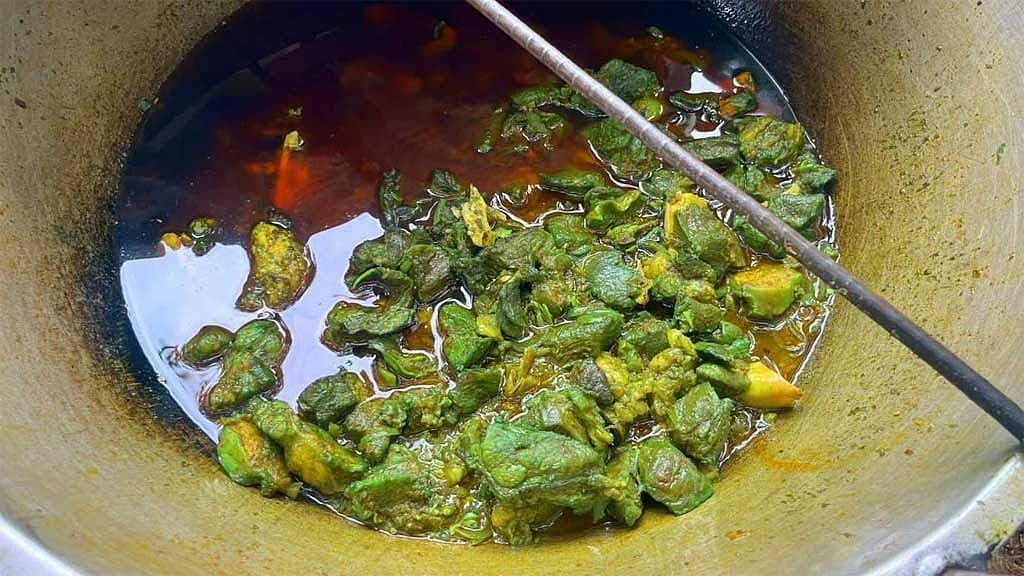
Cooked and raw samples of beef that turned green during cooking in Khulna have been collected for laboratory testing after the unusual incident sparked widespread discussion.


The samples are being sent to the Bangladesh Food Safety Authority (BFSA) for testing at a government laboratory.
Moklesur Rahman, an official at the BFSA's Khulna district office, said the results could take at least a week.
Raw and cooked samples have already been preserved, he said, adding that the laboratory to carry out the analysis has yet to be selected.
Officials say this is the first reported case in Bangladesh of beef turning green after cooking.
With no previous experience of such an incident, scientific experts have been unable to explain the cause and are waiting for laboratory findings.
Workers at Modern Bakery in Paikgacha Municipality bought beef for a picnic on Wednesday but said it turned green while being cooked.
They later took the pot of cooked meat to the Upazila administrator’s (UNO) office and the local police station.
Videos of the incident spread on social media, drawing widespread attention.
Several scientific officials told bdnews24.com the discolouration could have been caused by bacteria, fungi or other microorganisms.
They also said certain chemical reactions triggered by high cooking temperatures could sometimes produce unusual colour changes.
Shawrin Islam, a scientific officer for foodborne surveillance at the BFSA, said she had never encountered such a case in six years of service.
She said the meat itself did not appear to contain fungi or chemicals and suggested the cooking pot or spices could instead be responsible.
Although she did not believe the incident necessarily posed a health risk, she advised against eating meat that changes colour in this way.
Sadia Afrin, senior scientific officer at the Institute of Food Science and Technology under the Bangladesh Council of Scientific and Industrial Research (BCSIR), said she had never seen a similar case in either her professional or personal life.
She said some spices could occasionally give meat a slight greenish tint but, after watching the Khulna footage, felt the colour looked more like an added dye.
Laboratory analysis would also determine whether the meat came from another animal.
Asked whether commonly eaten meats such as beef, goat or chicken could naturally turn green after cooking, she said they normally would not.
She added that meat from an unusual or non-halal animal could be a possibility, but only laboratory tests could confirm the cause.
BFSA monitoring officer Aslam Uddin said inspectors had never previously come across green meat and there was no record of a similar incident.
Moklesur said about 500g each of the remaining raw and cooked meat had been collected from the seller and stored for testing.
He said the samples would be sent directly to the BFSA by courier on Sunday, as they could not be dispatched earlier.
Once they reached the laboratory, test results were expected within at least a week.
Explaining the timeframe, Shawrin said scientists must first decide which analyses are appropriate before testing begins.
She said the examination could include chemical and microbiological tests because fungi or chemical contamination might have caused the green colour.
According to her, the samples will be analysed at a recognised government laboratory.
Md Khairul Bashar, a scientist at the Livestock Research Institute, said three rare factors could explain the discolouration.
He said meat gets its red colour from the protein myoglobin. If minerals that react with myoglobin are present, cooking could trigger an abnormal colour change, making the meat unsafe to eat.
Bacterial contamination could also alter the colour, he added. While cooking kills many bacteria, some can produce toxins that leave meat discoloured, foul-smelling and unsafe for consumption.
A chemical reaction between the meat and a copper or metallic cooking pot could also produce the green colour, he said, adding that meat affected in this way should not be eaten.
The scientist described all three possibilities as uncommon.