


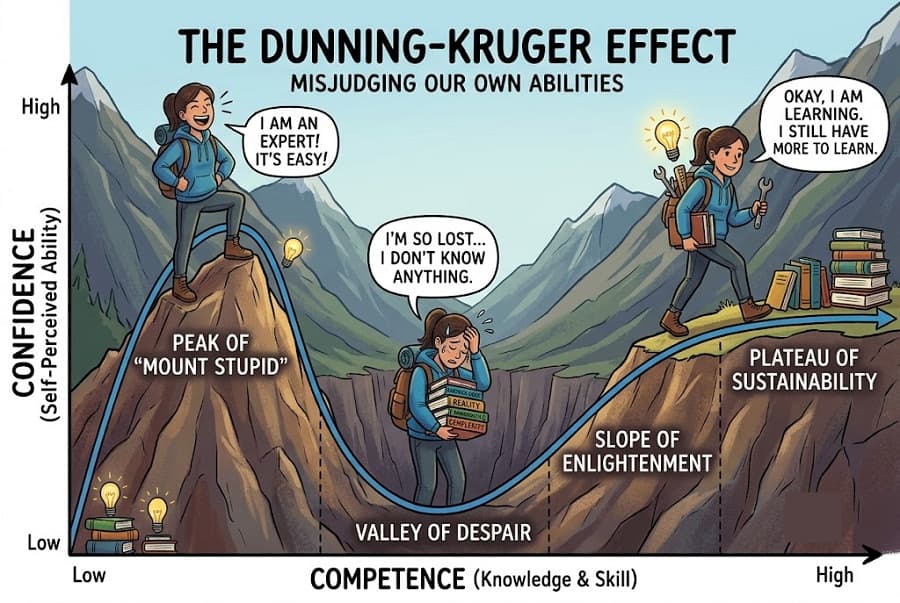
There is a quote by the British philosopher and mathematician Bertrand Russell in his 1933 essay The Triumph of Stupidity: "The fundamental cause of the trouble is that in the modern world the stupid are cocksure while the intelligent are full of doubt."


This is exactly the essence of the Dunning-Kruger Effect. Often, we see people around us who are 'unskilled' or 'not fit' in a specific matter. Still, their overconfidence overshadows their merit. This absence of domain awareness is known as the Dunning-Kruger Effect in psychology. First formally identified in 1999 by social psychologists David Dunning and Justin Kruger at Cornell University, this bias stems from an internal flaw in metacognition, which is the ability to analyse and evaluate one's own thought processes.
This condition brings in a double curse: not only do those individuals make incorrect decisions and reach faulty conclusions, but they also lack the metacognitive capability to recognise their own errors and ignorance.
The Dunning-Kruger effect has many social and psychological impacts on society. Especially for people who are in charge of policy-making, corporate affairs, or public relations, their individual decisions may incur heavy losses for the masses.
In the digital age, individuals who consume surface-level information online often feel equipped to challenge consensus science (such as epidemiology, climate science, or economics).
As they lack the background knowledge, their overconfidence drives them to preach the wrong message aggressively.
Misinformation spreads easily, misguiding trainees or beginners and ultimately harming the social environment. Moreover, in corporate settings, overconfident, under-skilled individuals are often louder, bolder, and more assertive in meetings.
Because human groups naturally associate confidence with competence, these individuals are frequently promoted into leadership roles. This is where organisational damage starts, and the company slowly begins to decline due to one or more people’s fault.
The Dunning-Kruger effect proves crucial in political polarisation.
Research shows that voters with the lowest objective knowledge regarding complex policy matters (such as taxation or foreign relations) often hold the most extreme, unwavering opinions, making diplomatic compromise difficult.
Apart from citizens, political leaders overestimate their capacity to manage the state, which damages the economy and the country's international image.
Overall, the condition also stagnates personal growth, where the individual trapped in this effect believes they are already experts, thus actively rejects constructive feedback, training, and education, stalling their professional development.
But how does it feel when a competent person underestimates their skills due to high domain awareness?
Well, there is a term for this condition, too. The polar opposite cognitive phenomenon to the Dunning-Kruger effect is Impostor Syndrome (or Impostor Phenomenon), first identified in 1978 by psychologists Pauline Clance and Suzanne Imes.
While Dunning-Kruger involves low-skill individuals overestimating their abilities, Imposter Syndrome occurs when high-achieving, highly skilled individuals chronically doubt their accomplishments and hold an irrational fear of being exposed as a 'fraud'.
Imposter syndrome works in the human brain through four different layers. Firstly, neuroimaging demonstrates that when individuals with Imposter Syndrome receive praise or take on a new project, the amygdala-the brain's emotional threat centre- flags the situation as a threat rather than an opportunity. The individual fears that elevated expectations will inevitably reveal their perceived 'incompetence'.
Secondly, the Anterior Cingulate Cortex (ACC), responsible for monitoring performance and detecting mistakes, becomes hyperactive. It magnifies minor faults.
Meanwhile, it leads to ignoring comparative steps toward success. This also creates low confidence and shrinks one's personality due to the irrational fear of being wrong.
After that, it mutes the brain's reward pathways. In a typical brain, receiving an award or finishing a project fires dopamine along the ventral striatum, reinforcing feelings of pride and self-efficacy.
In experiencing Imposter Syndrome, this reward signal is muted. Instead of internalising success ("I succeeded because I am capable"), the Prefrontal Cortex (PFC) rationalises the victory through external attributions ("I succeeded because of luck, timing, or over-preparing").
Lastly, just as Dunning-Kruger is caused by a lack of domain awareness, Imposter Syndrome is fueled by an excess of domain awareness.
Highly competent people understand how vast, deep, and complex a subject is. Because they see the full horizon of what they haven't mastered yet, they assume their current knowledge is small, mistakenly believing that everyone else in the room knows far more than they do.
This can be clearly interpreted through the famous quote of the Greek philosopher Socrates – "The more I know, the more I realise that I know nothing".
As human beings are rational creatures, attaining a state of balanced intelligence is necessary to navigate through the path of life. Therefore, we should recognise our own shortcomings and skills, and work to develop our personality in different ways.
amantuliffatfarisha@gmail.com