


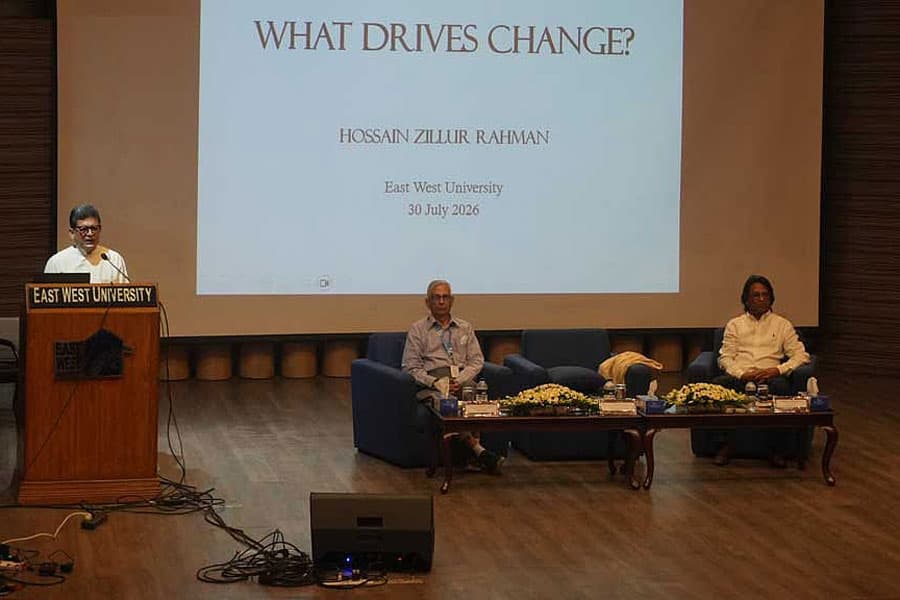
Bangladesh must shift away from a cheap-labour-dependent economy that relies primarily on garments and remittances, eminent economist and Chairman of BRAC Hossain Zillur Rahman said on Thursday.


Delivering the keynote speech at a public lecture styled “What Drives Change: Today’s Questions”, held at the Manzur Elahi Auditorium of East West University, Rahman emphasised that the key to change lies in the hands of citizens.
He noted that the country has struggled to embody democratic principles in state practices and has been unable to fully capitalise on its demographic dividend, leaving the economy stagnant.
In his address, Rahman outlined six drivers of change: narrative, institution, norms, initiatives, power, and interest groups, highlighting how both the positive and negative aspects of these drivers impact the nation's economy.
“If we fail to sustain norms then changes we see will be backtracked to the old stage,” he said, giving examples of how the unhealthy and unclean Dhaka city remains the same even after the 2024 uprising.
To achieve positive change, he urged a focus on several key areas, including reforming the concept of the state to view it as a service to the people rather than as an entity above them.
He also called for addressing the lack of professionalism among local professionals, improving the quality of education with forward-looking foresight, and shifting social norms toward greater cleanliness and transparency.
Drawing historical parallels to 1947, 1971, and 2024, Rahman remarked that the persistent aspiration for change among the citizens of Bangladesh is the nation's greatest strength.
In times of national crisis, citizen-led innovation and grassroots initiatives have consistently paved the path toward solutions. Therefore, he concluded, the ultimate key to change rests with the citizens.
Presiding over the event, Prof Mohammed Farashuddin, Chairperson of the Board of Trustees of East West University, highlighted that the benefits of national development are failing to reach the vulnerable and voiceless segments of society.
He called for special attention to healthcare and education for underprivileged populations and urged action to address the growing deficit of social equity.
Earlier, Prof Shams Rahman, Vice Chancellor of East West University, delivered the welcome address.
nsrafsanju@gmail.com