


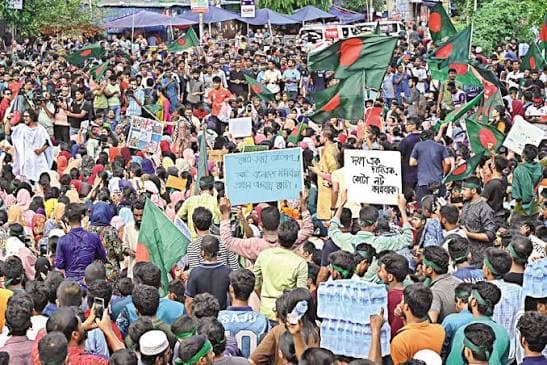
Police investigations into several murder and attempted murder cases filed with police stations across Dhaka over the crackdown during the July Uprising have uncovered major inconsistencies, according to final investigation reports.
Investigators failed to trace complainants in some cases, while in another, a man listed as having been killed is alive and working abroad, bdnews24.com reports.
Other investigations found no evidence to support claims that people had been killed or injured in police gunfire.
Police reports have also found evidence that some people were named as accused despite being hundreds of kilometres away from the alleged crime scenes when the incidents took place.
The movement demanding reforms to the government job quota system in July 2024 triggered widespread unrest after attacks on protesters and killings.
Large-scale violence unfolded in Jatrabari, Uttara, Bosila in Mohammadpur and Rampura, where many people were killed.
The crackdown could not stop the protests turning into a mass uprising.
Ousted prime minister Sheikh Hasina left for India on Aug 5, 2024, leading to the fall of the then Awami League government.
A UN fact-finding mission has put the death toll from the uprising at around 1,400. The government's official gazette lists roughly 850 dead.
Figures from the Dhaka Metropolitan Police (DMP) Prosecution Division, current up to last August, show 707 cases were filed across 50 police stations in the capital over the Uprising, naming 5,079 accused in total.
Jatrabari Police Station recorded the highest number of cases, 19, followed by 16 at Paltan Model Police Station.
Hatirjheel and Bhatara stations logged seven cases each, Rampura five, while Uttara East and West, along with Airport and Dakshinkhan stations, together saw 13.
Of these, 126 cases remain under investigation, several naming the ousted premier Hasina, her ministers and MPs, and senior Awami League leaders as suspects.
Final reports have already been submitted to court in 19 cases. Investigators have flagged three of these as entirely "false" in their reports.
The remaining 16 turned up inconsistent information, mistaken identities, forged documents and accounts that did not match the facts on the ground.
An analysis of the reports filed in court says innocent people were made suspects in some cases over personal disputes, land conflicts or business rivalries, investigators found.
Allegations of blanket case filing and money changing hands around Uprising-related cases have previously surfaced in the media.
Hasina and several of her former ministers, MPs, Awami League leaders and a former police chief are being tried in absentia at the International Crimes Tribunal over killings and enforced disappearances linked to crimes against humanity.
She and former home minister Asaduzzaman Khan Kamal have already been sentenced to death in one case, as have several former police officials in other cases.
The then interim government has banned the Bangladesh Chhatra League, the Awami League's student wing, as a "terrorist organisation" over its role in violence during the movement, along with a ban on the party's own activities.
'How Did I Get to Saudi If I'm Dead?'
A case was filed alleging that 46-year-old Md Babu was killed by police gunfire on Jul 19, 2024, during protests in the Ulon Road, with Hatirjheel police handed the investigation.
The case was signed by a man named Md Ismail, who identified himself as Babu's cousin.
It named Hasina, several senior Awami League figures, leaders of the now-banned Chhatra League and Jubo League, and several senior police officials as accused.
The final report, submitted to court on Oct 26, 2025, said police visited the address on Babu's national identity card in Barurkandi village in Chandpur’s Matlab South Upazila and found he was alive.
His real name is Md Shakil, and he is currently working in Saudi Arabia.
Reached over WhatsApp, Shakil sent bdnews24.com a voice message.
“I haven't died, brother. How could I have got to Saudi Arabia if I were dead? Police already spoke to me about this. I work here as a labourer now," he said.
Plaintiff Denies Filing Case
The investigation report also found inconsistencies in the plaintiff's identity.
Calling the mobile number given in the case, investigators reached a man who identified himself as Milon, not Ismail.
Tracing the identity card details, police later found an Ismail in Chandpur’s Faridganj Upazila, who denied filing any such case.
He repeated that denial in court, the report said, telling the investigating officer someone else had used his name and identity to file the case.
bdnews24.com also tried reaching Ismail.
When the number listed in the FIR was called, a woman answered and said: "I don't know anyone named Ismail. You've called the wrong number."
‘Forged’ Death Certificate
The final report, filed by Hatirjheel police's Sub-Inspector Rasel Islam, said no evidence was found that anyone named Babu had died.
A review of the crime scene, evidence, medical opinion, the government's official list of “July martyrs” and statements from those involved turned up no record of such a death.
The death certificate attached to the case was found to be forged, the report said, and no trace was found of the alleged victim or the plaintiff.
The investigating officer declared the case “false” and recommended the suspects be discharged.
"The case has been proven false in the investigation. Neither the claim of the death nor the plaintiff's identity held up. It appears to us that a group used someone else's identity to file this case for dishonest ends," Rasel said.
The final report is currently before the Dhaka Chief Metropolitan Magistrate Court, which has scheduled a hearing for Aug 3.
Lutfor Rahman, the lawyer representing the plaintiff's side in the case, did not answer repeated calls from bdnews24.com.
‘Cut Marks Presented as Bullet Wounds’
A murder case was filed on Sept 2, 2024, by Yasin Arafat alleging that 24-year-old Parvez Ali was shot dead by police and Awami League activists during an attack on protesters at Box Culvert Road in Paltan on the afternoon of Jul 19 that year.
Arafat also claimed he himself was shot that day.
The case accused then Dhaka South City Corporation mayor Sheikh Fazle Noor Taposh and then Jubo League chairman Sheikh Fazle Shams Parash of opening fire at the scene, alongside local Awami League activists and police personnel.
Hasina, Taposh, Parash and several senior Awami League leaders were named as accused, along with several then senior police officials.
The Police Bureau of Investigation (PBI) took over the case. It found no evidence that Parvez, the man said to have died from gunfire, ever existed.
Investigators also found Arafat's own claim of being shot was untrue.
PBI's final report, submitted to court on Dec 11 last year, said the alleged victim could not be traced at all, and declared the entire case baseless and false.
Contacted on Tuesday, Arafat initially denied being the plaintiff, then said: "I'm a bit busy, we'll talk about this later."
Repeated calls to his number on Wednesday found it switched off. His father, Billal Hossain Gazi, did not answer calls either.
bdnews24.com then made enquiries at Arafat's home village.
Locals at Chandnimukha Bazar in Gabura union of Satkhira’s Shyamnagar said Arafat and his father were well known there.
Several people at the market said Arafat was once involved with local Awami League activities and used to film rallies and gatherings.
After enrolling in the management department at Dhaka College, he was linked first to Chhatra League and later to Chhatra Odhikar Parishad.
Some locals claimed he also has ties to Jamaat-e-Islami figures in the area. He currently works as a multimedia reporter for a private television channel in Dhaka.
None of the locals could confirm any information that Arafat was shot in Dhaka during the July movement.
Gabura Union council Chairman GM Masudul Alam told bdnews24.com on Wednesday that no shooting ever took place. "It's all fake. Police came to investigate here too, and they found no evidence either," he said, adding, "That boy is cunning, always working an angle.
“Nothing he says can be trusted. I hear he's a journalist in Dhaka now."
PBI Sub-Inspector Md Masud Rana, the investigating officer, said an old scar on Arafat's leg, from a fall or an injury at some point, had been passed off as a bullet wound.
"By his own account he was shot in the leg, yet even his father didn't know about it," he said, adding that Arafat could not produce any medical certificate to support the claim.
Family Enemies Named As Suspects
The case Arafat filed at Paltan Police Station named Abdul Motin and Nazmul Hasan of Pabna, an uncle and nephew who both work as truck drivers, as suspects.
They learned of the case for the first time when police visited their village during the investigation.
Both said they were stunned when the investigating officer described the allegations against them.
They said they did not know either the plaintiff or the alleged victim.
Motin said transport had come to a near standstill during the unrest of July, leaving them without work, and there was no question of them being on Box Culvert Road in Paltan at the time.
"I hadn't even heard of this plaintiff or the person who's supposed to have died, in my father's lifetime, brother," he said.
Asked how they came to be accused in a Dhaka case with no connection to either of them, when the plaintiff is from Satkhira and they are from Pabna, Motin said: "We have a land dispute with our neighbour, Kashem Munshi.
His nephew Roni works as a cameraman in Dhaka. I hear the plaintiff and Roni are friends. Between them, they put us in this case to harass us."
Roni did not answer calls from bdnews24.com over the allegation.
PBI’s Masud said a review of the accused's phone records for that day showed they were not at the scene.
Plaintiff 'Missing'
Adabor police investigated another murder case that was found false in its final report, submitted to court on Nov 30 last year.
The allegations, the list of accused and the wording of the case bear similarities to the Hatirjheel and Paltan cases.
The mobile number given for the plaintiff in this case was also wrong. The name, identity and address of the man said to have been killed were incomplete, with inconsistencies in his identity, and investigators could not trace the plaintiff at all.
The case had alleged that a man named Ali Mia was shot dead by police, Awami League activists and members of its affiliated organisations near Adabor on Jul 19, 2024.
Md Toha Khan filed the case as plaintiff. Investigators found no evidence to support the allegation.
Adabor police Sub-Inspector Tarun Kumar, the investigating officer, said: "After the investigation, we submitted a final report to court saying the incident wasn't true."
bdnews24.com found the mobile number given for Toha in the case was no longer active.
Visiting the address given for him in Adabor also turned up no trace of him.
Residents at the address said on Wednesday morning that no one called Toha lived there. They asked instead why bdnews24.com wanted to know whether he lived there.
What Penalty Do False Plaintiffs Face?
Legal action against plaintiffs over false criminal cases is rare in Bangladesh.
No action has been taken so far against the plaintiffs in the July Uprising murder or attempted murder cases that investigations have found to be false.
Whether they will face any legal consequences at all remains an open question.
Supreme Court lawyer Jyotirmoy Barua said Section 211 of the Penal Code allows action against anyone who files a false criminal charge against an innocent person with intent to cause harm, calling it a punishable offence in its own right.
"There aren't many precedents for this kind of action, but there are some. We flagged this risk right at the start of the July cases. Now the investigations are bearing that out," he said.
Asked whether these false cases could affect the trial of genuine ones, Barua said each criminal case stands on its own under criminal law, and the outcome of one does not determine another.
"But when several false cases of the same kind come to light, it can shape judges' overall thinking. It can create an impression that perhaps not every allegation is true," he said.
Asked whether police have taken any steps against plaintiffs behind fake cases, Assistant Inspector General (Media) at Police Headquarters AHM Shahadat Hossain said: "Action is taken against plaintiffs found to have filed fake cases, in line with the law, and that will happen here too.
“But if the government takes any specific decision after these reports on fake July murder cases come out in the media, that would be a separate matter."