


Civil engineers, academics and policymakers on Sunday called for science-based urban planning, restoration of natural waterways and stronger integration of research into public policy, warning that Bangladesh's growing vulnerability to climate change, rapid urbanisation and recurring urban flooding demands long-term engineering solutions rather than short-term responses.
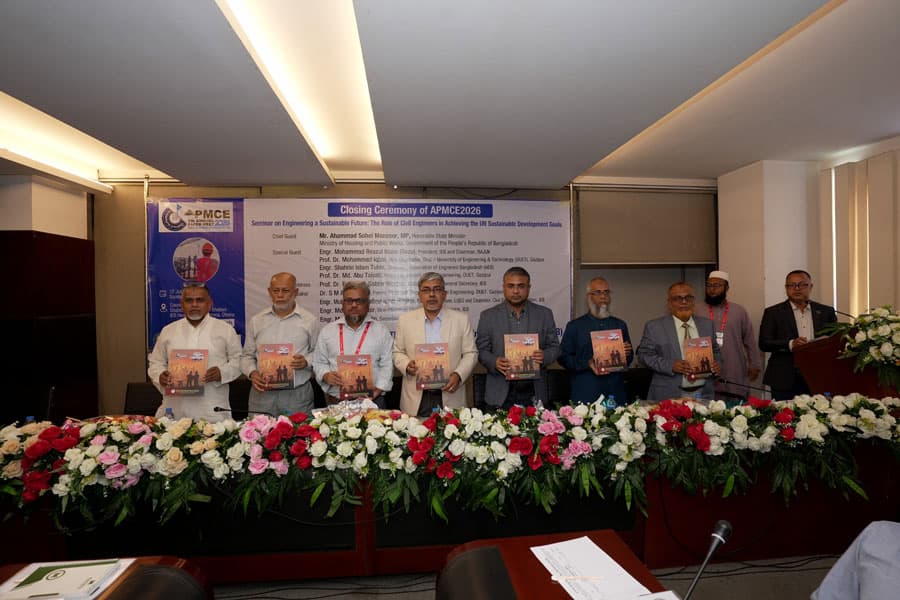
The call came at the closing ceremony of the Annual Paper Meet of Civil Engineering (APMCE 2026) and a seminar titled "Engineering a Sustainable Future: The Role of Civil Engineers in Achieving the UN Sustainable Development Goals," organised by the Civil Engineering Division of the Institution of Engineers, Bangladesh (IEB) at its headquarters in Ramna, Dhaka.
The two-day conference brought together researchers, academics and professional engineers from universities and institutions across the country to present papers on infrastructure development, transportation, water resources, climate change, disaster risk reduction, environmental sustainability and resilient urban development.
Long-term planning essential to tackle climate risks. Speaking as the chief guest, Prof Dr Mohammad Iqbal, Vice-Chancellor of Dhaka University of Engineering and Technology (DUET), said Bangladesh must move beyond emergency responses to disasters and adopt long-term, science-driven development strategies that work with nature rather than against it.
"Our development planning must preserve rivers, canals, wetlands and natural floodplains. If these natural systems are protected, many of the country's waterlogging, flooding and environmental challenges can be significantly reduced," he said.
Referring to Bangladesh's recurring urban flooding, Dr Iqbal stressed that restoring canals, maintaining river navigability and ensuring uninterrupted natural water flow are critical for sustainable water management.
He also highlighted sediment accumulation from upstream rivers, saying excessive silt deposition continues to reduce river depth across Bangladesh.
"Without regular dredging, scientific sediment management and integrated river management, it will be difficult to find a permanent solution to the country's drainage and flooding problems," he added.
Research must shape public policy
Special guest Prof Dr Engr Md Abu Tayeb, Head of the Department of Civil Engineering at DUET, said the Annual Paper Meet serves as an important platform for connecting academic research with national development priorities.
He said the conference featured research papers covering transportation engineering, water resources, environmental management, disaster resilience, climate adaptation and sustainable infrastructure.
"The recommendations presented in these research papers should not remain confined to academic discussions. They should be compiled and forwarded to relevant ministries and government agencies so they can inform policy formulation and infrastructure projects," he said.
Recent rainfall exposed urban drainage weaknesses
Delivering the welcome address, Prof Dr Engr Md Sabbir Mostafa Khan, Honorary General Secretary of the IEB, referred to the widespread disruption caused by recent heavy rainfall in both Dhaka and Chattogram.
He said only a few hours of rain had brought much of Dhaka to a standstill, disrupting transport, education and daily life, while prolonged rainfall also caused severe waterlogging in several parts of Chattogram.
According to him, one of the key reasons behind Chattogram's persistent flooding is the lack of effective coordination among responsible agencies.
Regarding Dhaka, he noted that although the city's drainage system has improved in recent years, it remains inadequate for the capital's growing needs.
He explained that many drainage canals are connected to rivers through pumping stations. During the dry season, water can be discharged efficiently when river levels remain low. However, during the monsoon, rising river levels significantly reduce pumping capacity, making drainage far less effective.
He also identified encroachment on canals, the loss of wetlands, unplanned urban expansion and clogged drains caused by solid waste as major contributors to the capital's recurring waterlogging.
Sustainable engineering key to future cities
The keynote paper was presented by Dr SM Atikul Islam, former professor of Civil Engineering at DUET.
He said sustainable development means meeting the needs of the present generation without compromising the ability of future generations to meet their own needs.
He said development must balance economic growth, environmental protection and social inclusion while ensuring responsible use of natural resources.
Dr Islam stressed that environmental conservation should be integrated into every stage of infrastructure planning to protect forests, rivers, wetlands, biodiversity and ecosystems.
He also called for wider adoption of green technologies in the construction sector, including solar energy, energy-efficient building designs, natural ventilation and environmentally friendly construction materials.
To develop sustainable cities, he recommended expanding public transport, electric vehicles, cycling infrastructure, pedestrian-friendly urban design and low-carbon technologies, saying these measures would reduce carbon emissions, improve energy efficiency and enhance quality of life.
The seminar was chaired by Engr Muhammad Shafiqul Islam (Khoka), Chairman of the Civil Engineering Division of the IEB.
The vote of thanks was delivered by Engr Md Ainul Kabir, Vice-Chairman of the division, while Engr Nesar Uddin, Secretary of the Civil Engineering Division, moderated the programme.