


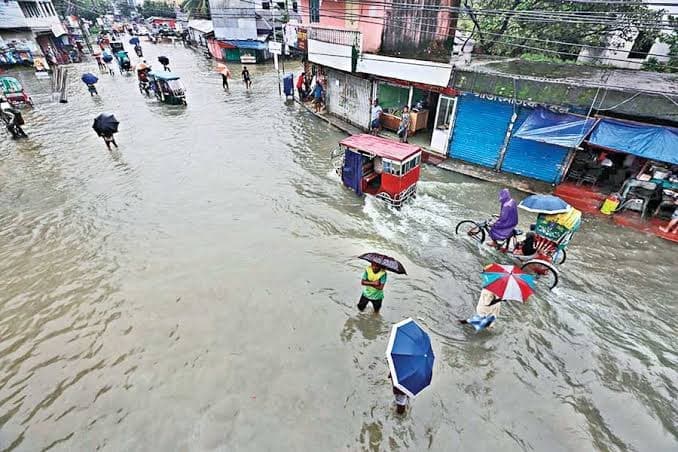
The worsening flood situation across vast swathes of Chattogram and Sylhet divisions is a cause for serious concern. Triggered by a week of heavy rains, the flood has so far claimed at least 43 lives and left nearly a million people marooned, disrupting normal life and causing immense suffering. The scale of the disaster is unprecedented in Chattogram region, which has long been considered relatively better protected from flooding. From the city areas to the rural hinterlands and from the hills to the low-lying coastal belts, the entire region is reeling under a spell of heavy rainfall. Torrential rain, triggered by a low over the Bay and an active monsoon, has continued to lash the country. However, the port city has been hit the hardest, with roads in most areas submerged under knee- to waist-deep water. According to the Met Office, Chattogram recorded its highest single-day rainfall in 43 years on Wednesday last week. The relentless downpours caused landslides, killing at least 30 people, while flash floods swept away homes, causing deaths and destruction.
It has also dealt a heavy blow to local agriculture, damaging over 15,900 hectares of cropland and submerging more than 7,400 fish farms and ponds. Besides, in many areas, roads and railway lines have gone under water, snapping transport links. Flight operations at Shah Amanat International Airport have also been disrupted. Hundreds of tourists stranded in Sajek Valley in Rangamati were later rescued by the Army. Meanwhile, the severity of the crisis has compelled the authorities to close educational institutions and postpone the Higher Secondary Certificate (HSC) examinations under the Chattogram Education Board.
As the rain rages on, rivers keep swelling and runoff from the hills continues, the situation is likely to aggravate. And if it does, it will cause a massive humanitarian crisis. Against this backdrop, the urgency of a swift, coordinated operation to ensure safety of the flood-hit people and provide emergency relief cannot be overstated. Now that the victims are marooned in distant villages in coastal or hilly areas, the challenge of rescue and relief operation is formidable. The government, security forces, public representatives and volunteers must stand shoulder to shoulder to ensure that the affected people receive the aid and support they so desperately need.
Most of the deaths over the past week appear to have been caused by landslides in Chattogram and Cox's Bazar, where thousands of families live on hill slopes clearing hillsides and cutting off trees. Thus, deaths from landslide has become a recurring tragedy every monsoon. Earlier, the authorities had banned construction of houses on hill slopes and launched drives to relocate residents living in risky areas. But this has turned out to be yet another example of how the authorities in Bangladesh talk the talk but hardly walk the talk. Once the clamour over an issue subsides, all the promises of taking corrective measures get relegated onto the back burner. Thus, the number of people living on hill slopes has been increasing, the death toll from this entirely preventable tragedy has continued to rise and many hills and hillocks have been wiped off the map. The incumbent government must put an end to this dangerous practice of reckless hill cutting and deforestation.