


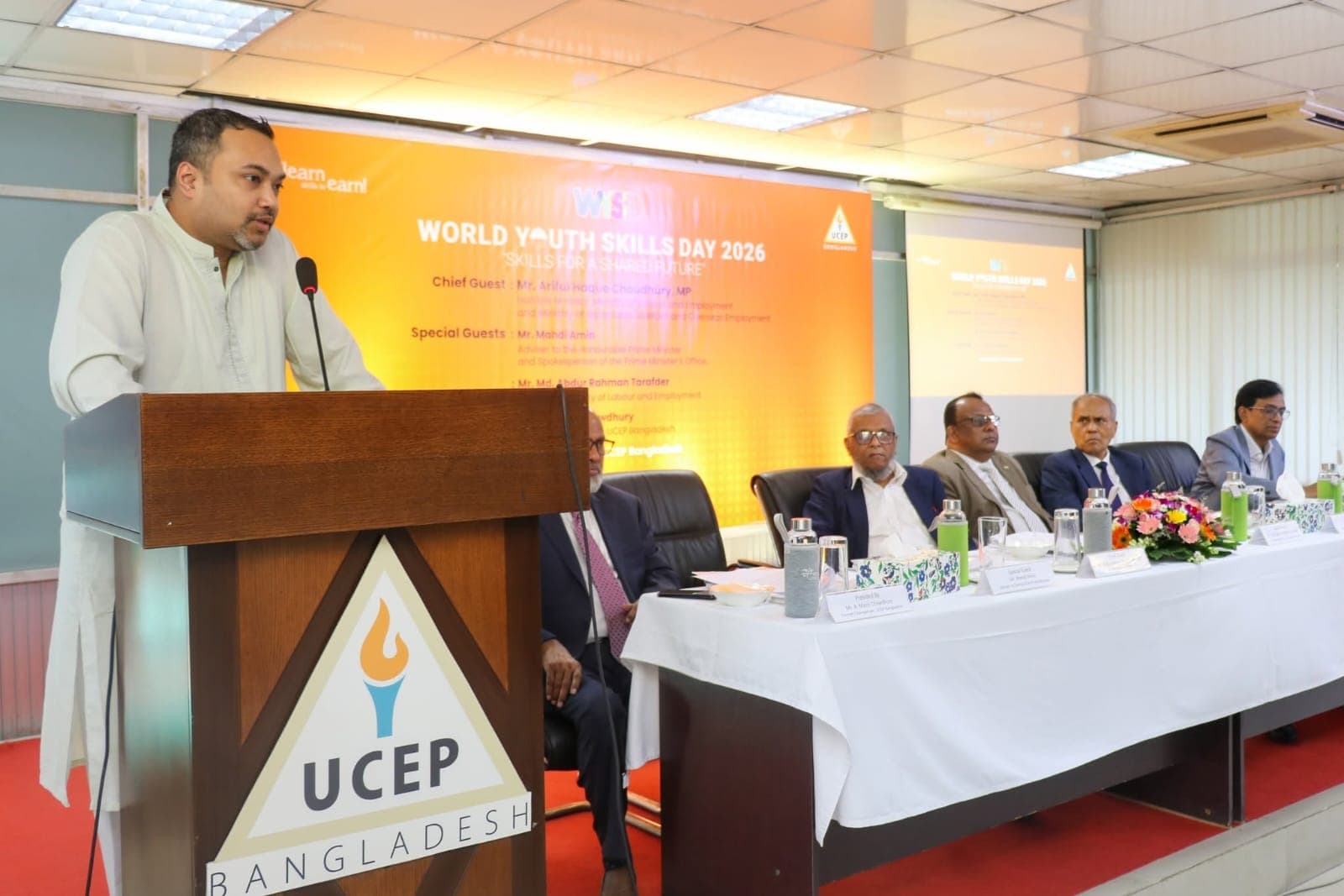


Prime Minister's Adviser Mahdi Amin on Wednesday said the government is working to build a skilled and competitive workforce by aligning education and skills development with the aspirations of the country's youth through stronger industry-academia collaboration, expanded technical training and internationally recognised certification.


Speaking at the “World Youth Skills Day 2026” programme organised by UCEP Bangladesh in Mirpur, he said empowering young people means empowering the government, adding that Prime Minister Tarique Rahman envisions a Bangladesh where youths are equipped with skills, moral values, family education and social responsibility, UNB reports.
The government wants to overhaul the education system by strengthening collaboration between academic institutions and industries so that students acquire market-relevant skills and become employable, Mahdi Amin said.
He said employment opportunities should be developed equally in the private sector, public sector, overseas job markets and entrepreneurship, stressing that not every student needs to become a doctor or engineer. “Instead, students should be encouraged to pursue fields matching their interests and abilities.”
Mahdi Amin, also Prime Minister’s Office (PMO) spokesperson, said the government wants to expand short-term, trade-based training programmes lasting three months, six months and beyond to better prepare young people for employment and entrepreneurship.
He also stressed the need to create greater overseas employment opportunities by improving workers' skills and developing an integrated ecosystem linking technical and vocational education, polytechnic institutes, SSC and HSC vocational education, Technical Training Centres (TTCs) and other training institutions.
Noting that 23 ministries currently run different skills development and training programmes, the adviser said greater coordination is needed to harmonise curricula, certification, training methods and competency standards.
Acting on the Prime Minister's directives, the government is working to establish a unified framework so that certificates issued by the National Skills Development Authority (NSDA) gain international recognition while maintaining common standards across training programmes offered by different ministries, he said.
Mahdi Amin praised UCEP Bangladesh for ensuring employment for more than 80 percent of its graduates, describing it as an encouraging example that should be replicated nationwide.
"Many students complete technical and vocational education or receive training but still struggle to secure jobs. We want to replicate successful models like UCEP across the country by adopting global best practices," he said.
The PMO spokesperson said the government also wants to ensure equal access to quality education, skills training and employment opportunities for young people living outside major cities.
"No student should fall behind simply because of where he or she lives. Students in remote and marginalised areas must have access to the same quality of education and skills training as those in Dhaka," he said.
Mahdi Amin said private institutions will remain the driving force behind skills development, innovation and expansion, while the government's role will be to provide policy support and create an enabling environment.
He also pledged greater government support for reputed institutions so that their expertise and experience can contribute more effectively to implementing national skills development policies.
Referring to labour welfare, the adviser said no major labour unrest was witnessed during the two Eid festivals after the current government assumed office, attributing the situation to measures taken to ensure workers' rights, freedom, and timely payment of wages and bonuses.
He said the current administration, elected through a genuine public mandate, remains committed to creating an inclusive system that expands opportunities for all young people regardless of their background or location.