


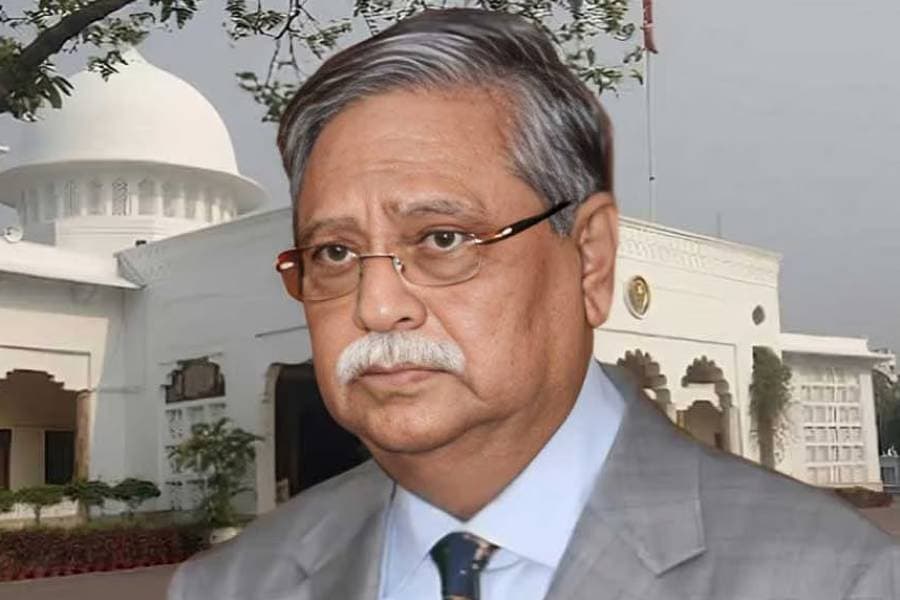
President, Mohammed Shahabuddin, has resigned on Friday, citing serious health complications that he said have left him physically and mentally unable to discharge the duties of the country’s highest constitutional office.


In a statement issued by Bangabhaban on Friday, the president announced that he had submitted his resignation letter to the speaker of parliament, Major (Retd) Hafiz Uddin Ahmed Bir Bikram.
“The President of the People’s Republic of Bangladesh, Mohammed Shahabuddin, has today submitted his resignation letter to the Speaker of the Jatiya Sangsad due to serious health reasons,” the Bangabhaban statement said on Friday.
In his signed resignation letter, addressed to the speaker, Shahabuddin said he had been suffering from multiple chronic illnesses, including heart disease, hypertension, diabetes and kidney complications. He noted that he had previously undergone bypass surgery and had recently been diagnosed with autonomic neuropathy, a condition that causes him to lose consciousness intermittently.
“Because of these illnesses, and the resulting physical and mental incapacity, I am no longer able to perform the responsibilities of the important constitutional office of the President,” he wrote. “I require long-term medical treatment.”
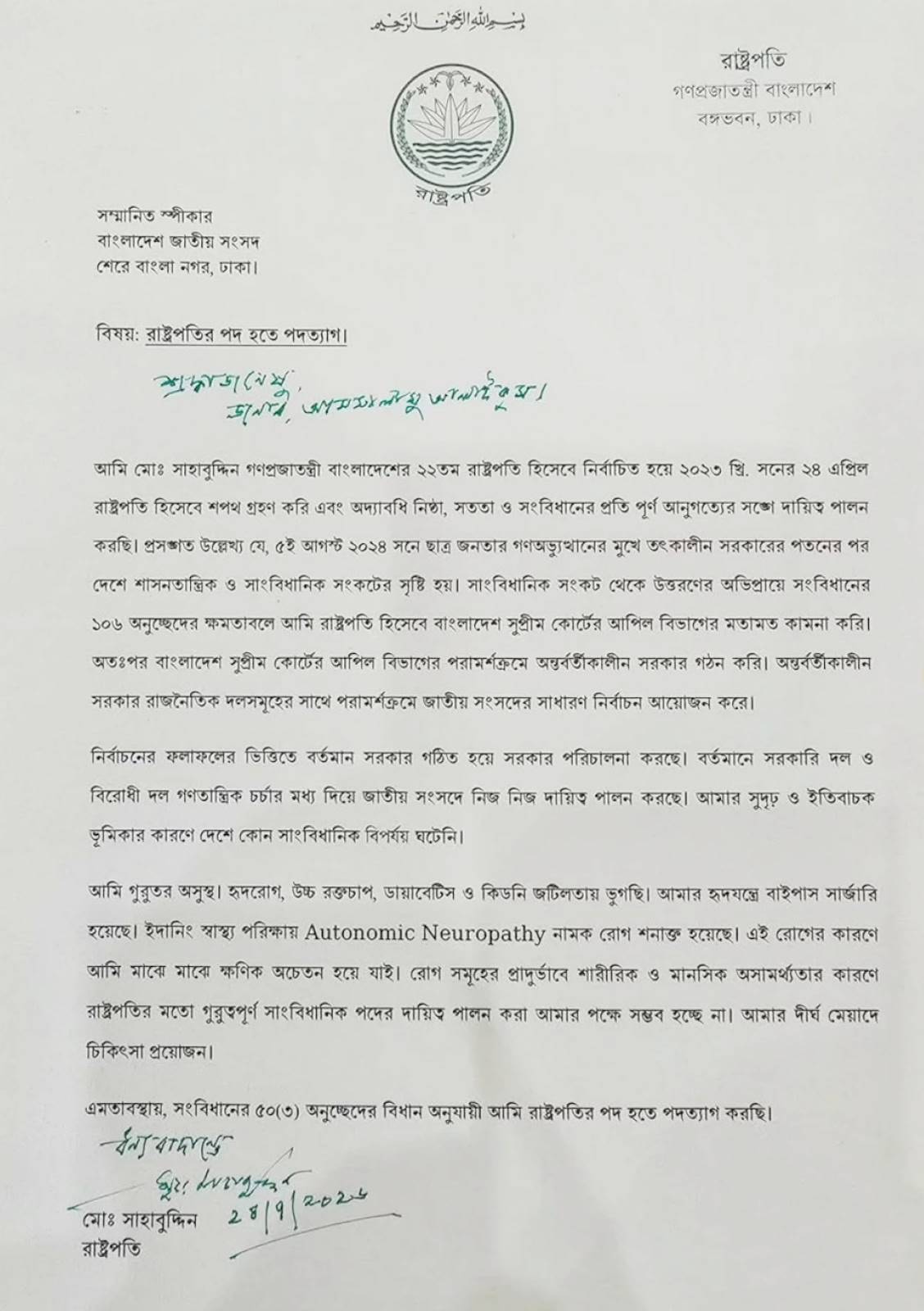
Invoking Article 50(3) of Bangladesh’s constitution, Shahabuddin formally resigned from office.
Under Article 54 of the constitution, the speaker of parliament will assume the responsibilities of acting president until a new head of state is elected and takes office.
Later, in an emergency press briefing at the Jatiya Sangsad complex at 5pm following receipt of the resignation, Speaker Hafiz Uddin Ahmed said that he had received the resignation letter of the President at 5.01 pm.
He informed that as per constitution he would be the acting president of the country until the election of the next President.
The Speaker praised the outgoing President and wished his wellbeing.
He urged the media not to create any confusion over the resignation of the President, ‘who made it clear that he had resigned on health grounds’.
The constitution provides that the office of president may be vacated through a signed letter addressed to the speaker. It also states that if the presidency falls vacant through resignation, death or removal, or if the president is unable to perform the duties of the office because of illness or any other reason, the speaker shall discharge those responsibilities until a successor is elected.
Article 123(2) requires parliament to elect a new president within 90 days of the office becoming vacant. Under Article 48(1), the president is elected by members of parliament.
In his resignation letter Sahabuddin claimed that due to his ‘firm and positive role, no constitutional crisis took place in the country’.
He also mentioned that when constitutional crisis emerged in the country after the fall of the Hasina government, he formed the interim government after taking consultation with the Appellate Division of the Supreme Court. The interim government held national elections in February through which BNP has come to power, he cited in his resignation letter.
With the ruling Bangladesh Nationalist Party (BNP) commanding a parliamentary majority, its nominee is widely expected to become the country’s next president. Senior BNP leaders have reportedly been discussing possible candidates for several days, although the party has yet to announce its choice.
Shahabuddin assumed office as Bangladesh’s 22nd president on 24 April 2023 during the Awami League administration, with a five-year term due to expire in April 2028. His resignation comes nearly two years before the end of that term.
His future had remained the subject of political debate since the student-led July uprising of 2024, which brought an end to the government of former prime minister Sheikh Hasina. Questions over whether Shahabuddin, who had been elected during the Awami League’s tenure, should continue in office intensified after the BNP returned to power following the 13th general election.
His resignation marks the first change in Bangladesh’s presidency since the change of government and opens the way for parliament to elect a new head of state within the constitutional timeframe.
Earlier, Speaker Hafiz Uddin Ahmed returned to Dhaka from Bangkok on Friday, cutting short a medical visit that had begun on 19 July. He had originally been scheduled to return on Sunday.
Speaking to reporters at Hazrat Shahjalal International Airport before the resignation was announced, the speaker said he had no knowledge of any decision by the president to step down while he was abroad. He added that, under the constitution, any resignation would have to be submitted to him and that he would assume the responsibilities of acting president until parliament elected a successor within 90 days.
Speculation over Shahabuddin’s resignation had intensified in recent days. Reports recently emerged in the media claiming that President Mohammed Shahabuddin had spoken by telephone with former prime minister Sheikh Hasina while she was in London for medical treatment in May. Hasina has been living in India since being ousted from power during the July uprising.
The reports triggered renewed speculation over the president’s future, with calls for his resignation gaining momentum.
Amid days of mounting political discussion, home affairs adviser Salahuddin Ahmed was asked about the possibility of the president stepping down after a meeting at the Secretariat on Wednesday. He declined to comment directly, telling reporters to “wait until Friday”.
Responding to questions about the media reports alleging that the president had spoken to Sheikh Hasina by phone during her stay in London, the adviser said the government had no information regarding the matter.
People familiar with the matter said the president had become mentally prepared to step down and had informed senior officials at Bangabhaban during a meeting on Wednesday that he was preparing to leave office.